
Overview
Most colony sims ask you to manage resources. Norland asks you to manage people—the resentful, horny, drunk, God-fearing, backstabbing kind. Developed by Long Jaunt and published by Hooded Horse, the strategy label that has quietly become the genre’s most reliable curator, Norland dropped into Steam Early Access on July 18, 2024 at $29.99. The concept lands. Whether it lands for you depends on how much friction you’ll tolerate on the way in.
The pitch is audacious: take the interlocking production chains and micromanagement of RimWorld, then bolt on the character-driven scheming of Crusader Kings. You inherit a noble family clawing to rule a small realm built on the bones of a collapsed empire. Your peasants farm, forge, and pray. Your nobles govern, study, and—inevitably—self-destruct. The game generates emergent narrative the way flint generates sparks: constantly, and sometimes at the worst possible moment.
What separates Norland from the crowded strategy shelf is its refusal to treat characters as stat blocks. Every family member and commoner carries distinct skills, traits, and relationships that shift in real time. A love affair blooms. An addiction festers. A slighted noble nurses a grudge until it curdles into assassination or open civil war. This is not window dressing layered over a spreadsheet. It is the spreadsheet, animated by grievance.
Positioned squarely at the hardcore strategy audience, Norland makes no concessions to the casual crowd. It is PC-exclusive—Windows only, mouse-and-keyboard, no console or mobile port on the horizon. That’s a deliberate stance, not an oversight. This is a game built for people who read tooltips for fun.
Key features
- Emergent Character Drama: Every noble and peasant has traits, moods, and evolving relationships that produce unscripted stories—romances, feuds, betrayals, and revolts—without a single line of authored plot.
- Interlocking Colony Management: Deep production chains govern food, wages, goods, religion, and cultural factions. Pull one lever and three others twitch. Stability is always provisional.
- Perishable Knowledge: Nobles unlock lost technologies by studying ancient texts—but that knowledge dies with them. Lose the wrong scholar to a dagger or a fever and your tech tree regresses.
- Grand Strategy Layer: Beyond your walls lies diplomacy, espionage, trade, and tactical warfare against rival lords, so internal collapse and external threat compound each other.
Analysis
The Gameplay Loop
Norland’s core loop is deceptively familiar. Assign labor. Build workshops. Balance the food supply against the wage bill. Route raw materials through refining chains until you’ve got bread, weapons, and coin. Anyone who has spent serious time in a colony builder will find the muscle memory intact.
Then the second loop kicks in, and it changes everything.
That second loop is human. Your nobles aren’t cursors—they’re personalities with ambitions, vices, and breaking points. A ruler with a cruel streak keeps the peasants terrified and productive, right up until terror tips into rebellion. A brilliant scholar unlocking metallurgy might also be drinking himself toward an early grave, taking his research with him. The strength of Norland is that these two loops are not parallel systems. They are the same system, viewed from two angles. Economic decisions create emotional consequences, and emotional decisions wreck your economy.
The perishable knowledge mechanic is the sharpest expression of this design philosophy. In most strategy games, progress is a ratchet—it only clicks forward. Here, progress is a living thing you have to keep alive. Concentrate your tech in one brilliant heir and you’ve built a single point of failure with a heartbeat. Spread the learning around and you’ve slowed your advancement to a crawl. There’s no clean answer, and that tension is exactly the point.
The Difficulty Wall
Let’s be honest about the onboarding. It’s rough. Norland throws an enormous number of interacting systems at you with tutorialization that ranges from adequate to absent. The learning curve is the single most common complaint in player reviews, and it’s earned. You will lose your first realm to something you didn’t know was a mechanic. You will lose your second to something you did know and mismanaged anyway.
For the right player, that opacity is a feature. Mastery feels genuinely won because the game never hands it to you. For everyone else, the first few hours are a wall of menus with no clear handhold. This is the eternal tension of the deep-sim genre, and Norland lands firmly on the punishing end of the spectrum—closer to Dwarf Fortress than to Frostpunk.
When Systems Collide
The best moments in Norland arrive when the machine eats itself. You spend hours stabilizing—full granaries, content peasants, a humming economy, a foreign rival held at bay through careful diplomacy. Everything is fine. Everything is fine.
Then one noble snaps.
Maybe he’s been passed over for a title. Maybe his lover was executed. Maybe he’s just an unstable man who drew a bad trait at generation. Whatever the trigger, he acts—and because every system is interlocked, his single act of violence cascades. An assassination fractures the family. The fracture becomes a succession crisis. The crisis becomes a civil war, and your carefully diplomatically-managed rival picks that exact moment to march. Hours of order unravel in minutes. It is infuriating. It is also the reason to boot the game up again tomorrow. Norland doesn’t generate stories about kingdoms. It generates stories about the flawed people who ruin them.
Visuals & performance
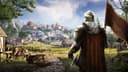
Norland won’t win awards for its art, and it isn’t trying to. The aesthetic is a functional, slightly storybook top-down medieval style—readable characters, clear building silhouettes, a muted palette that suits the grim-realm mood. It serves the simulation without ever calling attention to itself. That’s the correct choice for a game where you’re reading interface far more than you’re admiring scenery.
The UI is where the real critique lands, and it’s the familiar Early Access story. Managing this many interlocking systems demands a truly excellent interface, and Norland’s is merely serviceable. Information you need is often buried a click or two deeper than it should be, and surfacing the why behind a noble’s behavior can mean spelunking through nested panels. The density is the game; the presentation of that density is still a work in progress.
As a design, this kind of dense simulation invites the usual sim-genre entropy—bugs and slowdown are the expected companions as a realm and its population balloon, and Early Access means rough edges are part of the deal. Patch cadence under Hooded Horse has been steady, which is the encouraging part.
Platform nuances
On Steam, Norland is exactly where it belongs. This is a mouse-and-keyboard game to its marrow—the interface assumes precise cursor work, rapid menu navigation, and hotkey fluency that no gamepad could replicate and no touchscreen would survive. There is no console or mobile version, and it’s hard to imagine one that wouldn’t butcher the design.
Steam’s infrastructure also does real work here. The review corpus, the active discussion forums, and the visible update roadmap all matter enormously for an Early Access title, giving prospective buyers an honest read on where the game stands today versus where it’s promised to go. Workshop and community support round out a package that feels native to the platform. If you’re going to buy an unfinished game, this is the ecosystem you want to buy it in.
Final verdict
Norland is one of the more conceptually ambitious strategy games in recent memory, and it largely delivers on that ambition. By refusing to separate the economy from the emotions—by making a noble’s broken heart as consequential as a failed harvest—Long Jaunt has built something that generates drama no scripted game can match. When it clicks, little else on the market feels quite like it.
It is also unfinished, unforgiving, and occasionally opaque to a fault. The learning curve will cost it players who’d have loved it if they’d survived hour three. The UI hasn’t yet caught up to the sophistication of the systems beneath it. These are real problems, not rounding errors.
This is Early Access with a solid foundation, a distinctive vision, and a publisher with the track record to see it through—but it’s a recommendation for a specific audience, not a blanket one. Buy in now if steep climbs and growing pains sound appealing. If you’d rather wait for a smoother, better-tutorialized 1.0, that’s a perfectly rational call too. Either way, keep this one on your radar. Norland is building toward something worth watching—one snapped noble at a time.
Reviewed by the Rankeno Strategy & Sim Desk. Scores are out of 10; the overall score is the desk’s editorial judgement, informed by the four sub-scores above. How we review


