
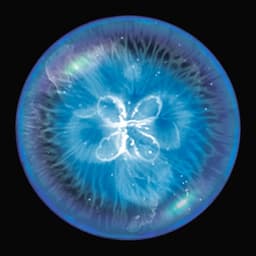
Bottom Line: Osmos is a masterclass in minimalist design that proves physics is the most unforgiving level designer in the medium. It is a rare work of interactive art that manages to be simultaneously meditative and pulse-pounding.
The Physics of Sacrifice
The core loop of Osmos is a brutal lesson in resource management. Most games treat movement as a "free" action—you push a stick, you move. In Osmos, movement is a calculated risk. Because you lose mass to gain momentum, the game forces you to rethink the very nature of navigation. This creates a unique "onboarding friction" that isn't about complex controls, but about unlearning the habit of constant input. You learn to value inertia. A single, well-timed ejection can carry you across the map, while frantic tapping will leave you shriveled and easily consumed by a passing predator. It is a game of conservation, where the most skilled players are often the ones who move the least.
Orbital Anxiety and Gravity
The "Force Reception" levels introduce a layer of complexity that elevates Osmos from a simple "eat the smaller dot" game into a sophisticated orbital mechanic simulator. In these zones, motes orbit massive central bodies. Suddenly, you aren't just moving in straight lines; you are managing trajectories, apoapsis, and periapsis. To reach a mote in a higher orbit, you must accelerate, which paradoxically feels counter-intuitive until you understand the math. It’s essentially Kerbal Space Program viewed through a microscope. These levels are where the game’s difficulty spikes significantly, shifting from a slow-burn experience into a high-stakes tactical exercise where a minor miscalculation in velocity can send you spiraling into a sun-like attractor.
The Sentient Struggle
While the "Ambient" levels allow for a contemplative pace, the "Sentient" zones introduce AI-controlled motes that are just as hungry as you are. This is where the "zen" facade completely evaporates. These AI motes are aggressive, efficient, and surprisingly intelligent. They will track you, predict your movements, and eject mass to escape your grasp. This creates a tactical maneuvering environment that feels closer to a dogfight than a puzzle game. You have to bait the AI into wasting its mass or corner it against larger, neutral motes. The power dynamic is constantly shifting; you can go from being the apex predator to the prey in a matter of seconds. It’s a ruthless ecosystem that rewards patience and punishes hesitation.
Interface and Flow
Hemisphere Games opted for an interface that is virtually non-existent. There are no health bars, no "lives," and no intrusive tutorials. Your size is your health, and the color of other motes—blue for edible, red for deadly—tells you everything you need to know. This minimalist UI ensures that the player’s focus remains entirely on the physics at hand. The ability to speed up or slow down time is a critical concession to the player, allowing you to fast-forward through long drifts or slow down for precise, microscopic adjustments during a chase. It’s a elegant solution to the pacing issues inherent in physics-based games.