
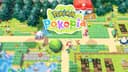
Overview
Historically, Pokémon has sent players outward: into tall grass, along routes, toward the next gym. Pokopia reverses that. The Pokémon come to the player, but only if the land gives them a reason to stay.
Pokopia is a cozy life-sim and building game for Nintendo hardware, co-developed by Game Freak and Omega Force, the KOEI TECMO GAMES studio behind Dragon Quest Builders 2. That lineage matters. Omega Force has already fused a construction sandbox with a long-running RPG license once, and Pokopia reads as another attempt at the same idea, with a larger roster attached.
The premise is distinctive. The player controls a Ditto that has taken human form. It wakes from a long sleep to find Kanto run-down and abandoned, with its people and Pokémon gone. Professor Tangrowth acts as guide, and the job is restoration: crafting items, making furniture, growing crops, building homes, and reshaping terrain until species from every generation decide to move in.
The genre neighbours are obvious, and the published reception names them. Animal Crossing supplies the daily rhythm, Minecraft and Dragon Quest Builders 2 the construction, and Viva Piñata the idea that the environment itself is the lure. Pokopia’s advantage over all four is the license. A habitat built to attract a specific, recognisable Pokémon carries more weight than one built for a generic villager.
The reception has been largely positive, with dissent centered on friction points that grow heavier the longer a player stays: a slow start, a tightly guided campaign and thin co-op.
Key features
- Ditto as protagonist: A shapeshifting Pokémon in human form fills the role a human trainer would normally take, and the fiction justifies the whole progression system.
- Habitat-driven collection: Each species needs specific conditions, such as tall grass under a tree or a dark, quiet spot. Attracting a broad roster from every generation becomes a series of terrain-design problems.
- Field moves learned through friendship: Befriended Pokémon teach Ditto abilities for reshaping the world: growing bushes, watering dry plants, cutting debris and smashing rocks.
- Crafting, farming and building: Item crafting, furniture making, crop growing and home construction drive the restoration of a ruined Kanto.
- Real-time world: Several biomes and a day/night cycle that follows real-world time.
- Multiplayer and expansion: Online play, GameShare access for owners of older Nintendo hardware, and a paid Expansion Pass that opens with the water-themed Bubbly Basin.
Analysis
The Habitat Loop
Pokopia’s central mechanic swaps the series’ oldest verb for a new one. Instead of catching, the player designs conditions. Each species wants a particular habitat, so the Pokédex turns into a stack of building briefs, and knowing the creatures turns into knowing the terrain.
This is the Viva Piñata model, and we consider it an effective collection structure for the cozy genre, because it gives every placement a purpose. Every tree doubles as shade for a resident who won’t arrive without it. Animal Crossing’s villagers show up on the game’s schedule. Pokopia’s show up on the player’s terms, so the town works like a proposal that the player builds and the Pokémon accept or decline.
The roster size is both the selling point and the stress test. A broad roster across every generation gives the loop a long tail, with reasons to keep reshaping land well after the town looks finished. It also carries the design’s main risk. At that scale, habitat requirements have to stay readable and distinct, or the loop turns into checklist homework. Requirements like shade, tall grass, darkness and quiet match intuitions about real animals rather than arbitrary item recipes, and that is the right foundation.
Field Moves as Progression
Friendship pays out in capability. Pokémon that befriend Ditto teach it field moves, and each move opens new ways to change the world. Changing the world attracts new Pokémon, who teach new moves. The loop feeds itself, and it borrows its gating logic from exploration games rather than from life-sims, where progression usually means a bigger shop or a new tool tier.
Casting Ditto as the lead turns that system into story rather than menu design. A Pokémon known for copying others is a natural fit for a hero who gains abilities from its neighbours. The choice also lets Game Freak and Omega Force avoid the awkward image of a human doing Pokémon work by hand. It is a well-judged decision.
Campaign Structure and Pacing
The weakness sits in the front half. The reception repeatedly flags a slow start and a heavily guided main campaign, with Professor Tangrowth steering progression. Guidance has a defensible purpose. Pokémon’s audience is broad and skews young, and a builder that layers crafting, farming, terraforming and habitat rules carries real onboarding friction. A mentor character reduces it.
Builders last because of autonomy, though. The genre is at its best when the player sets a goal and the systems support it. A campaign that holds the leash too long delays the moment when Pokopia becomes the player’s project rather than the game’s tutorial. We consider this the biggest structural flaw, and it keeps the game from a higher recommendation.
Time, Biomes and Rhythm
Several biomes give the habitat system range, and the day/night cycle runs on real-world time. That clock is a deliberate borrowing from Animal Crossing. It rewards short daily visits and makes time of day part of the town’s character. The trade-off is familiar: players with fixed play windows will see one half of the cycle far more often than the other.
Multiplayer and GameShare
Online multiplayer lets players visit and build together, and owners of older Nintendo hardware can join through GameShare. On paper, this suits the game well. A shared town chasing a large roster is a natural co-op project, the digital version of a community garden. The reception, however, calls both co-op and GameShare disappointing. A builder whose cooperative mode underdelivers leaves its social potential unrealised. Households pairing current and older Nintendo hardware should adjust expectations.
The Expansion Pass
A paid Expansion Pass extends the game. The opening part, Bubbly Basin, is a water-themed area that adds diving, aquatic Pokémon and new furniture. Water is the obvious next frontier for a habitat game, and diving gives Ditto a new way to move through the world, not just new décor. The structure still deserves scrutiny. Selling multiple paid parts on top of a game that promises a living Kanto risks splitting the roster across purchases. Bubbly Basin is a promising opening in concept, and the pass’s value depends on whether later parts match it.
Visuals & performance
The art direction aims for cozy, and the reception agrees it gets there. Two choices draw criticism. The first is a style mismatch: the chibi-proportioned human-form Ditto shares the screen with more realistically rendered Pokémon, so the player character and the residents look as if they come from different games. The second is limited facial animation on the Pokémon. In a battle game, that matters little. In a game whose whole loop is befriending creatures and persuading them to stay, faces carry the reward, and flat expressions weaken the moment a habitat finally works.
On the interface side, the heavy guidance layer effectively serves as the UI. Professor Tangrowth carries much of the instruction, which keeps the systems readable early on but adds to the sense of a game reluctant to let the player go.
For performance, the design sets the expectations. Building games accumulate objects, and player towns only get denser over time. Multiplayer sessions multiply that load, and a real-time lighting cycle adds another layer. Targeting current Nintendo hardware gives the team more headroom for that kind of sprawl, and it explains why older hardware participation takes the form of GameShare guest access rather than a native version.
Platform nuances
Pokopia is a Nintendo game, and its platform story comes down to who gets the full version and who joins as a guest.
- Current Nintendo hardware: The full game, including building, the habitat roster, the real-time clock, and online sessions.
- Older Nintendo hardware: Access through GameShare only, with no standalone version. The reception rates the feature as disappointing, so it suits a sibling joining in casually rather than a second player expecting parity.
- Input: Construction is controller-driven across terraforming, crafting and furniture placement. Building on a gamepad depends on placement and camera tools doing the work a mouse would do, and Omega Force’s prior builder work is the main reason for confidence here.
- Pricing: The base game is followed by a paid Expansion Pass, starting with Bubbly Basin. Players who want the complete package should budget beyond the base purchase.
Final verdict
Pokopia makes a clear case for Pokémon outside the battle format. Its key insight, that a Pokédex can work as a set of building briefs, gives a crowded genre a collection loop with clear goals. The Ditto premise ties progression to the fiction neatly. The flaws are structural rather than cosmetic: an opening that holds the player’s hand past the point of usefulness, a co-op mode that undercuts the game’s social potential, and a split art style that weakens the creatures the whole game asks players to care about. None of them sink it. We rate Pokopia as a good cozy builder for Pokémon fans and genre regulars, with caveats around pacing and multiplayer. Families planning to share it across Nintendo generations should treat GameShare as a bonus, not a reason to buy.
Reviewed by the Rankeno Puzzle & Casual Desk. Scores are out of 10; the overall score is the desk’s editorial judgement, informed by the four sub-scores above. How we review