Bottom Line: A masterclass in analog fetishism that strips the "hacker" mythos of its Hollywood flash and replaces it with the cold, mechanical satisfaction of a perfectly executed script.
The brilliance of Quadrilateral Cowboy lies in its rejection of the reflex. Most stealth games punish a lack of agility; this game punishes a lack of foresight. The gameplay loop is an iterative process of scouting, scripting, and executing. You walk up to a locked door, deploy your deck, and type door1.open(3). The door clicks open for three seconds. Simple. But when you need to disable a camera, open a gate, and trigger a jump pad in a synchronized window of eight seconds, the game reveals its true depth.
The Syntax of Stealth
The interface is the game. By forcing players to interact via a command line, Blendo Games creates a sense of agency that a simple "press E to hack" prompt could never achieve. You aren't just watching a progress bar; you are defining the parameters of the world's physics. There is a specific, nerdy thrill in typing cam1.off(5) and hearing the mechanical whir of a security lens losing power exactly when you predicted it would. This isn't "real" coding—the syntax is intentionally forgiving—but it captures the logic of programming perfectly. It rewards the player for thinking in sequences and contingencies.
Spatial Logic and Gadgetry
As the heists grow in complexity, the introduction of the Weevil and the portable jump pad shifts the focus from simple binary states (on/off) to spatial navigation. You find yourself navigating a miniature robot through a vent system while simultaneously timing a script to shut off a laser grid that the robot is about to cross. The friction here is intentional. The gadgets aren't "magic"; they are tools with physical limitations, battery lives, and deployment times.
Narrative Through Atmosphere
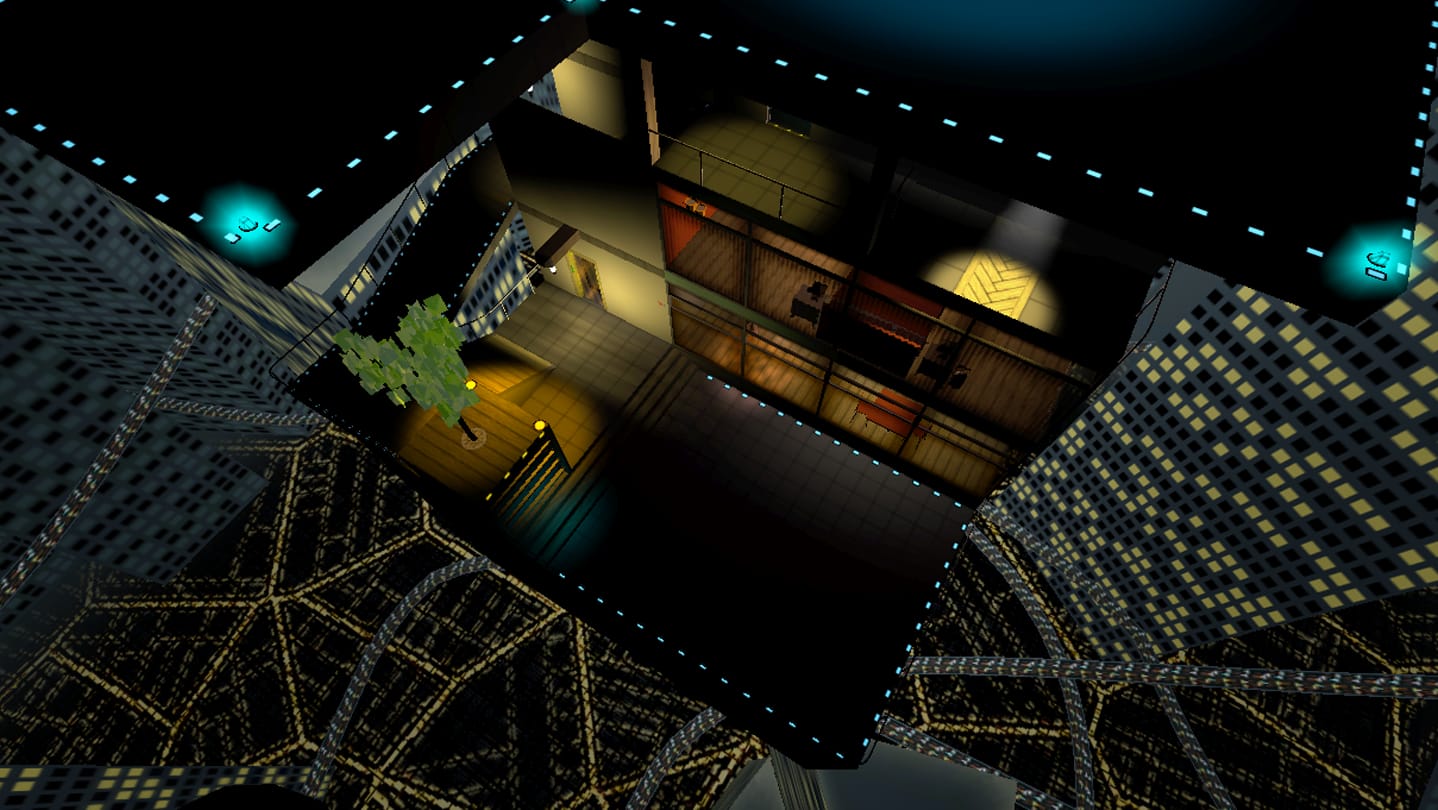
What is perhaps most impressive is how much story is told without a single line of spoken dialogue. The world is built through environmental storytelling. You see the lived-in apartments of your crew, the cluttered desks, the stacks of floppy disks, and the posters on the walls. It creates a sense of camaraderie and history that feels more authentic than a dozen cutscenes. You understand these people by the tech they use and the spaces they inhabit.
However, the experience is not without its limitations. The campaign is notoriously brief, clocking in at around five hours. Just as the mechanics begin to demand true mastery—specifically when you start coordinating three different agents—the credits roll. There is a sense that the logic puzzles could have pushed further into the "hardcore" territory. The difficulty curve plateaus early, leaving veteran puzzle fans wishing for a "Pro" mode that demanded more complex syntax or tighter timing windows. Nevertheless, the time spent in this world is so dense with style and "Aha!" moments that the brevity feels more like a choice of pacing than a lack of content.