
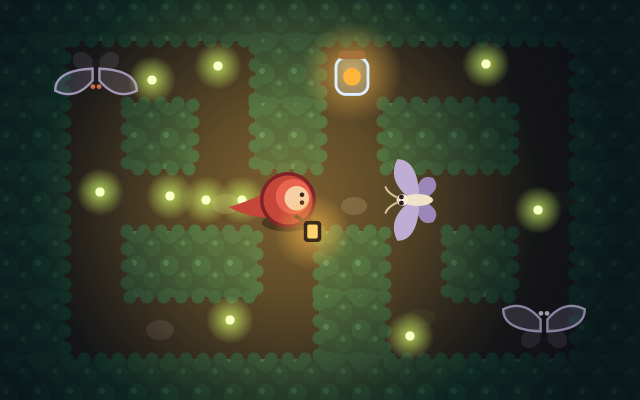
Overview
Every few years, a small studio makes something that feels bigger than its budget. Röki is that kind of game. It’s the debut effort from Polygon Treehouse, a British outfit founded by former Guerrilla Cambridge art directors, and that pedigree shows in the art direction. This is a point-and-click adventure — a genre most people wrote off around the time dial-up died — reborn as a melancholic Scandinavian storybook.
The setup is simple, almost archetypal. You play Tove, a young girl whose little brother Lars is snatched by a monstrous creature out of an old fairy tale. She grabs her journal and marches into an ancient, snow-blanketed wilderness to get him back. What follows is a journey through forgotten legends, sleeping guardians, and folklore creatures that range from endearing to genuinely unsettling.
Here’s what matters about Röki’s positioning: it deliberately refuses the crutches most adventure games lean on. There is no combat. There is no fail state that punishes you with a game-over screen. Polygon Treehouse pitched it as “a game of brains not brawn,” and the design backs that up. This is a title built to be welcoming — to kids, to lapsed gamers, to anyone allergic to twitch reflexes and boss fights.
The reception backs the gamble. Röki landed a 76 on Metacritic, a Best Debut nomination at The Game Awards 2020, and two BAFTA nods — a solid haul for a first-time studio working in a genre the industry had quietly buried. Röki isn’t chasing the mainstream. It’s carving out the same emotional real estate as Journey or Gris — the “quiet indie that makes you cry on a Tuesday” shelf. It mostly earns its spot there.
Key features
- Non-Violent Puzzle Adventure: The entire experience is built on exploration and environmental problem-solving. You gather items, decode folklore, and coax cooperation from strange creatures. Not a single sword swung.
- Tove’s Journal: A diegetic map-and-quest system. Tove sketches the wilderness as she explores it, logs creatures, and earns “wilderness explorer” badges. It’s part navigation tool, part scrapbook, and it does real narrative work.
- Hand-Crafted Storybook Art: A flat, illustrative aesthetic that looks pulled from a children’s picture book — soft edges, muted snow-light, and creature designs rooted in genuine Nordic myth.
- Emotional Family Narrative: Underneath the folklore sits a story about grief, family, and courage that refuses to talk down to its audience, even as it stays kid-safe.
Analysis
The Gameplay Loop
Röki’s core rhythm will be instantly familiar to anyone who grew up on LucasArts adventures, stripped of that era’s cruelty. You explore a region. You find a locked path — sometimes a literal locked gate, sometimes a creature that won’t budge, sometimes an ancient mechanism gone quiet. You hunt down the object or the knowledge that solves it. You move on.
What separates Röki from the genre’s worst instincts is restraint. Classic adventure games were infamous for “moon logic” — combine the rubber chicken with the pulley to reach the mustache, that sort of nonsense. Röki almost never does this. Its puzzles are grounded in the world’s internal rules. When you need to appease a spirit, the solution follows from what the game has taught you about that spirit. The logic is clean. Solutions feel earned rather than stumbled into.
That clarity is a double-edged blade. For newcomers and younger players, it’s a gift — the onboarding friction is close to zero, and the game trusts you to think without ever leaving you truly stuck. For puzzle veterans, it can tip into the too-easy. Several of Röki’s brain-teasers resolve the moment you spot the mechanism. You rarely sit and stew. If your favorite part of an adventure game is the twenty-minute standoff with an obstinate puzzle, Röki may feel like it’s holding your hand a beat too long.
Exploration and the Journal
The connective tissue here is exploration, and this is where Röki is at its most confident — and, occasionally, its most frustrating. The world is designed to be a pleasure to wander. Tove’s journal is the standout system: it auto-maps regions, tracks objectives without nagging, and rewards curiosity with collectible badges and creature entries. It reframes progress as discovery rather than checklist completion, and it’s the smartest design decision in the game.
But that world is also connected by a web of interlocking paths, and Röki asks you to walk them. A lot. The backtracking is the game’s most-cited flaw, and the criticism is fair. Solving a puzzle in one zone frequently means trekking back across two others to fetch a component, then retracing your steps. The world isn’t large enough to justify how often you cross it. There’s no fast-travel worth the name for long stretches, and the moment-to-moment traversal — while atmospheric — threatens to drag in the middle third.
Narrative Craft
The story is the engine that pulls you past those rough patches. Röki treats its emotional core — a family fractured by loss, a child shouldering impossible responsibility — with unusual maturity. It never dissolves into treacle, and it never flinches. The folklore isn’t set dressing; the myths are the plot, and unraveling them doubles as unraveling Tove’s own family history. By the final act, the game’s collectibles and creature logs have quietly built a world worth caring about. That’s the payoff for all that walking.
Visuals & performance
The art direction is the headline, and it deserves to be. Röki’s storybook aesthetic is disciplined and specific — not generic “cute indie,” but a coherent illustrative language of soft geometry, snow-diffused light, and hand-drawn warmth. The creature designs are the highlight: friendly folk render as huggable, but the fearsome ones carry a real edge of fairy-tale menace, the kind that used to give kids nightmares before folklore got sanded down for mass consumption.
The soundtrack matches the visuals move for move — haunting, restrained, and melancholic without tipping into misery. Sound and image work as one mood-making instrument.
Technically, Röki is a modest game by design. It’s not pushing polygons, so a 2D-styled adventure of this scope is light on hardware. The trade-off is the occasional loading pause between areas — which, combined with the backtracking, is exactly where friction hurts most. Camera work is fixed and cinematic, which serves the art beautifully but sometimes makes precise navigation of a scene fiddlier than it should be.
Platform nuances
On Steam, Röki plays to the genre’s home-field advantage. Mouse-and-keyboard point-and-click is the native idiom for adventure games, and Röki honors it — clicking to move and interact should feel natural, and the cursor gives you the precision the fixed cameras occasionally demand. Controller support is there too, but the mouse is the purist’s pick.
On Nintendo Switch, Röki arguably finds its ideal home. This is a game built for the couch and the commute — short-session-friendly, gentle, contemplative. Handheld mode suits it well; the storybook art is the kind that holds up on a smaller screen, and the pace matches the way people actually play Switch. Stick-driven cursor navigation is a small step down from mouse precision, and the Switch’s modest hardware means loading transitions may run a touch longer. But the portability more than compensates. If you want Röki as a bedtime story you play in fifteen-minute chunks, the Switch is the one to buy.
Final verdict
Röki is a debut with the confidence of a veteran. Polygon Treehouse understood exactly what they were making — a tender, hand-painted folktale about a girl, her brother, and the monsters between them — and they executed it with real craft. The art hooks the eye. The story holds attention. The refusal to lean on combat or cheap difficulty spikes makes it one of the more welcoming games in recent memory.
It isn’t flawless. The backtracking is a design flaw the studio should have caught, and the puzzles won’t test anyone who cut their teeth on the genre’s harder classics. But these are the complaints of a game reaching for something ambitious and landing at good-but-not-great, not the failures of a game that didn’t know what it wanted to be. Röki knows exactly what it is. It’s a small, sad, beautiful thing — solid rather than essential, and well worth the time of the right audience. At $19.99 on Steam and Nintendo Switch, we recommend it to anyone who wants a quiet folktale more than a challenge.
Reviewed by the Rankeno RPG & Adventure Desk. Scores are out of 10; the overall score is the desk’s editorial judgement, informed by the four sub-scores above. How we review