
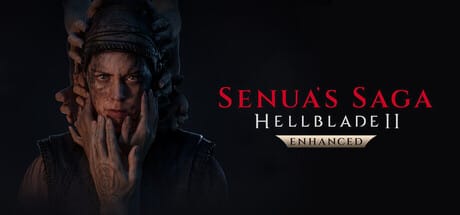



Bottom Line: The most technically staggering game you can run on a PC right now, and one of the most cautiously interactive. Hellblade II is a masterpiece of craft strapped to a design so restrained it barely trusts you to touch it.
The Gameplay Loop
Here is the honest shape of it. You walk. You occasionally solve a puzzle. You fight, briefly and cinematically. You walk some more. Then a set-piece detonates and reminds you why you're still holding the controller.
The exploration is the connective tissue, and it's where the "walking simulator" accusation gains teeth. Senua moves at a deliberate, cinematic pace through gorgeous, largely linear corridors dressed up as open wilderness. You are frequently pushing forward on the stick and little else. When the scenery is this good, that's not immediately a problem. Over hours, it becomes one. The game is so terrified of breaking its own atmosphere that it rarely lets you do anything that might.
The perception puzzles are the returning signature mechanic: hold a button, and Senua "focuses" until runes and shapes hidden in the environment align into a solvable form. In 2017 this felt novel — a clever externalization of pattern-seeking cognition. In 2024 it feels like a mechanic the studio was contractually obligated to bring back. The puzzles are light, repetitive, and never genuinely stump you. They pad the runtime without deepening it.
Combat as Cinema
The combat is the most interesting design argument in the game, and it will divide you along a clean line. Ninja Theory stripped away spectacle deliberately. Every fight is a one-on-one duel. There are no crowds, no crowd-control, no skill tree. Just you, one enemy, a dodge, a parry, and a heavy strike that lands with genuine physical impact. The camera hugs tight. Blood and breath fill the frame.
When it works, it's the most intimate melee combat in a big-budget game — you feel the exhaustion, the desperation, the weight. When it doesn't, it's simplistic to the point of hollowness. There is very little mechanical growth across the entire runtime. The fight you win in hour one plays almost identically to the fight in hour seven. If you come to games for systems that deepen and reward mastery, this well runs dry fast.
The Interactive Journey
What holds it all together — and what genuinely justifies the experience for the right player — is the psychological through-line. This is not a story with a psychosis subplot. It's an interactive attempt to build empathy for a state of mind most players will never experience, and the collaboration with clinicians and people with lived experience shows in the restraint. The voices aren't horror-movie decoration. They contradict each other. They doubt you. They're sometimes right. That texture is rare, and Ninja Theory earned it honestly.
The trouble is that empathy is not interactivity, and Hellblade II keeps confusing the two. The most powerful moments are the ones you least control. The game is at its best as a piece of directed drama and at its weakest whenever it hands you agency and then quietly clips your wings. You are a passenger on a beautifully engineered rail, and the game only occasionally pretends otherwise.