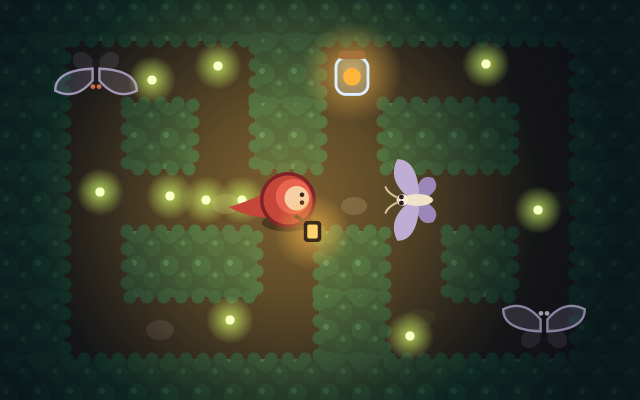
Overview
Most deck-builders are exercises in cold, ruthless optimization. You cull your deck to maximize damage-per-turn, treating every card as a weapon in a war of attrition. Echodog Games takes this familiar loop and pivots it toward something far more vulnerable: the act of talking. In Signs of the Sojourner, you aren’t slaying dragons; you are trying to keep your late mother’s general store afloat in a near-future world scarred by environmental decay. To do this, you must leave your small town of Bartow, travel to distant hubs, and secure rare goods through the medium of symbol-matching conversations.
Positioned at the intersection of narrative adventure and card-driven strategy, the game understands a fundamental truth that many “choice-based” RPGs ignore: communication is a two-way street where you don’t always have the right words. Your deck represents your voice and perspective. Each card features symbols—circles, triangles, squares—that represent different conversational styles, from empathetic and logical to forceful or diplomatic. When you play a card, you are attempting to match the symbol of your interlocutor. Succeed, and the conversation flows; fail, and the “chain” breaks, leading to misunderstandings, closed doors, and occasionally, the permanent fracturing of a relationship.
This is a game about identity flux. As you travel, you encounter new cultures and learn their way of speaking. To incorporate these new symbols into your deck, you must often discard an old card. This tactical choice is a literal representation of how travel and experience change us. You return to your hometown only to realize you no longer possess the “symbols” to talk to your childhood best friend. It is a poignant, often heartbreaking exploration of outgrowing your origins.
Key features
- Conversational Deck-Building: Instead of attacks and defense, your cards represent tonal nuances. Matching symbols builds “common ground,” while mismatches create “discord.”
- Forced Evolution: Every encounter ends with you adding a new card to your deck and, crucially, discarding an old one. This represents the involuntary way our perspectives shift over time.
- Mood & Fatigue Mechanics: Your character’s mental state impacts the deck. Exhaustion adds “Fatigue” cards—dead weight that clutters your hand—simulating the difficulty of being “on” while traveling.
Analysis
The strength of Signs of the Sojourner lies in its mechanical friction. In most games, friction is a design flaw; here, it is the entire point. The game is built to put you in a state of constant, low-level anxiety about whether you can actually connect with the person in front of you.
The Vocabulary of Connection
Every conversation is a sequence where you and an NPC play cards into a central chain. If the symbols on the ends match, the chain continues. If they don’t, you rack up “discord” points. Too much discord and the conversation fails. What makes this fascinating is how Echodog Games handles the deck limit. You are restricted to a small number of cards, which means you cannot be everything to everyone. If you optimize your deck to speak with the tech-savvy residents of a bustling city, you will find yourself fundamentally incapable of communicating with the rugged miners of the south.
This creates a specialization trap. The “win condition” of the game—saving the store—requires you to succeed in various towns, but the mechanics of the deck make it impossible to maintain a “universal” voice. This mirrors the real-world trade-off of niche expertise versus social cohesion. You don’t just “level up” in this game; you sideways-step.
The Friction of Growth
The most controversial element of the design—and arguably its most effective—is the punishing difficulty spike in the later acts. As the world expands, the “conversational patterns” become more complex. Some NPCs will play cards that skip your turn, or change the symbols mid-stream. If your deck isn’t tuned to their specific frequency, you will fail.
Critics have pointed to this as a balance issue, but we’d argue it is a narrative necessity. Miscommunication is a catastrophic event in Signs of the Sojourner. Failing a conversation with a key character might mean they leave town forever, or that you miss a vital shipment for your store. This stakes-heavy approach gives weight to every card played. The game doesn’t want you to feel empowered; it wants you to feel the fragility of empathy. That said, the spikes can cross the line from meaningful friction into plain frustration, and not every player will have the patience for it.
Interface & Flow
The UI is clean, focusing on the cards and the expressive character portraits. The “Fatigue” system is a particularly smart touch. As you travel further from home, your “voice” becomes cluttered with the mental exhaustion of the road. It forces you to plan your routes carefully, deciding if that one extra stop for a rare item is worth the risk of being too tired to speak coherently when you arrive.
Visuals & performance
The aesthetic direction is lovely. Using a hand-drawn, painterly style, the game avoids the generic “gritty post-apocalypse” tropes in favor of something warmer and more textured. Each town feels distinct, not just through its color palette but through its musical identity. The soundtrack is a highlight—atmospheric, folk-infused, and reactive to the tension of the card games. On a technical level, a 2D game of this scope is light on hardware, and the design keeps transitions between narrative beats and card play quick and unobtrusive.
Platform nuances
On Steam, mouse input suits the game’s precision, allowing for quick scanning of your deck and the opponent’s “intent.” The Nintendo Switch version, meanwhile, suits the game’s portable, episodic structure: the bite-sized “talk-match” loop is a natural fit for handheld play. The lack of touch controls on Switch is a minor missed opportunity, but the controller mapping is intuitive enough that it doesn’t hinder the experience.
Final verdict
Signs of the Sojourner is a distinctive achievement that uses a “logic” genre to tell a “feeling” story. It gamifies one of the most difficult tasks humans face: understanding one another. While its difficulty can occasionally feel like a slap in the face, that sting is what makes its rare moments of perfect connection feel earned. It is a haunting experience that will stay with you long after you’ve discarded your last childhood card — one we recommend to the right audience, with the caveat that its friction is a feature, not a bug, and should be embraced as such.
Reviewed by the Rankeno RPG & Adventure Desk. Scores are out of 10; the overall score is the desk’s editorial judgement, informed by the four sub-scores above. How we review