Overview
Every so often a developer takes two things that have no business being together and forces them into the same room. Usually you get a mess. Occasionally you get Solitairica, a game from Toronto-based Righteous Hammer Games that treats the humble game of solitaire not as a time-killer but as a combat engine.
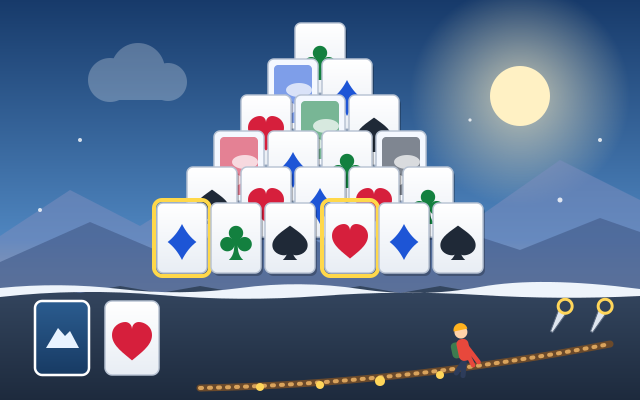
Here’s the pitch: you’re a hero in the fantasy kingdom of Myriodd, and the tyrant Emperor Stuck has overrun the land. You fight back not with a sword but with a deck of cards. Each enemy encounter is a self-contained round of TriPeaks-style solitaire—you clear stacked columns by playing cards one rank above or below your active card. Do it well and you generate elemental energy. Spend that energy on spells. Kill the monster before it kills you. Repeat until you die, because you will die, and then start over a little stronger.
That last part is the roguelike DNA. Runs are short, permadeath is absolute, and the map is procedurally stitched together so no two campaigns feel identical. Between fights you hit a shop, buy spells and passive trinkets, and try to assemble a build that snowballs before the difficulty curve catches up. When you fail—and early on you’ll fail a lot—you bank Wildstones, the meta-currency that unlocks new character classes and permanent upgrades.
On price and positioning, this is a premium indie, not a free-to-play energy-timer trap. There are no ads mid-battle, no lives to refill, no store nagging you for gems. You pay once ($4.99). That alone earns it goodwill in a mobile market drowning in dark patterns. It carries a 4.4 out of 5 rating on the App Store, a respectable mark that suggests where this game shines—and that’s coming up.
Key features
- Solitaire-as-Combat: A TriPeaks variant where clearing columns isn’t the goal—it’s the ammunition. Every valid play feeds one of four energy pools, turning a relaxing pastime into a resource-management problem.
- Four-Energy Spell Economy: Attack, Defense, Agility, and Willpower power a deck of buyable spells and abilities. How you spend—and hoard—these energies is the entire tactical game.
- Roguelike Progression: Procedurally generated enemy armies, permadeath runs, a between-battle shop, and synergistic passive items that chain into build-defining combos.
- Unlockable Classes & Meta-Progression: Earn Wildstones to unlock the Warrior, Monk, Wizard, and other classes, each with a distinct starting spell pool and playstyle that reframes how you read the board.
Analysis
The Gameplay Loop
The cleverness of Solitairica is that it hides a strategy game inside a reflex most people already own. Solitaire is universal—played in airports and waiting rooms and during boring meetings. Righteous Hammer bets that this familiarity is a Trojan horse, and the design backs that bet. The onboarding friction is close to zero. The first column can be cleared before a single tooltip gets read.
Then the second layer arrives and the whole thing detonates. Clearing cards isn’t about tidying the board; it’s about manufacturing energy. Each clear pumps resource into one of four pools, and those pools are the difference between casting a fireball and eating a claw to the face. Suddenly every play is a fork: take the safe, obvious clear that nets Defense you don’t need, or gamble on a longer chain that fuels the Attack spell that ends the fight now?
That tension is the game. And it’s relentless. Enemies don’t wait politely—they telegraph attacks with a countdown, so the board doubles as a timer. You’re solving solitaire against a shot clock while budgeting four currencies against a spellbook. When it clicks, it produces that rare, addictive “one more run” compulsion that the best roguelikes trade in.
Builds and Synergy
The shop is where Solitairica reveals its depth. Spells and passives interact in ways that reward experimentation and punish autopilot. A passive that converts excess Willpower into Attack turns a defensive class into a glass cannon. A spell that reshuffles the board becomes a lifeline when you’re staring at a dead layout. The best runs are the ones where two mediocre items combine into something absurd, and it feels like breaking the game. It isn’t. It’s building the break. That’s good design.
The unlockable classes extend this. The Wizard wants you thinking about spell efficiency; the Warrior wants aggression; the Monk wants patience and conversion. Each one is a different lens on the same board, and mastering the shift between them is the long-tail hook that keeps veterans coming back after the novelty of the core mechanic fades.
Where the Cracks Show
Now the honest part. Solitairica is hostage to the shuffle. This is a card game, and cards are random, and randomness cuts both ways. Some runs hand you a beautifully cascading board and a shop full of synergy. Others deal a wall of dead cards, no reachable plays, and a monster with a fast timer—and there is nothing, skill-wise, to be done about it. Good roguelikes make you feel responsible for your death. Solitairica sometimes makes you feel robbed by the RNG, and that’s a different, more frustrating flavor of defeat.
The meta-progression can also drag. Wildstones accumulate slowly, and the stretch between “understanding this game” and “having the tools to reliably win” involves a fair amount of grind. The learning-by-losing loop is a feature, but the pacing of unlocks doesn’t always respect your time. These aren’t dealbreakers. They’re the friction points that keep a good game from being a great one.
Visuals & performance
The art direction is charming without being twee. Solitairica goes for a vibrant, storybook-cartoon look—bold outlines, saturated color, and a rogues’ gallery of enemy designs with real personality. The monsters emote. They gloat, they flinch, they die with a satisfying little animation flourish. It’s not photorealism and it isn’t trying to be; it’s a cohesive, readable aesthetic that keeps the fast-moving board legible.
And readability matters here more than eye candy. In a game where you’re parsing four energy meters, an enemy timer, and a shifting card layout simultaneously, UI clarity is a mechanical requirement, not a polish item. Righteous Hammer largely nails it. Card values pop, energy pools are color-coded and unambiguous, and spell effects animate clearly enough that misreads should be rare.
Technically, it’s featherweight by design. A 2D card game of this scope is light on hardware, and the art style asks nothing a modest phone or years-old laptop can’t deliver. For a game built around short, tactical sessions, that snappiness is exactly right—no loading screen stands between you and the next run.
Platform nuances
Solitairica is a touch game first, and that heritage shows in the best way on iOS and Android. Tapping cards to clear them is direct, tactile, and immediate—your finger is the cursor. The pacing suits mobile perfectly: a battle takes minutes, a run fits a commute, and permadeath means you can drop it mid-campaign without guilt. This game was born for a phone.
On Steam, mouse-and-keyboard play is perfectly competent on paper—click a card, click a spell, done. But there’s a subtle loss of intimacy. The point-and-click abstraction adds a hair of distance that touch erases. It works. It just doesn’t sing the way the mobile version should. The upside of the PC build is the bigger canvas: on a large monitor the board and its details have room to breathe, and the art benefits from the real estate.
The recommendation splits cleanly. Want the definitive experience? Play it on your phone. Want it in a Steam library for longer couch sessions on a big screen? That version should deliver too—just know you’re getting the very good port, not the native-feeling original.
Final verdict
Solitairica is proof that the best innovations aren’t always new mechanics—sometimes they’re new combinations. Righteous Hammer took the most familiar card game on the planet and turned it into a tense, buildcraft-driven combat system, and the fact that it works as well as it does is genuinely impressive. The loop is sharp, the classes give it legs, and the premium, no-nonsense business model stands out in a market that rarely earns praise.
It stops short of greatness for one reason: the dice. When the shuffle cooperates, Solitairica is one of the more satisfying tactical toys on mobile. When it doesn’t, you’re a spectator at your own funeral. That variance is baked into the concept, so how much it bothers you depends on your temperament—and the grind to unlock the classes that smooth it out doesn’t help. If you can shrug off a bad deal and start the next run, this game will eat your commutes for months. If you need every loss to be your fault, the RNG will occasionally break your heart.
We rate it a solid pick for the right audience: buy it for your phone, keep your expectations calibrated, and keep the shop’s reshuffle spell handy—you’ll need it.
Reviewed by the Rankeno Puzzle & Casual Desk. Scores are out of 10; the overall score is the desk’s editorial judgement, informed by the four sub-scores above. How we review