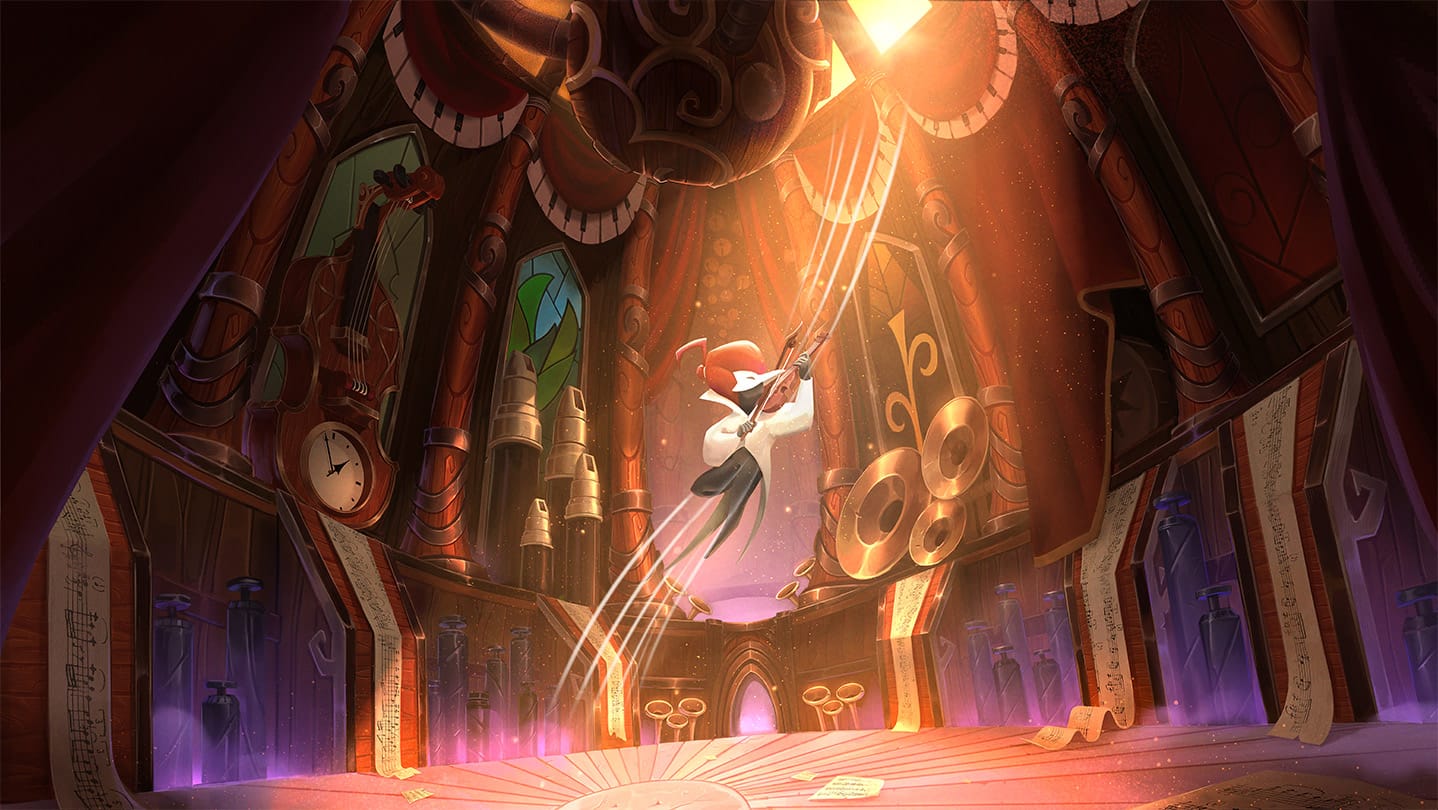

Bottom Line: Symphonia is a mechanically rigorous, visually arresting precision platformer that successfully trades traditional combat for a sophisticated, instrument-based movement system. It is a brief but intense masterclass in kinetic storytelling.
The brilliance of Symphonia lies in its refusal to offer the player a traditional safety net. Most platformers treat "movement" as the means to an end—the thing you do between fights or puzzles. Here, movement is the puzzle.
The Kinetic Language of Philemon
The core interaction model revolves around the violin bow. It’s a versatile tool that introduces a unique mechanical friction. When Philemon springs off a surface, it isn't a simple button press; it's a calculated release of tension. This creates a tactile sensation that is rare in 2D titles. You aren't just navigating a level; you are "playing" it. The movement feels analogue and weighted, demanding that you master the arc of your catapult launches and the timing of your dashes. This isn't about memorizing patterns so much as it is about developing a feel for the physics engine. When you find the flow, the game achieves a state of "kinetic grace" that rivals the best in the genre.
Mechanical Friction and Difficulty
However, this reliance on precision is a double-edged sword. Symphonia is meditative in its presentation but demanding in its execution. The lack of combat doesn't mean a lack of stakes. The challenge comes from the environment itself—narrow corridors, shifting platforms, and vertical climbs that punish a lack of discipline. I observed several difficulty spikes that felt slightly disconnected from the established learning curve. Certain sequences require a level of dexterity that might alienate casual players drawn in by the "poetic" marketing. That said, for the veteran of the genre, these spikes provide the necessary resistance to make the eventual mastery feel earned.
The Problem of Scale
The biggest critique leveled against Symphonia is its brevity. A seasoned player can reach the credits in under four hours. In an era where "value" is often measured in hours-per-dollar, some will find this thin. But this perspective ignores the narrative efficiency on display. The game doesn't waste time on fetch quests or repetitive combat encounters. It presents its mechanics, tests them to their limit, and concludes. It is a concise, high-fidelity experience. The "onboarding friction" is minimal, and the game trusts the player to keep up with its escalating demands without hand-holding.