Overview
Most RPGs lie to you about scarcity. They dangle a hunger meter, a weight limit, a fuel gauge — and then quietly make sure you never actually run out, because running out isn’t fun, and fun is the product. Vagrus - The Riven Realms does not lie to you. You can go broke. Not “reload the save” broke. Broke as in the wages come due, the water runs out, the crew’s morale craters, and the run is simply over. Hungarian studio Lost Pilgrims Studio built an entire game on the premise that the fantasy of leading a caravan across a dead continent is inseparable from the terror of the ledger, and that conviction is what makes this thing work.
The setup: a thousand years ago the Elder Gods opened up on the continent of Xeryn and left behind a wasteland of arcane anomalies, mutated wildlife, and undead that didn’t get the memo about staying buried. You play a vagrus — a caravan master, part merchant, part smuggler, part warlord — hauling goods and people across roads that want you dead. Three systems interlock: open-world route planning, caravan logistics and trade, and turn-based tactical combat. Around them wraps an enormous volume of branching prose.
Market-wise, this is a deliberate outsider. It shares DNA with Battle Brothers and King of Dragon Pass, and it’s tonally adjacent to Darkest Dungeon, but it’s text-heavier than any of them and slower than all of them. That’s not an accident or a budget constraint — it’s the pitch. The game’s long tail of post-launch patches and a support run that ends with a final planned content update in 2026 suggest a studio that found its audience and kept faith with it. Small studio, long game, no compromise. The result is niche by construction and solid within that niche.
Key features
- Caravan Management With Real Consequences: Supplies, water, wages, morale, and crew vigor all deplete on their own schedules. Trade goods across regional markets to stay solvent. Bankruptcy is a genuine failure state, not a scary-sounding tooltip.
- Route Planning as Core Gameplay: The map isn’t connective tissue between the “real” content. Weighing a dangerous shortcut against a safe road — against your water reserves, your crew’s condition, and a delivery deadline — is the content.
- Positioning-Focused Tactical Combat: Turn-based encounters where formation and placement decide outcomes. Your companions fight alongside hired mercenaries whose loyalty is a line item.
- Extensive Branching Prose: Choice-driven events and companion questlines written at a standard that justifies the word count — an unusually high bar, and one Vagrus clears.
- Zero-Sum Faction Politics: Trading Houses, criminal syndicates, and religious orders offer real boons for loyalty. Courting one antagonizes others. There is no path where everyone likes you.
- Three Starting Backgrounds: Trader, mercenary, or explorer — each reshapes the opening hours, which in an economy this tight is a substantial difference.
Analysis
The Gameplay Loop
Here’s the rhythm: you take a contract, you plot a route, you provision for it, you eat whatever the road serves you, you arrive, you sell, you pay the crew, you take another contract. Stated flatly it sounds like errand-running. On paper it’s one of the more consistently tense loops in the genre, and the reason is that every one of those steps is a bet against the others.
Provisioning is the clearest example. Water and supplies are weight. Weight is speed. Speed is exposure — more days on the road, more random encounters, more deterioration. So you underpack, because underpacking is faster, and faster is safer. Until the shortcut turns out to be blocked, or an anomaly forces a detour, and now you’re four days from a settlement with two days of water and a crew whose morale is sliding toward the point where they start asking why they’re still following you. You didn’t get ambushed. You got arithmetic’d. Vagrus kills you with math more often than with monsters, and the deaths are always, infuriatingly, your fault.
That’s the design’s central insight: it makes logistics dramatic by refusing to make it optional. Most games with supply systems let you solve them once and forget them. Vagrus keeps the ledger open on your desk the entire campaign.
Combat, and Its Place
Combat is the third pillar and, honestly, the least essential one — which is a compliment, not a knock. Encounters are turn-based and built around positioning: front line, back line, who’s exposed, who’s protected, who gets to act. It’s tactically legitimate and rewards learning your crew’s kits.
But it’s deliberately subordinate. Fights are a cost. Every scrap burns vigor, risks wounds, and consumes time you’d rather spend covering ground. The game is quietly, persistently telling you that the best fight is the one you talked, paid, or fled your way out of — and that’s exactly right for a game about being a merchant rather than a hero. Players who came for the combat will find it thinner than Battle Brothers. Players who understand what it’s for will find it well-calibrated.
The Writing
This is the load-bearing wall. There is an enormous amount of text here, and the reason the game survives that is that the text is good. Not “good for an indie.” Good. The setting is specific and grimy and has clearly been lived in by the people who built it, and the choice-based events consistently offer decisions with real teeth — options that are all bad in different, interesting directions. Companion questlines unfold in prose rather than cutscenes, and they land.
The failure mode is obvious and unavoidable: if you don’t want to read, there is no game here. Not a reduced game. No game. Vagrus is a novel you’re allowed to argue with, and it never pretends otherwise.
Onboarding Friction
Now the real problem. The learning curve is steep and the game does very little to soften it. It’s the single most common complaint aimed at the design: the tutorial gestures at the systems and then leaves you to reverse-engineer the rest. Three interlocking systems, an unforgiving early economy, and a UI that presents information rather than teaching it.
Precision matters here, because “hard game is hard” is a lazy read. The difficulty isn’t the flaw. The flaw is that the opening hours conflate not-knowing-the-systems with playing-them-badly, and punish both identically. A player who goes bankrupt in hour three because they misread a market spread learns nothing except that they lost. That’s a bad first lesson, and it’s a self-inflicted wound — the ceiling of this design is high enough that the floor doesn’t need to be trapped. A better onboarding wouldn’t have made Vagrus easier. It would have made it legible, and legibility is what converts bouncers into evangelists.
The players who push through find the payoff. But count the bodies too.
Visuals & performance
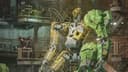
The aesthetic direction is the strongest non-textual thing here. Hand-painted, muted, sun-bleached — a wasteland that reads as exhausted rather than merely hostile. Character and location art carry real personality, and the composition does exactly what a text-heavy game needs its art to do: anchor the imagination without overriding the prose. It’s evocative on a budget, which is the harder trick.
The UI is the weak link, and it’s a familiar weakness. This is a game built by people who know their systems cold, and the interface reflects that fluency rather than compensating for its absence in the player. Information is present — density isn’t the sin; a game this systemic needs dense screens. The sin is hierarchy. Everything arrives at the same volume, so the number that’s about to end your run doesn’t announce itself any louder than the one that doesn’t matter. That’s form deferring to the designer’s mental model instead of the newcomer’s.
Performance is a non-issue by design. Turn-based, 2D-forward, mostly static presentation — a game of this scope is light on hardware. The engine is not where the risk lives.
Platform nuances
Steam is home. Mouse-and-keyboard is the native idiom for a game that is fundamentally a series of menus, maps, and text, and the platform gives you the two things this design needs most: a large display to hold dense screens at once, and a community that has spent years writing the guides Lost Pilgrims’ tutorial doesn’t. If you’re buying Vagrus to learn Vagrus, buy it here.
Nintendo is the interesting case, and the harder one. The pitch is obvious and genuinely appealing — a slow-burn text RPG is a handheld game in its bones, and Vagrus’s episodic structure fits a commute or a couch session better than it fits a marathon at a desk. The road between two settlements is a natural session boundary.
But the port inherits two problems it did not create. Text at handheld size is the first: a prose-driven game on a small screen is a legibility question before it’s a design question, and the answer determines whether the whole thing works. The second is navigation without a cursor. A UI already criticized for burying critical information under mouse-driven density has to survive translation to a d-pad and a stick, where every buried menu costs several times more input. That’s a port fighting a UI that was already fighting the player.
The default recommendation is Steam — and if the handheld version lands the text scaling and the navigation, it’s arguably the better way to play. Check the current-hardware specifics before you commit.
Final verdict
Vagrus is not for most people, and Lost Pilgrims knew that before they wrote a line of it. That clarity is the game’s greatest asset. Every choice here — the text volume, the brutal economy, the deliberate pace, the combat that exists to be avoided — points the same direction, and the result is a game with an identity specific enough to be worth the time of the people it fits. Little else does this. That’s rarer than quality.
What holds it back isn’t ambition, it’s hospitality. The onboarding is a wall in front of a door, and the UI is a designer’s tool that never got translated into a player’s. Those are fixable problems, and the fact that they persist through years of otherwise committed support is the one place where the studio’s conviction curdles into stubbornness. A player who bounces at hour two never learns the game was worth it — and that’s a loss the design chose to accept.
Push through and there’s a distinctive niche RPG in here: a game about debt, thirst, loyalty, and the specific dread of watching a number go down on a road with no towns on it. Bring patience. Bring reading glasses. Bring a plan for the water.
Reviewed by the Rankeno Strategy & Sim Desk. Scores are out of 10; the overall score is the desk’s editorial judgement, informed by the four sub-scores above. How we review