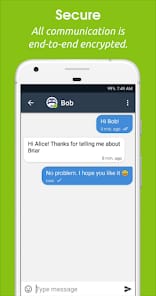



Bottom Line: Briar is an uncompromising, decentralized fortress for communication that trades every modern convenience for total digital sovereignty. It is less an app and more a survival tool for those who treat privacy as a matter of life and death.
The Architecture of Absolute Trust
The brilliance of Briar lies in its refusal to trust anything it doesn't own. Most "secure" messengers still rely on a central directory to tell you which cryptographic key belongs to which phone number. Briar throws that out. When you add a contact in Briar, the default and most secure method is a physical handshake. You stand in the same room, you scan a QR code off their screen, and you establish a cryptographic bond that is tied to that specific hardware. This creates a web of trust that is physically anchored in reality.
This approach introduces significant onboarding friction, but for Briar’s target demographic, that friction is the point. It prevents the kind of remote impersonation and "contact discovery" vulnerabilities that plague phone-number-based systems. Once that bond is established, the app manages a complex dance of connectivity. If you both have internet, it uses Tor to hide your location and your relationship from prying eyes. If the government shuts down the ISP, Briar automatically looks for your contacts over Bluetooth or local Wi-Fi mesh. This adversarial design is what separates Briar from the "lifestyle" privacy apps; it is built to function precisely when everything else has failed.
The Cost of Digital Sovereignty
Using Briar requires a radical shift in how you think about mobile software. Because there is no central server to hold your messages in a "queue," both devices must be online simultaneously to exchange data. If I send you a message and your phone is off, that message sits on my device until we are both active at the same time. This is the Sync Loop, and it is the price of true decentralization. To make this work, Briar has to stay alive in the background, constantly listening for its peers.
The impact on battery longevity is noticeable and, for some, will be a dealbreaker. Modern operating systems like Android are designed to kill background processes to save power, and Briar has to fight those optimizations constantly to remain functional. Furthermore, the lack of asynchronous messaging (where a server holds the data for you) means Briar feels "slower" than a centralized app. It lacks the instant gratification of a blue checkmark appearing the millisecond you hit send. However, critiquing Briar for its speed is like critiquing an armored tank for its fuel economy—it misses the fundamental purpose of the machine.
Features vs. Essentials
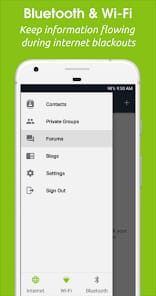
While the core of the app is private messaging, Briar includes private groups, forums, and blogs. These aren't just social fluff; they are tools for organizing. The forums, in particular, use the same P2P sync logic, meaning a community can share information across a city using a "store-and-forward" mesh: if Person A syncs with Person B via Bluetooth, and Person B later syncs with Person C at a different location, the forum posts propagate through the crowd without ever touching a cell tower. This is information persistence in a crisis. The glaring absence of voice or video calls is a significant limitation for general utility, but given the massive bandwidth and latency requirements of P2P VOIP over Tor, the omission feels like a disciplined engineering choice rather than an oversight.