Bottom Line: Euclidea is a rare triumph of educational design that treats geometry not as a chore to be memorized, but as a series of increasingly elegant puzzles to be solved. It is arguably the most intellectually honest app on the mobile market.
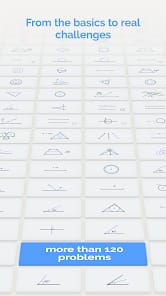
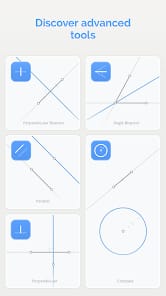
The core of Euclidea’s brilliance lies in its onboarding friction. That might sound like a critique, but in the context of an educational tool, it is a feature. Most apps seek to minimize friction to keep the user engaged; Euclidea uses it to ensure mastery. You cannot simply skip to a complex construction. You must earn your tools. This creates a gameplay loop rooted in genuine comprehension rather than rote memorization.
The Star Paradox: L vs. E
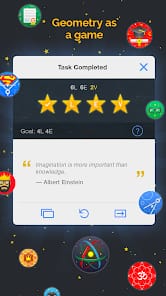
The most fascinating mechanic is the distinction between 'L' (Moves) and 'E' (Elementary) stars. In a standard puzzle game, "efficiency" usually means "fewer clicks." In Euclidea, the 'L' star rewards the use of advanced tools you’ve already unlocked to reach a solution quickly. However, the 'E' star demands you solve the puzzle as if you only had a physical, non-collapsing compass and a straightedge. This dual-objective system forces the player to look at the same problem through two different lenses: one of modern optimization and one of classical proof. It’s a brilliant way to extend the life of a puzzle while deepening the player's spatial reasoning.
The Drag-and-Drop Proof
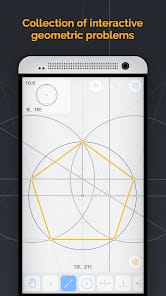
The dynamic geometry engine is where the app moves from a static puzzle book to a powerful educational utility. In traditional geometry, a student might draw a figure that looks correct but fails when the initial conditions change. In Euclidea, you can grab a vertex and move it. If your "square" turns into a "rhombus" when you drag a corner, your construction was a failure of logic, not just an aesthetic error. This immediate, visual feedback loop teaches the difference between "looks right" and "is proven" more effectively than any textbook.
The Difficulty Wall
We need to talk about the later levels. Euclidea eventually stops being a "game" and starts being a brutal mental workout. By the time you reach the advanced theorems, the "hints" (which are sparse to begin with) feel more like riddles than solutions. For those without a background in geometry, the learning curve doesn't just steepen; it becomes a vertical cliff. Some might find this discouraging, but there is a profound satisfaction in finally seeing the hidden symmetry of a complex construction after forty minutes of failed attempts. It respects your time by not wasting it on trivialities.
The interface is nearly invisible, which is the highest praise I can offer. There are no intrusive menus, no flashing "BUY COINS" buttons, and no unnecessary animations. Every pixel is dedicated to the workspace. However, the lack of a robust undo/redo stack in certain versions can be frustrating when a single misaligned tap ruins a complex construction. It's a minor grievance, but in a game where precision is the only currency, UI snags feel amplified.