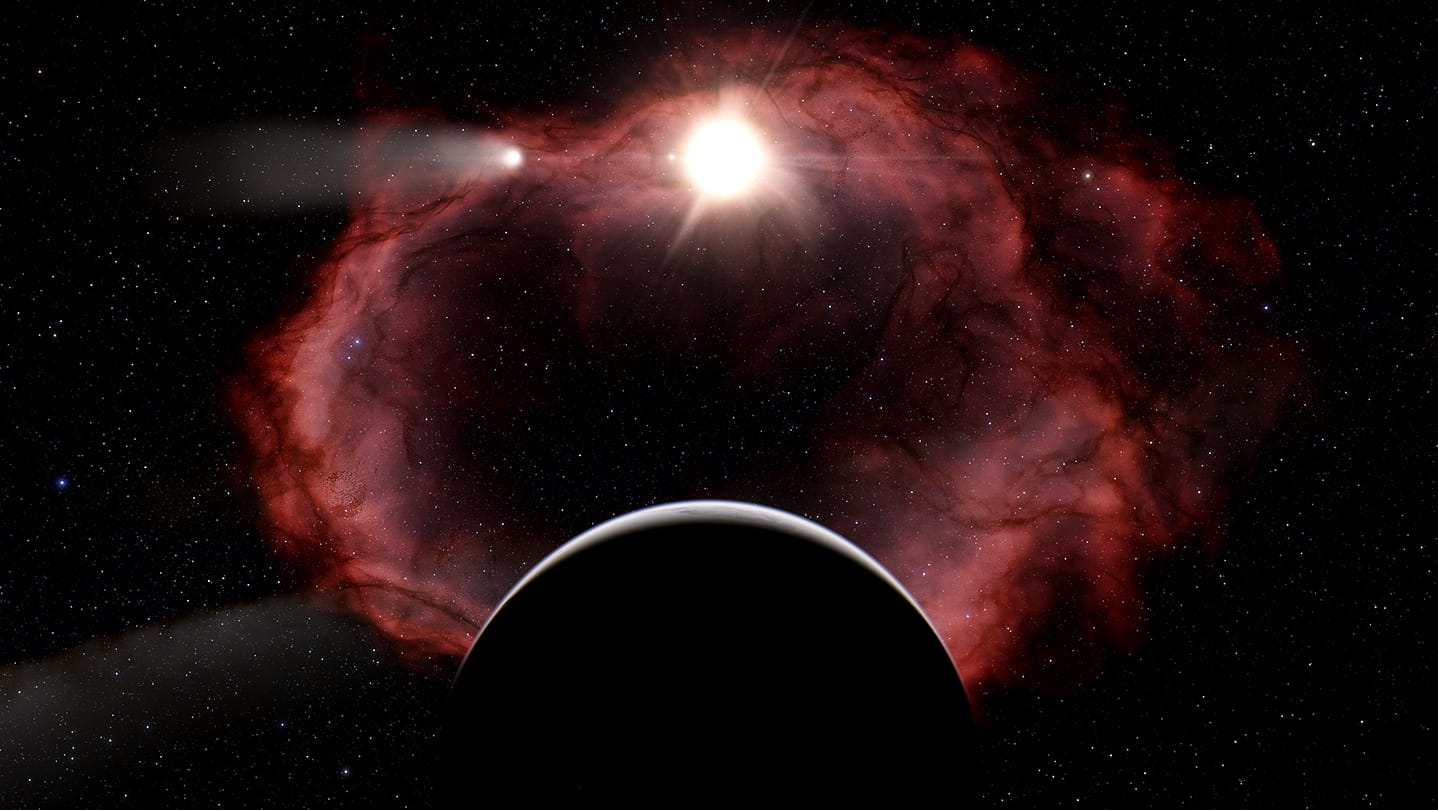
Bottom Line: SpaceEngine is less a piece of software and more a terrifyingly beautiful, scientifically rigorous existential crisis. It is the gold standard for digital planetariums, offering a 1:1 scale universe that makes every other "open world" look like a child’s sandbox.
The Architecture of Infinity
The core "loop" of SpaceEngine is one of discovery and subsequent insignificance. You start on Earth, a familiar enough point of reference, and begin to scroll. Within seconds, the moon is a pebble; within a minute, the Sun is a fading spark; within five minutes, the Milky Way is one of a trillion glowing smudges in a dark sea. The technological wizardry required to maintain this level of scale without the software collapsing into a jittering mess of floating-point errors is nothing short of miraculous.
Most software "fakes" scale using skyboxes and clever culling. SpaceEngine does not. If you see a star three billion light-years away, it exists as a coordinate you can travel to. This creates a sense of presence that is rarely achieved in digital spaces. When you land on a planet orbiting a black hole, you aren't just looking at a pretty shader; you are witnessing the calculated distortion of light through gravitational lensing, a phenomenon rendered with such accuracy it could be used for a university physics lecture.
Navigation as a Skill Tree
The interface is SpaceEngine’s most significant barrier to entry. This is not a "plug and play" experience. The UI is dense, filled with icons, graphs, and search parameters that look more like an AutoCAD workstation than a consumer application. Navigating the menus requires a genuine interest in the subject matter. You aren't just clicking; you are filtering for "K-type main-sequence stars" or searching for "super-terran worlds with life."
The learning curve is steep. Learning how to control your velocity is a literal lesson in physics. If you don't respect the logarithmic speed controls, you will find yourself shooting past your destination and into the intergalactic void in a fraction of a second. However, this friction is what gives the discovery its weight. When you finally find a habitable moon tucked away in a distant nebula, the sense of achievement is real because you had to use actual astronomical knowledge to find it.
The Educational Paradigm
As a tool for pedagogy, SpaceEngine is peerless. It provides a "god-mode" view of orbital mechanics that no textbook can replicate. Watching a solar eclipse from the perspective of the moon, or seeing the tilt of a planet’s axis affect its seasonal lighting in real-time, provides an intuitive grasp of the cosmos. The software doesn't just tell you the universe is big; it forces you to feel it. The inclusion of VR support amplifies this to a degree that is almost uncomfortable. Standing on the edge of a canyon on a planet orbiting a red dwarf, with the massive sun filling half the sky, provides a sense of scale that is practically hallucinogenic.