
Bottom Line: A brutal, hilarious, and intellectually demanding expansion on parallel processing that turns the drudgery of office work into a masterclass in logic. It is quite possibly the most entertaining way to experience a mid-career existential crisis.
To understand why 7 Billion Humans is such a significant step forward, you have to look at the "parallel" problem. In most puzzle games, you are the lone actor. In 7 Billion Humans, you are the architect of a system. The transition from one worker to sixty isn't just a visual flourish; it introduces race conditions and logic bottlenecks that are the literal bane of real-world software engineering.
The Language of the Crowd
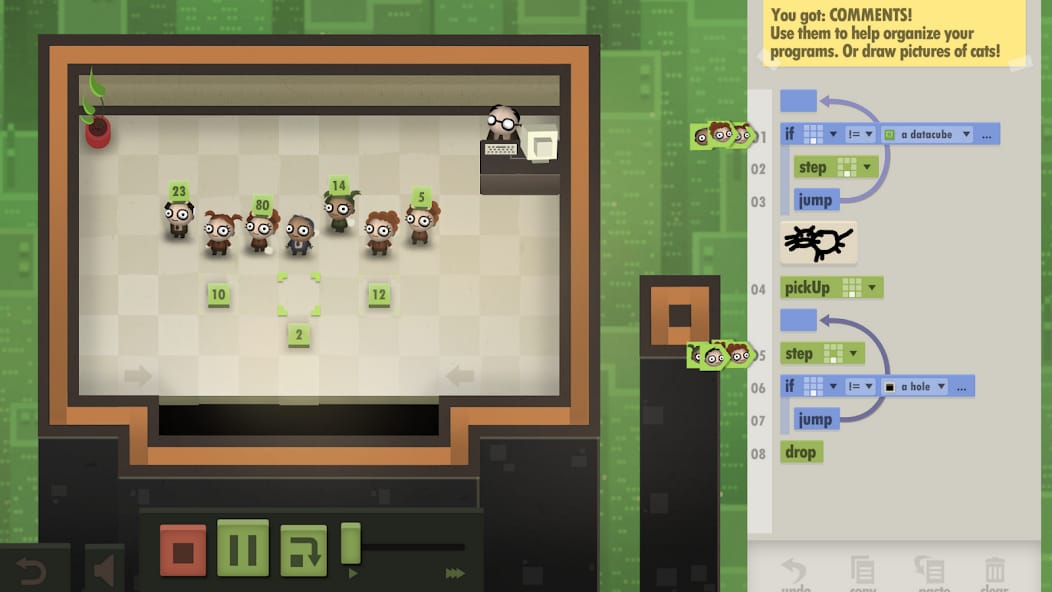
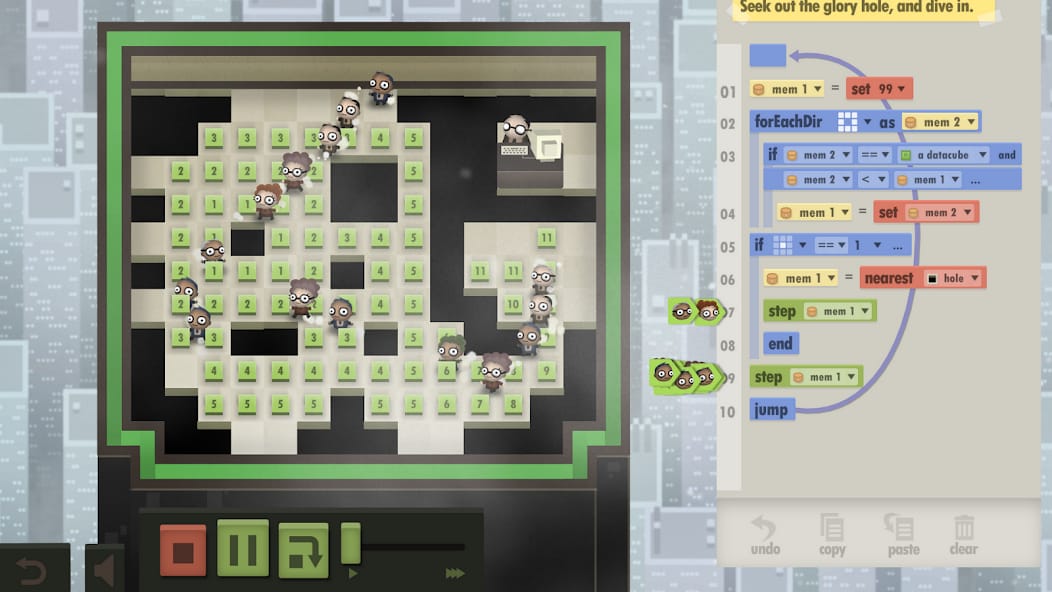
The game’s programming interface is deceptive. It looks like a friendly drag-and-drop system, but it forces you to think in a way that is profoundly unnatural for most humans: SIMD (Single Instruction, Multiple Data). Every worker on the floor is reading the same script. If you tell them to "Step North," they all step North. But what if one is blocked by a wall? What if one is standing on a data cube and the others aren't? This is where the sensory commands come in. You aren't just giving orders; you are writing "if/then" statements based on the worker's immediate environment.
The brilliance lies in the spatial sensors. Workers can look at their neighbors or the floor beneath them. Success requires you to write code that is robust enough to handle different starting positions and varying environmental layouts. You aren't just solving a puzzle; you are building a generalized algorithm. When your code finally clicks—when sixty workers move in a synchronized ballet to sort numbered cubes from lowest to highest—it provides a dopamine hit that few games can match. It feels like you’ve successfully tamed a riot.
The Friction of Automation
However, the experience isn't without its "onboarding friction." Tomorrow Corporation hasn't softened the blow for newcomers. The difficulty curve is less of a slope and more of a series of jagged cliffs. By the time you reach the midpoint, the game expects you to understand complex concepts like pointers and recursive-style loops without ever using those words. For a seasoned programmer, this is a delightful playground. For a casual fan of Sudoku, it might feel like being thrown into a deep-end pool filled with sharks that only speak C++.
The interface, while clean, can become a liability when scripts grow long. Dragging a block of code from the bottom of a sixty-line script to the top is a chore. A "copy-paste" or "grouping" mechanic would have gone a long way in reducing the manual labor of, well, simulating manual labor. There is an irony in a game about automation requiring so much repetitive clicking to reorganize your logic.
Narrative as Motivation
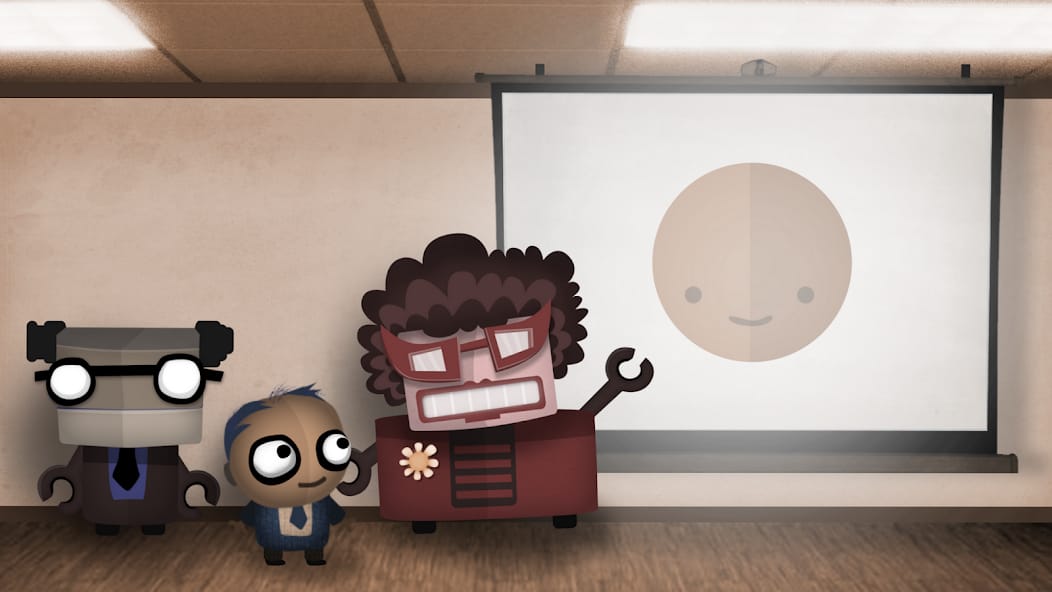
What keeps you going through the more punishing levels is the humor. The cutscenes are brief but punchy, maintaining that signature Tomorrow Corporation "grim-whimsy." The workers are cheerful in their uselessness, and the elevators—the game's version of a level-select screen—are filled with bureaucratic nonsense that perfectly captures the absurdity of the modern workplace. It isn't just window dressing; it provides a necessary emotional counterweight to the cold, hard logic of the puzzles.