Overview
Some games sell you a fantasy. A House of Many Doors sells you a job description: explorer, poet, and spy. You are all three at once, piloting a kinetopede — a walking, mechanical train — across a dead void called the House, a parasite dimension that reaches into other worlds and steals people, objects, and whole cities, then leaves them to rot in the dark.
That premise alone tells you what kind of game this is. It is weird fiction, unapologetically. Developer Pixel Trickery wears its influences on its sleeve — this is a game raised on Failbetter’s Sunless Sea, weaned on Planescape: Torment, and fluent in the grammar of China Miéville and the New Weird. It is not trying to be for everyone, and it knows it.
Market-wise, this sits in a well-defined but crowded niche: the literary survival-exploration RPG, where the real combat is with your own dwindling resources and your own patience. The game’s reputation rests squarely on the prose — this is a game people finish and then quote to their friends.
What makes it interesting as a product is how much it asks of you. There is no comfortable onboarding ramp. You are handed a broken train, a crew of dysfunctional oddities, and a text engine deep enough to drown in. The systems — fuel, hull integrity, crew sanity — are lifted from the survival-sim playbook, but they exist mostly to give the writing stakes. Everything mechanical here is in service of the words. Whether that trade lands depends entirely on how much you love to read, and how much tedium you’ll forgive to keep reading.
Key features
- A 300,000-word branching narrative: The core draw. A sprawling text story with genuine literary ambition, deep companion quests, and faction politics that reward curiosity over completionism.
- The kinetopede: Your walking mechanical train and mobile home base. You manage fuel, hull integrity, and crew sanity as you cross the void — the resource loop that keeps the stakes real.
- FTL-style real-time-with-pause combat: You manually station a bizarre crew — humans, sharkmen, and stranger things — to man defenses, patch breaches, or board enemy vessels.
- Procedural poetry generation: You literally write verse about your travels to earn a living. A mechanic-as-metaphor that few other games have attempted this seriously.
- Hand-drawn art and an original soundtrack: A distinct, haunting aesthetic that carries the mood between story beats.
Analysis
The Gameplay Loop
Strip away the atmosphere and the structure is familiar to anyone who has played Sunless Sea: you leave a safe port, you burn fuel crossing a hostile map, you arrive somewhere strange, you read, you decide, you profit or you bleed, you limp home to resupply. Repeat. It is a loop built on anticipation — the thrill isn’t the destination, it’s not knowing what the destination will do to you.
When that loop sings, it’s very good. Each location is a self-contained short story with real consequences, and the branching writing is smart enough that choices feel authored rather than sampled from a menu. The companion quests are the standout. These aren’t fetch errands with a portrait attached; they’re character studies, and the crew’s dysfunction is the point. You are not commanding a competent starship. You are babysitting a floating asylum, and the game is honest about it.
The poetry system deserves its own paragraph, because nothing else in the medium works quite like it. You compose verse — assembling lines about your experiences — and sell it to survive. It’s economy as literature. It could have been a gimmick. Instead it’s the thesis of the entire game rendered as a mechanic: in a dimension that steals everything, meaning is the only renewable resource. That is a genuinely original idea, and it’s executed with wit.
Where the Loop Grinds
Here’s the honest part. The space between those strong locations is where the game asks the most of its players. Traveling across the void is slow, and the map is deliberately empty. That emptiness is thematically defensible — the House is a wasteland — but design intent doesn’t make the minute-to-minute experience less tedious. The loop demands real stretches of time watching a mechanical bug trudge through darkness toward the next paragraph worth reading. It’s onboarding friction stretched across the whole runtime.
The Combat Problem
The real-time-with-pause combat has a difficulty curve shaped like a ski jump. Early on it’s punishing — under-crewed, under-armed, and juggling positioning while breaches open and sanity frays. Lose a key crew member early and the whole run can spiral. Then, somewhere in the mid-to-late game, the tension evaporates. Once the kinetopede is upgraded and the crew-management rhythm learned, encounters stop being decisions and start being formalities. The system never finds a stable middle where it’s consistently engaging. It’s either white-knuckle or a rubber stamp, rarely the interesting thing in between.
That inconsistency matters because combat is the one system asking for mechanical mastery in a game otherwise about reading and choosing. When it’s trivial, it becomes another stretch of empty void between the writing — a speed bump, not a challenge.
Visuals & performance
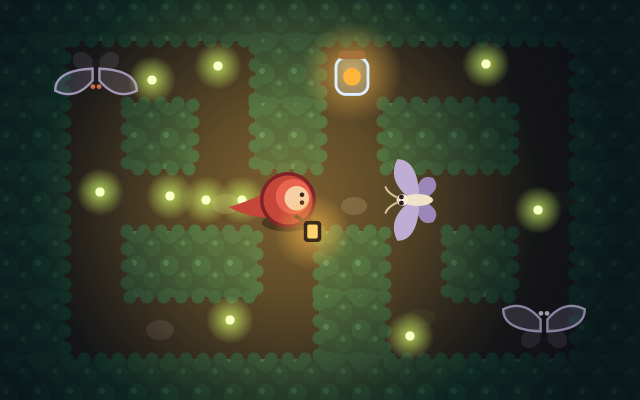
The hand-drawn art is a real achievement, especially for a small studio. It’s illustrative and slightly grotesque in the right way, giving the House a storybook-gone-wrong quality that matches the prose. The soundtrack is the quiet hero — melancholy, atmospheric, and doing an enormous amount of work to make the empty travel bearable. Turn it up.
The UI is functional rather than elegant. It’s dense, text-forward, and clearly built to serve information over beauty — which is defensible for a game this reading-heavy, but it’s built for small menus and gets unfriendly for newcomers hunting for what a screen means. As a 2D indie title of this scope, it’s light on hardware demands; you’re not buying this for the technical showcase, and it doesn’t pretend otherwise.
Platform nuances
On Steam, this is a keyboard-and-mouse game through and through, and it’s better for it. The interface is built for a cursor — clicking through branching text, dragging crew to stations during combat, managing menus. That pointer precision helps during the real-time-with-pause encounters, where you’re repositioning bodies under mild time pressure.
This is a sit-down, lean-in experience, not a lean-back one. It rewards a proper monitor, a quiet room, and attention. It is emphatically not a game for second-screen half-focus — the writing demands you actually read it, and the payoff evaporates if you skim. Steam’s cloud saves and the ability to alt-tab and breathe between story beats fit the pacing well.
Final verdict
A House of Many Doors is a flawed gem, and both words count. The writing is among the best in the genre — inventive, funny, haunting — and the poetry mechanic is the kind of swing-for-the-fences idea that makes the independent games scene worth watching. Pixel Trickery made something that could only exist as a game, and only as this game.
But the void between the brilliance is real. The slow travel and the seesawing combat are the price of admission, and it’s a price not everyone should pay. If you need your systems tight and your action balanced, the friction will wear you down before the story wins you over. If you’re here for the words, those flaws shrink against a singular experience on Steam. Bring patience. It pays out in poetry.
Reviewed by the Rankeno RPG & Adventure Desk. Scores are out of 10; the overall score is the desk’s editorial judgement, informed by the four sub-scores above. How we review