
Overview
Most driving games are about arriving first. Absolute Drift is about never quite arriving at all.
Funselektor Labs — the small Canadian outfit that would later refine this same austere design language into art of rally — built this game around a single, stubborn idea: the drift is not a technique you use to win a race. The drift is the game. There are no opponents on the track. There is no finish line to sprint toward. There is a car, a top-down camera, an empty white expanse of asphalt, and the question of whether you can hold a slide through a corner without touching a wall, spinning out, or losing your nerve on the throttle.
This is a deliberately narrow product in a genre that has spent two decades getting wider. Where Forza Horizon buries drift scoring inside an open-world buffet of collectibles, seasonal events, and licensed metal, Funselektor stripped everything else out. Six cars. 34 hand-designed levels. Three event types — Driftkhana, Drifting, and Mountain Drifting. Five free-roam zones themed as airports, docks, industrial yards, and a floating metropolis. That’s the whole menu, and it hasn’t changed since launch.
The market positioning is unusual and, frankly, smart. Absolute Drift sits on the same shelf as Trials, Super Hexagon, and Threes — the score-attack skill-box, sold cheap, priced to be an impulse buy and engineered to be a years-long habit. The Zen Edition update, now bundled into every current release, softened some of the game’s original hostility with an expanded tutorial, custom drift-line challenges, five night-time “midnight” events, and better controller support. It did not, however, make the game easy. Nothing was ever going to do that.
The reception suggests the approach works. The iOS build holds 4.6 out of 5 from 714 ratings — years of consistent word-of-mouth for a game with no marketing engine behind it, which tells you the loop holds up.
Key features
- The Drift Physics Model: Throttle, handbrake, and counter-steer operate as three independent, continuously-modulated inputs. You are not holding a turn button. You are managing a controlled loss of traction, moment to moment, with enough input granularity to punish sloppiness at any point in a five-second slide.
- Three Event Types Across 34 Levels: Driftkhana is a tight technical playground of cones and gates. Drifting is the score-multiplier discipline on closed circuits. Mountain Drifting is a downhill run against gravity and hairpins, and it’s where the game’s difficulty ceiling actually lives.
- Five Free-Roam Zones: Airport, docks, industrial, and a floating metropolis, each seeded with hidden challenges and unlockables. These are the game’s exhale — no timer, no scoreboard, just space to practice.
- Leaderboards, Replays, and Ghost Cars: The real endgame. You race your friends’ best runs as translucent ghosts, or chase world-record lines, and the replay system turns every failure into a diagnostic tool.
- Six Tunable Cars with Liveries: Cosmetic customization plus meaningful tuning as you climb the apprentice-to-master progression.
- The Presentation: Flat white geometry with a single accent color, and a lengthy drum & bass and electronic soundtrack that carries more of the emotional weight than most AAA orchestral scores.
Analysis
The Gameplay Loop
The loop is brutally simple and hard to walk away from: enter a level, initiate a drift, hold it, link it into the next corner, watch the multiplier climb, and then — nine times out of ten in the early hours — clip a wall and lose all of it.
That last part is the design’s load-bearing wall. The score doesn’t bank until you finish clean. A 40-second chain of perfect linked slides evaporates the instant your rear quarter-panel kisses a barrier. This is a punitive structure, and it’s the right call. It transforms every run from an accumulation exercise into a tension curve. The longer you hold, the more you have to lose. Score-attack games live or die on whether they can manufacture stakes out of nothing, and Absolute Drift manufactures them out of a wall you can see coming from four seconds away.
What makes the physics compelling — and what makes the early hours miserable — is that the car does not want to help you. Modern arcade racers are full of invisible assists: snap-to-line steering, drift angles that self-correct, forgiveness baked into the collision model. Funselektor removed nearly all of it. Your car has weight, momentum, and a genuine tendency to snap into a spin if you overcook the counter-steer. Getting a clean transition — flicking the car from a left-hand slide into a right-hand slide without losing angle — requires you to be ahead of the vehicle, feathering throttle before the rotation happens, not reacting after it does.
This is a real skill, learned the real way, and there’s no shortcut. The game does not scale to you. You scale to it.
The Onboarding Problem
Here is where the praise has to stop. The tutorial is the weakest thing in the box, and even the Zen Edition’s expanded version doesn’t fully solve it.
The game explains its inputs. It does not explain its technique. It tells you the handbrake initiates a drift; it does not adequately teach you that throttle modulation controls your drift angle, or that counter-steer is a continuous correction rather than a discrete action, or why the car keeps snapping around at what feels like random. That gap is the single most common reason people bounce off in the first hour.
The frustrating part is that this is a solvable problem. A slow-motion diagnostic overlay on failed runs, or a guided drift-line trainer with real-time input feedback, would have converted a meaningful chunk of the players who quit at level five. The Zen Edition’s drift-line challenges gesture at this but arrive as content, not as instruction.
Once it clicks — and for most players it eventually does — the character of the game inverts completely. The thing that felt hostile becomes hypnotic. The white void stops reading as sterile and starts reading as focus. Players describe it as meditative, and that’s not marketing copy; it’s what happens when a difficult motor skill becomes automatic and the conscious mind is freed up to just watch the line.
Interface and Progression
The UI matches the art direction: flat, sparse, minimal chrome. Menus are clean and get out of the way fast, which matters enormously in a game built on rapid retry loops. Restarts are built to be instant, with no loading screen standing between a failure and the next attempt — in a game built on repeated failure, that single design decision is worth more than any feature on the box.
Progression is the softest part of the design. Unlocking cars and cosmetics gives structure to the early hours, but the tuning options are shallow enough that they read as flavor rather than strategy. Nobody finishes this game because they wanted the sixth car. They finish it because a stranger on the leaderboard beat their Mountain Drifting time and that is now a personal matter.
Longevity
The leaderboards, ghosts, and replays are the actual product. The 34 levels are a tutorial for the infinite game that starts after them. If you’re the kind of player who bounces off a title once you’ve seen all the content, expect a modest run. If you’re wired for optimization, this is a game you keep installed for years and reopen whenever you need twenty minutes of total absorption.
Visuals & performance
The art direction has aged better than most of the games released alongside it, and the reason is that it was never chasing fidelity in the first place.
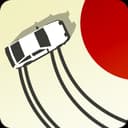
Everything is white. Tracks, buildings, barriers, terrain — a flat monochrome plane, punctuated by a single saturated accent color on your car and the smoke trailing behind it. It’s a design decision with real functional payoff: your drift line is the only visually interesting thing on screen, so your eye tracks it perfectly. Tire smoke becomes a readable, real-time diagram of what your car is doing. That’s not decoration. That’s information design, and it’s clever.
The night-time “midnight” events from Zen Edition invert the palette and prove the system is flexible enough to carry a mood shift without a single new asset type.
The soundtrack deserves separate billing. Drum & bass and electronic production, tempo-matched to the game’s rhythm, and it does something unusual — it makes failure feel less like failure. The music doesn’t stop when you spin out. It just keeps rolling, and you restart, and you’re back in the pocket. Games with punishing retry loops usually fight their own audio design. This one leans on it.
Performance is a non-issue by design. A flat, 2D top-down game of this scope is light on hardware, and it should run comfortably on devices that would choke on almost anything else in the racing genre. On mobile, that translates into a battery profile suited to a commute.
Platform nuances
This is the section that should determine which version you buy, because the platforms are genuinely not equivalent.
Steam is the definitive edition. Full analog gamepad support, high frame-rate headroom, the fastest access to leaderboards and ghost data, and mod-adjacent community activity. Pair it with an Xbox or DualSense controller and you get the full resolution of the input model — analog triggers giving you the throttle granularity the physics were designed around. Keyboard is playable and some leaderboard chasers swear by the binary precision of it, but it fights the design.
Nintendo Switch carries the platform’s one significant caveat: the Joy-Con triggers are digital, not analog. There is no partial throttle. You get on or off, which strips out the single most important variable in fine drift-angle control. The game remains fully playable and the Zen Edition’s controller improvements help, but you’re competing on leaderboards with one hand tied. Pro Controller doesn’t fix this — it has the same digital shoulder buttons. If Switch is your only option, factor in a harder climb.
iOS and Android deliver a competent touch adaptation, and the 4.6/5 iOS rating suggests Funselektor didn’t phone in the port. But touch is touch. Screen-space controls give you less positional feedback than a stick, your thumbs occlude part of a game that depends on reading the road ahead, and precision at the high end of the skill curve suffers. Mobile is well suited to the free-roam zones and the meditative side of the experience. It is not where you set a world record. Both platforms support external controllers, and if you’re serious, use one.
Final verdict
Absolute Drift is years old and still has almost no direct competition, which is a strange thing to say about a driving game. Nobody else has been willing to make something this narrow. Funselektor bet everything on the proposition that a single mechanic, tuned properly, could sustain a full product — and the lasting word-of-mouth says the bet paid.
What holds it back from a higher tier is entirely a communication failure, not a design one. The physics are strong. The teaching is not. There’s a version of this game with a real diagnostic trainer that would convert every frustrated quitter into a devotee, and the Zen Edition got close without closing the gap. That’s a shame, because the players who bounce off in hour one never find out how good it gets once the skill becomes automatic.
We rate it a solid buy for the right audience — score-attack players who will live on the leaderboards. Buy it on Steam if you can. Buy it on mobile if you want the meditative version in your pocket. Buy it on Switch knowing you’re playing with a handicap the hardware imposed, not the developer. And when you spin out for the fortieth time in Mountain Drifting, understand that this is the game working exactly as intended.
Stay on the throttle. Trust the counter-steer. It clicks.
Reviewed by the Rankeno Strategy & Sim Desk. Scores are out of 10; the overall score is the desk’s editorial judgement, informed by the four sub-scores above. How we review