Bottom Line: Bitburner is a brutal, brilliant subversion of the idle genre that demands actual JavaScript proficiency instead of just a fast clicking finger. It is less of a game and more of a terminal-based baptism by fire.
Bitburner’s greatest achievement is how it transforms the mechanics of engineering into the core gameplay loop. In a standard idle game, the primary friction is time; you wait for a bar to fill up so you can buy a thing that makes the bar fill faster. Bitburner introduces a secondary, more rewarding friction: optimization.
The Scripting Paradigm
The "Aha!" moment in Bitburner occurs when you realize that your manual hack command is an embarrassing waste of time. You start with a basic script that weakens a server, grows its cash reserves, and then hacks it. But soon, you’re calculating the exact ratio of weaken, grow, and hack threads to ensure the server’s security level never rises and its money never bottoms out. You move from running a single script to deploying a "manager" script that scans the entire network, copies your payload to every vulnerable machine, and executes it with maximum thread density based on available RAM. This isn't just "numbers go up"; it is an exercise in distributed computing.
The Interface and Onboarding
The interface is a unapologetic terminal. If you’ve ever spent time in a Linux bash shell, you’ll feel at home. If you haven't, the onboarding friction is significant. The game expects you to learn how to navigate directories, use nano for editing files, and understand the difference between an argument and a variable. This initial wall of text and syntax errors is the game's primary filter. It is an honest representation of the subject matter. The game doesn't hold your hand; it provides a comprehensive API documentation and expects you to read it.
Deep Systems Integration
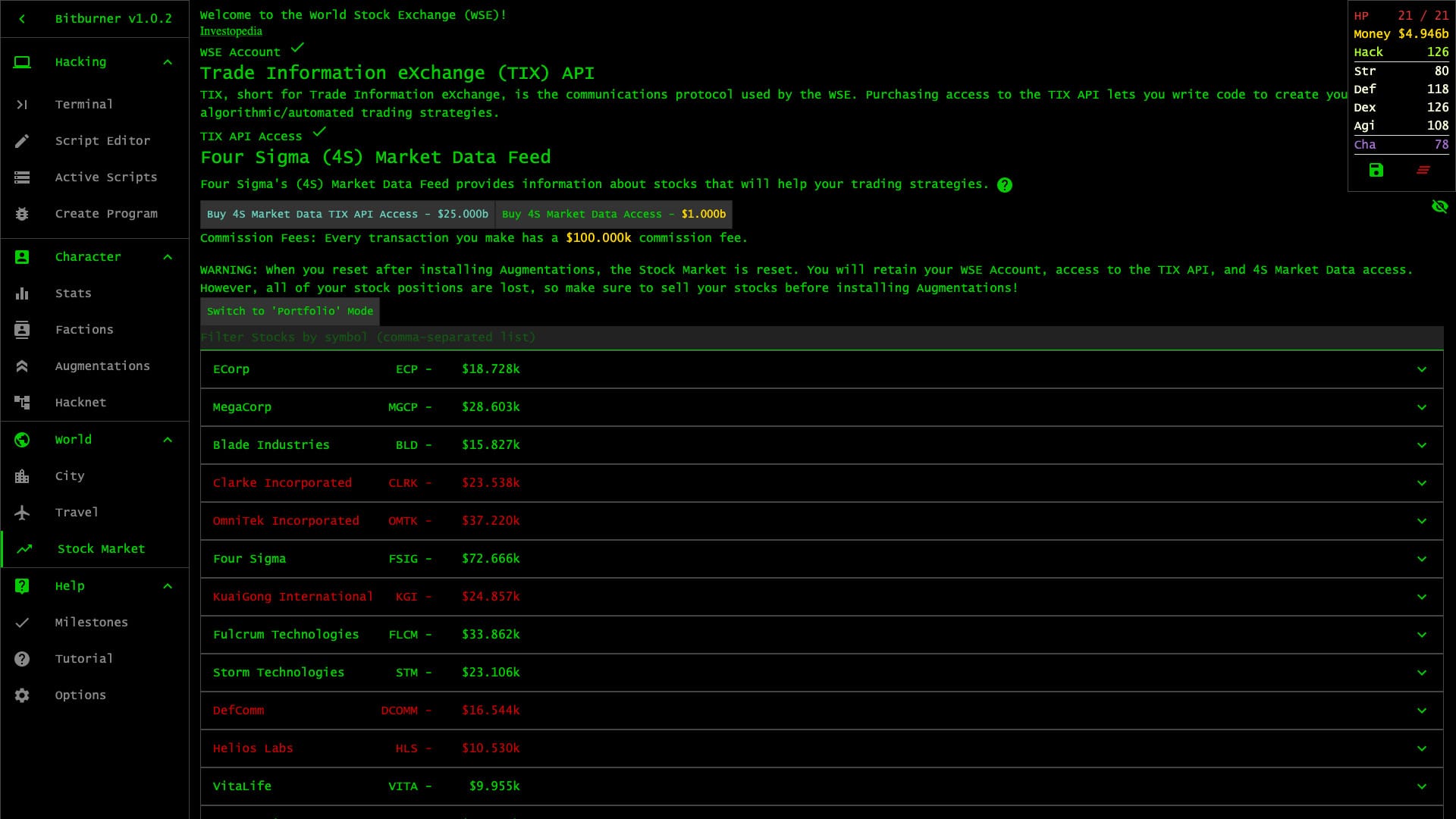
As you progress, the game layers on complexity that would be overwhelming if it weren't so logically integrated. Joining factions requires specific "karma" or stat requirements, leading to unique scripts designed to grind reputation. The stock market isn't just a side-hustle; it’s a data-mining challenge where you can write scripts to monitor price trends and execute trades based on moving averages. The late-game introduces "BitNodes," which are essentially different realities with unique rules—some might nerf hacking income but buff the stock market, forcing you to completely rewrite your library of scripts to adapt to the new paradigm.
This creates a sense of intellectual ownership that few games achieve. When you return to the game after being "away" for eight hours and see that your bank account has exploded, you don't feel lucky. You feel like a genius because your code worked. You optimized the logic, you handled the edge cases, and the results are the direct consequence of your architectural decisions.