

Overview
In a digital ecosystem often oversaturated with ephemeral time-wasters and microtransaction-laden distractions, Card Thief, developed by indie creator Arnold Rauers, emerges as a stark, compelling counter-narrative. This is not a game designed for passive consumption; it demands engagement, foresight, and a willingness to learn its intricate language. Positioned firmly within the niche of mobile roguelikes, Card Thief skillfully fuses the strategic depth of a deck-builder with the nail-biting tension of a stealth game, all presented in a compact, solitaire-like format.
At first glance, one might dismiss it as a simple card game, a digital diversion for a few idle moments. Yet, beneath its minimalist facade lies a profoundly complex system of interlocking mechanics. Players assume the mantle of a shadowy pilferer, navigating a dynamic 3x3 grid of cards. Each card represents an environmental element—torches to extinguish, guards to circumvent, loot to snatch, or the coveted treasure itself. The market positioning of Card Thief is unique: it appeals both to casual players seeking short, impactful heists lasting only a few minutes and hardcore strategists who revel in optimizing every move for leaderboard dominance. Its offline playability on iOS and Android makes it an ideal companion for the modern, on-the-go technophile. This is a carefully crafted digital puzzle box, proof of thoughtful design in a market full of disposable apps. Rauers has delivered a product that doesn’t just entertain; it challenges, it rewards, and it lingers in the mind long after the screen has dimmed.
Key features
- Solitaire-Style Stealth Gameplay: Navigates a 3x3 card grid, blending strategic card play with stealth mechanics like extinguishing torches and pickpocketing.
- Deep Customization & Replayability: Features multiple unique heists, a roster of unlockable and upgradable equipment cards, and a set of distinct thieves, each with special abilities.
- Mini Deck-Building Mechanics: Players construct a small, adaptable deck of equipment cards to synergize with chosen thieves and heist objectives.
Analysis
The brilliance of Card Thief lies in its seemingly simple premise masking an extraordinary depth of strategic possibility. The game’s gameplay loop is a constant, exhilarating tightrope walk between risk and reward. Each move on the 3x3 grid is about managing stealth points, predicting guard movements, and maximizing loot while minimizing exposure. Extinguishing a torch reduces visibility, but the card is then removed, altering the board state. Pickpocketing a guard yields treasure points, but often at the cost of stealth, making subsequent moves more perilous. This perpetual push-and-pull creates a dynamic tactical environment where no two runs ever feel identical.
The strategic depth is further amplified by the innovative “mini deck-building” element. The unlockable equipment cards are not mere stat boosts; they are fundamental modifiers that can radically alter optimal strategies. A “Sneakers” card might grant extra stealth, enabling bolder maneuvers, while a “Lockpick” could open up new paths to treasure. The true mastery comes in understanding how these equipment cards synergize with the distinct thieves, each endowed with unique abilities. One thief might excel at direct confrontation (a risky proposition in a stealth game), while another might specialize in escaping detection. This system encourages experimentation, demanding players not only adapt to the board but also to their chosen thief and loadout, fostering a truly roguelike experience where failure is merely a stepping stone to a deeper understanding of the mechanics.
The game does present a steep learning curve. New players will inevitably fumble through early heists, their carefully laid plans unraveling under the watchful gaze of virtual guards. This initial friction might deter some, yet for those who persevere, the game transforms into a highly addictive and rewarding endeavor. The gradual mastery of its systems, the subtle tells of card interactions, and the nuanced understanding of stealth point management provide a genuine sense of accomplishment. Successfully pulling off a complex heist, chaining together moves with surgical precision, should feel like a genuine intellectual victory. The Daily Heist mode, complete with global leaderboards, provides a competitive outlet for seasoned players, extending the game’s longevity far beyond its initial offering. It’s an ecosystem of emergent strategy, where every decision carries weight, and every successful escape is hard-earned. The game doesn’t hold your hand; it equips you with tools and challenges you to become the master thief it knows you can be.
Visuals & performance
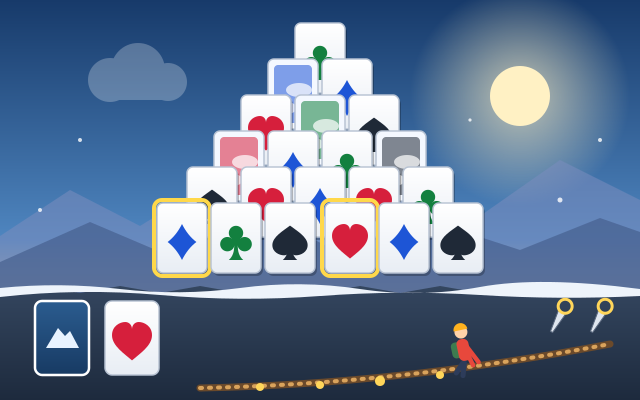
Card Thief distinguishes itself immediately with its distinctive dark storybook art style. The style is an integral part of the game’s identity. The charming paper-puppet-like characters possess an almost tangible quality, imbuing the otherwise abstract card grid with personality. Guards shuffle across the screen with a delightful, almost stop-motion animation, and the flicker of torchlight casts dynamic shadows, enhancing the stealth illusion. The UI is clean, functional, and intuitive, prioritizing clarity without sacrificing aesthetic appeal. Information is presented concisely, allowing players to focus on strategic decisions rather than parsing cluttered menus. As a turn-based card game of modest visual scope, it is inherently light on hardware, and its design demands precise, unhurried input rather than raw processing power. This visual identity, paired with the game’s modest technical demands, makes it well suited to a wide range of mobile devices.
Platform nuances
As a mobile-first title, Card Thief is built for both iOS and Android. The touch controls are perfectly suited to the game’s grid-based, turn-by-turn nature. Tapping a card to move, extinguish a torch, or interact with an object maps naturally onto the format, as if the digital cards were physical objects. The short play sessions are ideally aligned with the demands of mobile gaming—perfect for commutes, waiting rooms, or quick breaks. The game’s design inherently minimizes onboarding friction for mobile users, as its core mechanics are easily graspable through tactile interaction, even if mastering the strategy takes time. This is a game that feels native to the mobile platform, leveraging its strengths rather than merely porting a desktop experience.
Final verdict
Card Thief is a puzzle to dissect, a system to learn to exploit, and a rewarding challenge to repeatedly conquer. Arnold Rauers has delivered a masterstroke of mobile design, proving that immense depth and replayability can thrive within a seemingly constrained format. We rate it among the very best of its kind: an essential title for anyone seeking a sophisticated, engaging, and utterly unique stealth-card experience on their mobile device.
Reviewed by the Rankeno Puzzle & Casual Desk. Scores are out of 10; the overall score is the desk’s editorial judgement, informed by the four sub-scores above. How we review