


Bottom Line: A hypnotic, razor-sharp puzzle disguised as a massacre. It’s a masterclass in mechanical minimalism that proves one bullet is more than enough to dismantle a cult.
The Geometry of Violence
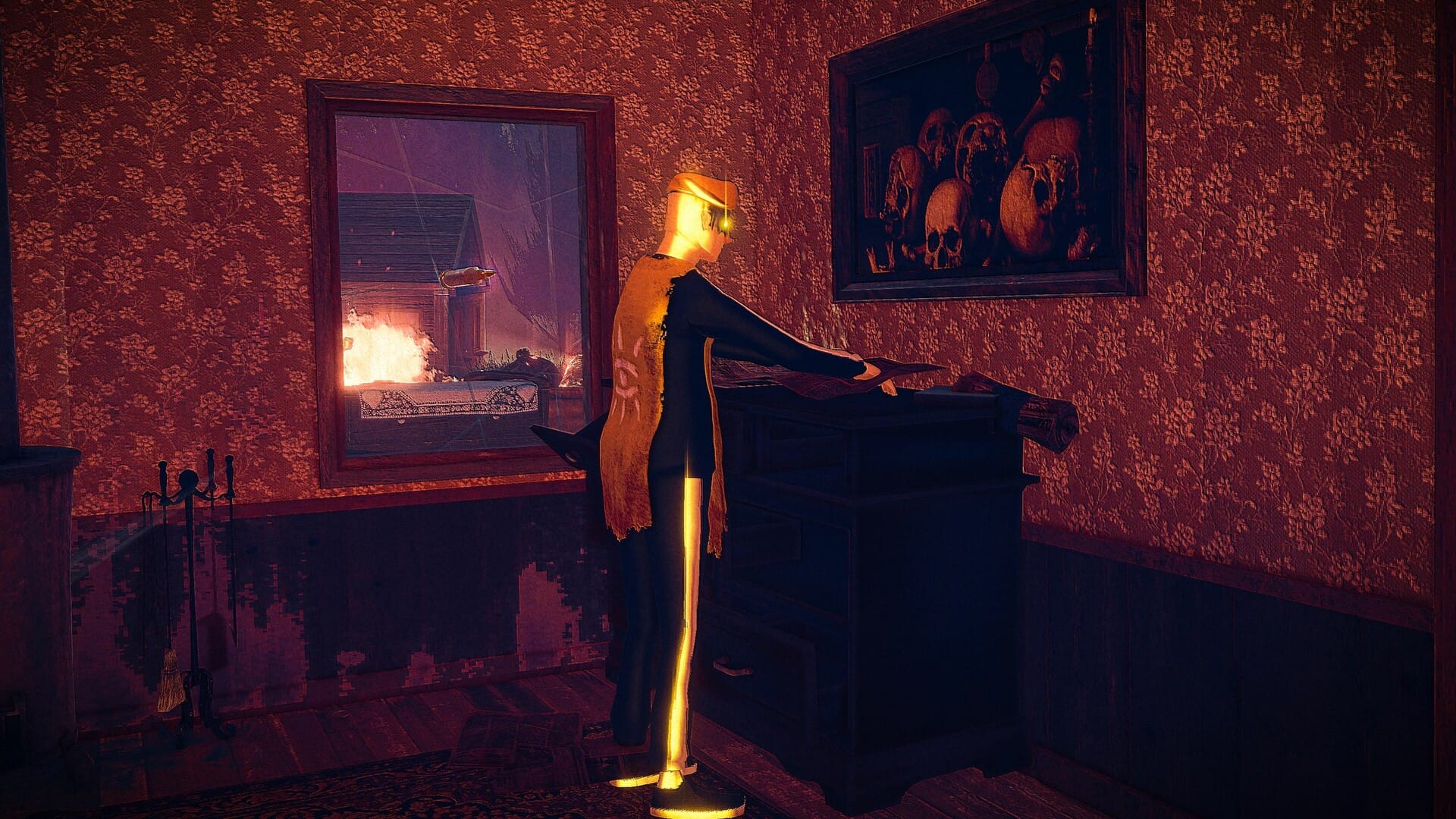
Most shooters treat bullets as disposable resources. In Children of the Sun, the bullet is your avatar. The gameplay loop is less about twitch reflexes and more about pathfinding. You aren't just shooting; you are drawing a continuous line through a three-dimensional space, where every node on that line is a human life. The satisfaction doesn't come from the kill itself, but from the realization that your planned trajectory—the one you spent three minutes scouting—actually works.
When the bullet hits a target, the world freezes. This pause is the heartbeat of the game. It’s where the "tactical" part of the tactical shooter label really lives. You have to account for line-of-sight, environmental hazards (like gas tanks), and the movement patterns of enemies who might be wandering in and out of your reachable zones. The game forces you to treat the environment as a series of interconnected points. Can I hit that cultist through the window, use his body to pivot toward the bird flying overhead, and then use that height to dive-bomb the armored guard in the courtyard? That’s the constant internal monologue.
Mastery Through Manipulation
As the difficulty spikes, the game introduces mechanics that elevate it from a simple "connect-the-dots" exercise into something far more fluid. The curving mechanic is particularly transformative. Being able to bend a bullet around a corner or over a wall mid-flight adds a layer of "kinesthetic" satisfaction that few games capture. It stops being a static puzzle and starts feeling like you are conducting a morbid orchestra.
The introduction of armored enemies and varying enemy types ensures that the "one-bullet" constraint never feels like a gimmick. You have to learn how to manipulate the bullet's velocity. Hitting certain targets builds up power, allowing you to accelerate the projectile to a point where it can punch through reinforced glass or heavy plate. This adds a layer of resource management within the pathfinding itself. You have to kill the "easy" targets first to build the momentum needed for the "hard" ones. It’s a brilliant way to dictate the order of operations without explicitly telling the player what to do.
The Replayability Trap
While the narrative campaign is relatively short—you can see the credits in under four hours—the real meat of the game lies in its scoring system. This is where René Rother taps into the competitive "speedrun" culture. Every level tracks your efficiency, the distance traveled by the bullet, and how quickly you executed the sequence. Online leaderboards turn every puzzle into a challenge for optimization.
However, this focus on high scores highlights the game’s primary limitation: if you aren't the type of player who cares about being #422 on a global leaderboard, the experience might feel fleeting. The minimalist storytelling—told through surreal, wordless cutscenes—is effective at setting a mood, but it doesn't provide much of a "hook" once the mechanical curiosity is satisfied. You are here for the loop, not the lore. Fortunately, the loop is addictive enough to sustain several sittings of obsessive "one-more-try" gameplay.