Overview
Amanita Design has spent nearly two decades as the arthouse conscience of adventure gaming. Machinarium, Botanicula, the Samorost trilogy—these are games you recommend to people who “don’t play games,” the ones that end up in design school lectures and museum exhibitions. They are also, almost uniformly, point-and-click affairs: static screens, clickable hotspots, gentle logic. Creaks is the studio’s first real departure from that formula, and that alone makes it worth a look.
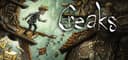
Here the player gets direct character control. A nameless, pajama-clad protagonist moves through a surreal subterranean mansion discovered behind a wall in his bedroom after a tremor cracks it open. Down he goes, into a vertical warren of rooms populated by two species: the hostile, luminous-eyed Creaks of the title, and a race of gentle avian humanoids whose story is pieced together entirely through observation. Nobody speaks. There is no text, no tutorial pop-up, no quest log. Amanita trusts the player to figure it out, and that trust is the game’s defining posture.
The hook is pareidolia—the brain’s habit of seeing faces and figures in random shapes. Catch a Creak in a beam of light and it instantly locks into an inanimate household object: a bedside table, a coat rack, a globe. Kill the light and it reanimates, hunting again. Every puzzle spins out of that single reversible transformation.
Released July 10, 2020 at $2.99 as a premium, one-time purchase with no microtransactions and no live-service scaffolding, Creaks knows its lane. This is a compact single-player experience aimed squarely at players who want craft over content volume. In a market bloated with 100-hour open worlds and battle passes, that focus reads as confidence, not limitation.
Key features
- The Light-and-Furniture Mechanic: Creaks freeze into furniture in light and reanimate in darkness. The player weaponizes this—dropping a monster into a beam to create a climbable step or a weighted platform, then cutting the light to send it tumbling onto a switch. It’s the whole game, and it’s enough.
- Behavior-Driven Enemy Design: Enemies chase, mimic, or patrol, and each demands a different read. The puzzles aren’t about reflexes; they’re about learning temperaments and exploiting them.
- Wordless Environmental Storytelling: A hand-painted world that narrates itself through animation, staging, and the occasional interactive wind-up painting—optional mini-games that double as the closest thing to lore on offer.
- Adaptive Score by Hidden Orchestra: A live, shifting soundtrack that swells and recedes as puzzles are solved, tightening the loop between action and atmosphere.
Analysis
The Gameplay Loop
Creaks is structured as a chain of single-screen puzzle rooms, each a self-contained logic box. Enter, assess, solve, descend. The grammar is deliberately narrow: climb ladders, flip switches, pull levers, ride platforms, and—crucially—reposition monsters by controlling where the light falls. That narrowness is the point. By refusing to pile on new verbs, Amanita forces depth out of combination rather than accumulation.
The design’s smartest choice: the monsters are tools and threat simultaneously. A Creak that kills on contact becomes, under a lamp, the exact end table needed to reach a high ledge. The tension between those two states—asset and hazard—is where the game lives. The constant question isn’t “how do I avoid this thing” but “how do I use this thing without it using me first.”
The enemy taxonomy does the heavy lifting. The chasers create urgency and force light placement under pressure. The patrollers are timing problems, predictable metronomes to slip past. The mimics—which copy the player’s movements—turn the screen into a mirror-logic riddle, some of the sharpest puzzles in the game. Understanding behavior is the puzzle. Once a creature’s rules are internalized, the solution often snaps into focus with that clean, satisfying click that separates good puzzle design from busywork.
Difficulty and Onboarding
Amanita’s no-text philosophy could have been a disaster. It isn’t. The game teaches through space. Early rooms introduce one idea in isolation, allow safe failure, and quietly widen the concept a screen later. There’s no hand-holding, but there’s no cruelty either—death returns the player to the start of the current room with no penalty beyond a few seconds. That generous failure state is essential; it lets each room function as a hypothesis to test rather than a gauntlet to survive.
Where the design strains is the back half. Once the core vocabulary is fully deployed, Creaks leans on variations of solutions already seen. The puzzles remain competent, but the sense of discovery flattens. The question stops being “what is this?” and becomes “which of the three things I already know does this want?” It never becomes tedious, but the curve plateaus when it should keep climbing. A tighter edit—trimming some of the middle-game repetition—would have left a sharper game.
The Narrative Question
The wordless story is beautiful and thin, and both those things are true at once. The avian humanoids, the looming central threat, the wind-up paintings that hint at a larger mythology—it’s evocative, atmospheric, and ultimately more mood than plot. Anyone coming to Amanita for the melancholy-whimsical worldbuilding of Machinarium may find Creaks emotionally cooler. The story is a frame for the puzzles, not the reverse. Set expectations accordingly and it delivers; expect a narrative payoff and the thinness shows.
Visuals & performance
This is where Creaks is strongest. The hand-painted art is dense, textured, and lit with real craft—every room looks like a plate from a darkly elegant children’s book that wandered somewhere it shouldn’t have. The animation sells the central conceit: the moment a snarling creature seizes into a globe is uncanny, and the trick holds up throughout.
The Hidden Orchestra score deserves equal billing. It’s not wallpaper. It reacts—layers dropping in and out as the environment is manipulated, so that solving a puzzle feels scored rather than merely soundtracked. Paired with the detailed sound design (the creaks, the clicks, the mechanical groans of the mansion), it achieves a sensory coherence few games reach.
Technically, this is a lightweight, screen-by-screen production with no open-world streaming to worry about—a 2D game of this scope is light on hardware, and the art direction, not a tech budget, is doing the work. That’s exactly the right call.
Platform nuances
Steam is the purist’s pick. Keyboard control maps cleanly to the deliberate, grid-adjacent movement, and a controller works just as well—arguably better, given the platforming DNA. On a large monitor, the painted detail shines.
Nintendo Switch may be the ideal home. This is a lean-back, low-stress puzzler, and it belongs in handheld mode on a couch or a train. The screen size flatters the art, and there’s no precision requirement that suffers from portable play. For Switch owners, that’s the version to get.
iOS is the compromise. Touch control on a puzzle-platformer that involves timed movement past patrolling enemies introduces real onboarding friction—a thumb occludes the very action being timed, and virtual d-pads are always a downgrade from physical input. The art shrinks, too. It’s playable and, on iPad, quite pleasant, but on a phone it’s the weakest way to experience an otherwise precise game.
Final verdict
Creaks is the sound of a studio stretching. Amanita took its signature atmosphere and craft, welded it to a mechanic that could have carried a game twice its size, and had the discipline to stop before wearing it out—mostly. The second-act repetition and the wispy story keep it short of the studio’s very best, but the ambition and the execution still carry it. It’s a confident, beautiful, clever game that respects the player’s intelligence and time. We recommend it to puzzle fans and art-game devotees; everyone else can wait for a sale. Turn on the lights. Kill the monster. Climb the furniture. Few puzzle games feel so wholly themselves.
Reviewed by the Rankeno RPG & Adventure Desk. Scores are out of 10; the overall score is the desk’s editorial judgement, informed by the four sub-scores above. How we review