Overview
Most post-apocalyptic games serve you the same cold gruel: brown deserts, laconic wanderers, a UI ripped from a decommissioned nuclear reactor. Death Trash wants none of it. This is a wasteland that oozes. Cosmic horrors hunger for humanity, and humanity answers with shotguns, bad attitudes, and — this is not a typo — the ability to vomit on command as a tactical maneuver.
The game is the work of essentially one person: Stephan Hövelbrinks, operating under the studio banner Crafting Legends. That matters. Death Trash is an auteur project, and it shows in every hand-painted screen. This isn’t design-by-committee sludge; it’s a singular, slightly deranged vision of body horror, punk defiance, and old-school RPG mechanics welded together. A solo-developer vision this strong leaves its personality bleeding through the pixels.
Positioning-wise, it lands squarely in the “immersive-sim-adjacent action-RPG” lane — think Fallout 1 and 2 filtered through Hyper Light Drifter‘s pixel craft, with a real-time combat layer bolted on top. It launched into Steam Early Access on August 5, 2021, at $19.99. The tension at the heart of any honest look at Death Trash is the long Early Access stretch with the story campaign unfinished. The bones are strong. The question is whether the skeleton ever got its full body of flesh.
Key features
- Reactive Multiple-Choice Dialogue: The heart of the game. You can talk, sneak, or fight through nearly every encounter. Branching choices carry consequences, and the writing is sharp enough to make you actually read it.
- Hand-Painted Pixel Art World: A semi-open wasteland traversed by world map, stitched together from organic, detailed, hand-painted locations. The aesthetic is grimy, alien, and unmistakably its own.
- Deep Skill & Character Building: Lockpicking, pickpocketing, stealth, ranged and melee combat — and the infamous “puking” skill. Character freedom is the point, not a footnote.
- Living Inventory (Fleshworms): You manage items and living Fleshworms, tied into a crafting system that leans into the game’s biological grotesquerie.
- Drop-In/Drop-Out Local Co-Op: Full-campaign splitscreen co-op, with a second player able to join or leave at any moment — a rarity for a story-driven RPG of this depth.
Analysis
The Gameplay Loop
Death Trash runs on a loop that older RPG fans will recognize in their bones. You arrive somewhere organic and strange. You talk to the locals. You unravel a problem. Then you decide how you want to solve it — with words, with a lockpick, with a shotgun, or with a well-aimed stomach.
That last option isn’t a joke. The puking ability is the perfect thumbnail for the whole design philosophy: this is a game that hands you unconventional verbs and trusts you to find uses for them. Distraction, disgust, area denial — bodily function as a legitimate tool in your problem-solving kit. It’s ridiculous, and it’s exactly the kind of texture that separates a designed world from a manufactured one.
Where Death Trash makes its boldest bet is the collision of old-school RPG depth with real-time action. Classic Fallout was turn-based and cerebral. Death Trash keeps the branching dialogue and stat-driven consequence but drops combat into real time — ranged, melee, stealth, all executed live. On paper, that’s the best of both: the reactivity of an immersive sim, the pace of an action game.
In practice, the seams show. The real-time combat is built to be twitchy and freeform, and that design reads as janky — imprecise, occasionally stiff, with pacing that stumbles between the meaty conversation systems and the fights. It’s not broken. But it’s the clear weak link in a chain of otherwise strong ideas, and it’s where the solo-dev scope shows its edges.
Choice and Consequence
The branching narrative is where Death Trash earns its Fallout comparisons honestly rather than aspirationally. Dialogue is multiple-choice and reactive — the world remembers, and your character build genuinely reshapes which doors open. High social skills unlock a pacifist route through encounters that a combat build would have to shoot through. This is the RPG dream a lot of games promise and few deliver: your character sheet as a lens on the entire story.
The catch, and it’s a big one, is completeness. For a long stretch of Early Access, the campaign simply ended before the story did. A choice-driven narrative game lives or dies on its payoff, and anyone who fell in love with the setup was left standing at the edge of an unfinished map. That’s not a bug you patch. It’s a structural risk of buying into any Early Access RPG, and Death Trash asked its audience to hold that faith for years.
Interface and Systems
The inventory, crafting, and Fleshworm management systems are more than window dressing — they feed the atmosphere. Managing living worms alongside your loot keeps the body-horror theme present even in menus. The systems are reasonably legible, though the sheer number of skills and interactions means there’s real onboarding friction for players who expect a modern game to hold their hand. Death Trash doesn’t. It expects you to experiment, fail, and figure out what “puking” is actually good for.
Visuals & performance
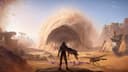
This is Death Trash’s strongest suit. The hand-painted pixel art is not retro nostalgia-bait; it’s a deliberate, detailed aesthetic that renders the wasteland as something organic and diseased. Locations feel drawn by a human hand because they were. The color work leans into sickly greens, meat-reds, and industrial grime, and the whole thing carries a dark, weird, cohesive atmosphere that far bigger studios routinely fail to conjure.
Technically, the design is light on hardware by nature: a 2D pixel-art game of this scope doesn’t demand much, and its text-and-menu-heavy layout suits handheld play. Cross-platform support across Windows, Mac, and Linux rounds out a technically responsible package. The real technical wart lives in combat’s occasional jank, not in the rendering.
Platform nuances
On Steam, Death Trash is in its natural habitat. Mouse-and-keyboard gives you precision for the ranged combat and quick navigation of dense dialogue trees — this is the setup for players who want to min-max their reads and their reactions. The game is designed to be played slowly and exploratorily, on the couch or in transit.
The standout platform feature is local splitscreen co-op across the full campaign. Drop-in/drop-out means a friend can grab a controller mid-session and bail just as freely. Couch co-op in a narrative RPG is a genuine rarity, and it’s the kind of feature that fits the game’s punk, communal spirit. Just know it’s local only — there’s no online co-op here, so your second punk needs to be in the same room.
Final verdict
Death Trash is what happens when one person refuses to make the safe post-apocalypse. It’s grotesque, funny, mechanically ambitious, and visually distinctive in a way that outclasses studios with a hundred times the headcount. The dialogue-driven RPG freedom is the real thing — a wasteland that bends to your character build instead of railroading you through it.
But ambition and completeness are different currencies, and for years Death Trash was rich in one and poor in the other. The combat jank is forgivable; the long-unfinished campaign is the harder pill. Buying an Early Access RPG means buying a promise as much as a product, and this one demands patience as well as curiosity.
We rate it a solid, flawed package: buy it for the art, the weirdness, and the writing, and go in knowing the combat stumbles. Death Trash doesn’t want to be your comfort food. It wants to make you flinch, laugh, and reach for the shotgun — and for the right audience, it delivers.
Reviewed by the Rankeno RPG & Adventure Desk. Scores are out of 10; the overall score is the desk’s editorial judgement, informed by the four sub-scores above. How we review