Overview
Space is lonely. Most games forget that. They fill the void with aliens to shoot, factions to appease, or a chatty crew that never shuts up. KeokeN Interactive remembered. Deliver Us The Moon casts the player as Earth’s last astronaut in a near-future where the planet has burned through its resources and pinned its survival on a lunar mining operation that has gone dark. No cavalry. No backup. Just a rickety launch and a silence that stretches the whole way home.
This is a small studio punching several weight classes above itself. KeokeN, a Dutch team, built something that reads like a AAA prestige project and plays like a tight, focused indie. That tension—big ambition, modest scope—defines the whole experience. The game slots into the “walking simulator plus” genre, sitting alongside titles like Tacoma and Firewatch, but it borrows the physicality of harder sci-fi. Think Interstellar by way of a mid-budget studio that clearly loves Kubrick and Christopher Nolan in equal measure.
The pitch is elegant: humanity founded the World Space Agency, secured a new energy source on the Moon, then lost contact. Someone goes to find out why. What follows is a short campaign of exploration, environmental puzzle-solving, and archaeological detective work, piecing together the fate of the missing crew through logs, holograms, and the debris of a catastrophe.
Positioned as a premium narrative adventure rather than a blockbuster, it earns its place through craft, not spectacle-per-dollar. Reception has been divided—Metacritic sits at 68—and that lukewarm number is the whole story of this game. It moves people. It rarely challenges them.
Key features
- Seamless Perspective Shifts: The camera fluidly moves between third-person exploration—useful for conveying the scale of a dead space station—and first-person puzzle interaction. The transition is purposeful, not a gimmick.
- Zero-Gravity Traversal & the Moon Rover: Floating through derelict corridors and driving across the lunar surface are the game’s best moments of physical immersion. The vacuum has weight.
- ASE, the Robotic Companion: A small floating drone that handles hacking, lighting, and the occasional puzzle assist. Functional companionship without the narrative baggage of a talking sidekick.
- Oxygen Management: A recurring survival mechanic designed to turn quiet exploration into breathless sprints when the air runs low.
- Environmental Storytelling: No combat. The mystery unfolds through discovered logs and reconstructed holographic scenes.
Analysis
The Gameplay Loop
The core rhythm is explore, discover, solve, advance. The player enters a new environment—an abandoned station, a launch facility, a mining outpost—and reads it. What happened here? Where did everyone go? A locked door, a dead terminal, a severed power line. ASE helps hack it or reroute power. Then a holographic memory flickers to life and hands over another piece of the puzzle.
When this loop works, it’s mesmerizing. The game understands pacing in a way many bigger productions don’t, alternating long stretches of mournful silence with sudden scrambles across decompressed chambers, air gauge dropping, lunging for the next oxygen station. Engineering that spike of tension is not easy, and KeokeN manages it repeatedly.
Where the Puzzles Fall Short
Here’s the problem. The puzzles are the connective tissue between narrative beats, and too often they feel like busywork. Rotate a few valves, match a frequency, redirect a laser, reconnect a circuit. None of it is dumb. None of it is memorable either. There’s rarely that satisfying click of a solution that makes a player feel clever. The game telegraphs answers so clearly that “solving” collapses into “executing.” For anyone who came for a cerebral workout, this is the central disappointment—and it’s a big reason the critical reception sits where it does.
The Tension Problem
The oxygen timers and light stealth segments are a double-edged sword. When they land, they’re the best suspense in the game. When they miss, they curdle into frustration. A timed sequence that kills the player for not intuiting the exact route the designer intended isn’t tension—it’s trial and error dressed as drama. There are a handful of these moments where the game’s reach exceeds its grip, forcing retries not because a skill check was failed, but because the developer’s mind wasn’t read. That’s a design smell, and it undercuts the immersion the rest of the game works so hard to build.
The Narrative Engine
The mystery is what carries the game, and it’s a good one. The story of the missing crew is doled out with restraint. It respects the player’s intelligence, trusting environmental clues and fragmentary logs to build a picture rather than dumping exposition. The voice acting sells the human cost of the catastrophe. By the final act, the emotional stakes feel earned. It’s a real achievement for a game with no living characters to speak to for most of its runtime.
The short length is the right call. This is a story that would sag if padded to twenty hours. It’s a tight, deliberate experience that ends before it wears out its welcome—a discipline more studios should learn.
Visuals & performance
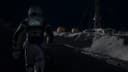
The aesthetic direction is the star. Built in Unreal Engine, the game trades in the stark beauty of hard sci-fi: sunlight cutting through dust in an abandoned habitat, the sterile geometry of a launch tower, the desolate grey sweep of the lunar plains under a black sky with Earth hanging small and fragile in the distance. On capable hardware, the lighting design makes these spaces breathtaking. This is a studio that understands that in a game about absence, light and shadow do the emotional heavy lifting.
The soundtrack deserves its own paragraph. Sweeping, melancholic, and precisely timed, it swells during moments of scale and drops to near-silence during moments of dread. It’s the kind of score that lingers.
Technically, the design is ambitious for a small team, and the polish stops just short of AAA sheen; a game this dependent on lighting and physics was never going to be bulletproof across every setup.
Platform nuances
On Steam, this is the definitive version. Mouse-and-keyboard precision helps in the puzzle segments, a controller suits the exploration and rover driving, and the game supports both. With a capable GPU, the visual payoff is enormous. This is a game built for a big screen and a good pair of headphones.
The Nintendo Switch version is where compromises bite. Bringing an atmospheric, lighting-dependent Unreal experience to Switch hardware means real sacrifices: softer textures, a lower resolution, and muddier shadows. The core experience survives—the story and tension are intact—but the visual splendor that makes the PC version special is significantly dimmed. Portability is genuine value, but it means trading the game’s greatest strength for convenience. If both platforms are on the table, this isn’t a close call: PC is the way to play.
Final verdict
Deliver Us The Moon proves that a small team with a clear vision can outclass studios ten times its size on the things that actually matter: mood, restraint, and the courage to let silence speak. Its depiction of the loneliness of space cuts deeper than most blockbusters with budgets in the hundreds of millions. That’s rare.
But the seams are showing. The puzzles are the weak link—competent, forgettable filler between the moments that count—and a few timed sequences trade real suspense for cheap frustration. This isn’t a masterpiece, and at $24.99 it’s a hard sell for most people. It’s a good game with a great one flickering just beneath the surface, held back by mechanical timidity.
For narrative-adventure devotees, we recommend the PC version, headphones on and lights off, with expectations tempered on the gameplay front. What it does well, it does beautifully. Just don’t expect the gameplay to match the view.
Reviewed by the Rankeno Action Desk. Scores are out of 10; the overall score is the desk’s editorial judgement, informed by the four sub-scores above. How we review