
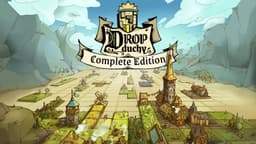
Bottom Line: Drop Duchy is a brilliant, high-friction marriage of Tetris-style spatial puzzles and deep deckbuilding strategy that demands far more than just quick reflexes. It is the rare hybrid that understands exactly how to tension its disparate parts into a cohesive, addictive whole.
The core of Drop Duchy is a masterclass in mechanical tension. In a standard falling-block puzzle, your primary objective is erasure—you want the blocks to disappear. In Drop Duchy, your objective is construction—you want the blocks to stay, but only if they are the right blocks in the right places. This creates a fascinating cognitive dissonance. You need to clear lines to prevent a game-over, but clearing those lines might destroy a vital barracks you just placed or disrupt a forest-fortress synergy that was holding your defense together.
The Gameplay Loop
Every run begins with a choice of faction, and this is where the deckbuilding elements first flex their muscles. These aren't just cosmetic changes; a run with the core faction feels fundamentally different from a run using the DLC expansions. You start with a basic deck and slowly introduce more complex structures. The onboarding friction is surprisingly low for a game with this much depth, though the meta-progression system eventually introduces a layer of complexity that can lead to "deck bloat." Finding the balance between adding powerful new cards and keeping your deck lean enough to draw your essential "boss-counter" cards is a constant, nagging challenge.
The "combat" is perhaps the game's most innovative pivot. Periodically, you aren't just building; you are defending. Enemy blocks fall with hostile intent, and your military structures—positioned carefully during the construction phase—must deal damage to these threats before they stack to the ceiling. It transforms the screen from a quiet diorama of a burgeoning kingdom into a high-stakes battlefield where a single misplaced "river" block can lead to a tactical collapse.
Strategic Depth & Adjacency
The genius lies in the adjacency bonuses. If you place a farm, it’s fine. If you place a farm next to a plain, it’s better. If you surround that farm with plains and markets, you’ve created an economic engine that allows you to play more cards per turn. This "Carcassonne-style" spatial optimization means you are constantly scanning the board not just for where a piece fits, but where it thrives. You aren't just playing Tetris; you are playing a high-speed urban planning simulation where the zoning laws change every five seconds.
However, the game isn't without its frustrations. The RNG (Random Number Generation) can be a cruel mistress. There are moments where you have a perfect military setup waiting for one specific card or piece shape, only to be buried under a flurry of useless terrain. While the "Complete Edition" provides tools to mitigate this, the sheer volume of cards can sometimes make the meta-progression feel like it's working against the player's desire for a "perfect" run. This complexity is a double-edged sword; it provides the "one more go" hook, but it can also lead to a sense of helplessness during particularly unlucky draws.