Bottom Line: A decade on, Duck Game remains the gold standard for couch multiplayer — a physics-drunk, one-hit-kill arena brawler whose 50+ weapons turn every 15-second round into a story worth retelling. Buy it, but buy it for a room with people in it.
The Gameplay Loop
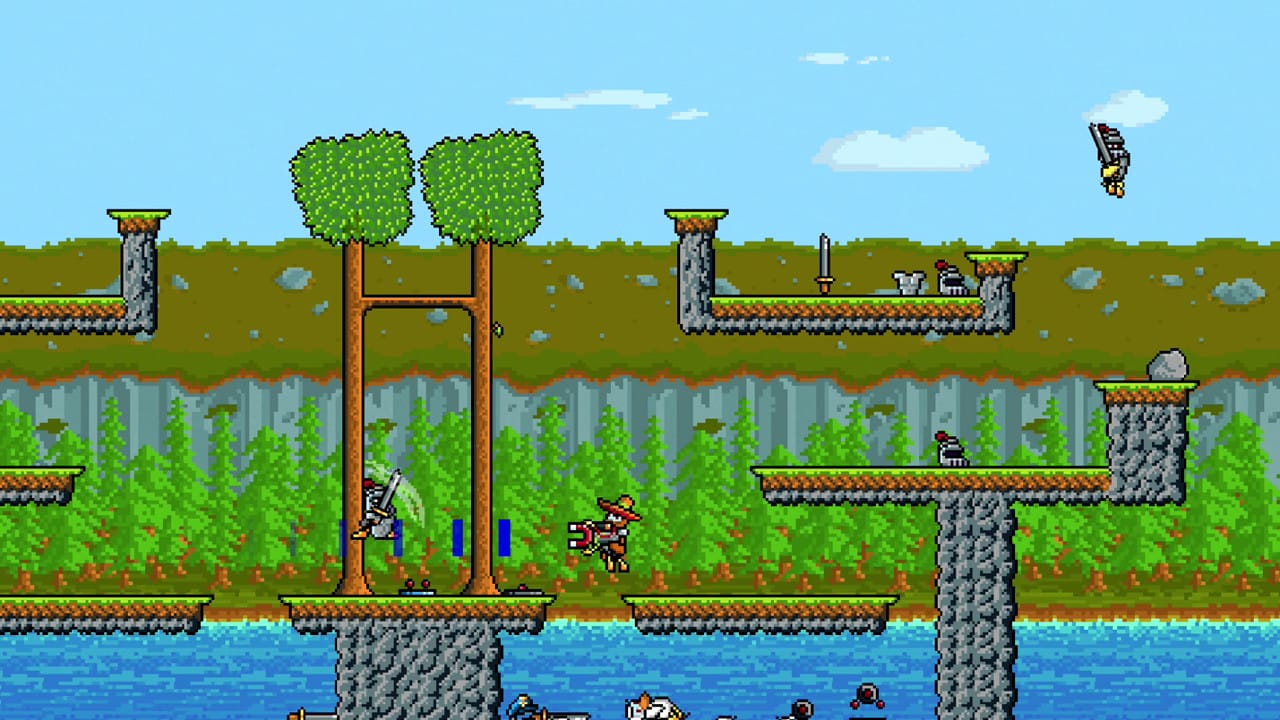
A round of Duck Game lasts about fifteen seconds. Players spawn on a small symmetrical stage littered with weapon crates, scramble for hardware, and try to land one hit. Someone dies. Points go up. Next map. The entire cycle — spawn, scramble, kill, replay, reset — runs under thirty seconds including the celebration.
That compression is the design. Short rounds mean losing costs you almost nothing, which means nobody tilts, which means the person who's down 0-8 is still laughing. Compare this to a fighting game, where a bad matchup means ninety seconds of being held down. Duck Game's failure state is over before frustration can compound.
The real mechanical spine is scarcity of ammo. Guns run dry fast, and an empty gun is not a gun — it's a rock. This forces a constant loop of scavenge → commit → discard → scavenge, and it's what keeps the arena in motion. You cannot camp a corner with a shotgun and win. You'll fire twice, hear the click, and then you're a duck in a corner holding a stick. The economy of the game is positioning relative to the next crate, not aim.
Layered on top is a physics system that treats everything — ducks, guns, crates, grenades, hats — as objects with mass. Every weapon can be thrown. Ducks can be picked up and used as shields. Grenades bounce off geometry with enough fidelity that skilled players learn bank shots, and unskilled players learn that grenades bounce back. A dropped weapon is live ordnance. This is where the "irresponsible" in the marketing copy earns itself: the systems interact in ways that produce outcomes the developer clearly did not script, which is the highest compliment you can pay a sandbox this small.
The strategy-over-reflexes claim in the game's own description is largely true, with a caveat. Reaction speed still helps. But because a hit is a kill, the dominant skill isn't tracking — it's threat assessment. Who is armed? With what? Is that a net gun or a laser? Do I have line of sight, and more importantly, do they? Good Duck Game players spend most of a round not shooting. They spend it waiting for the other three ducks to spend their ammo on each other.
The Replay Is the Product
Most arena games end a round and move on. Duck Game stops, rewinds, and shows you the kill in slow motion from a fixed camera. It is a comedy delivery mechanism disguised as a feature, and it fundamentally changes what the game is.
Because the replay exists, ridiculous deaths aren't just funny in the moment — they're confirmed, framed, and re-watched by the whole room. A grenade you threw in panic bouncing off two walls into your own face becomes a shared artifact. The replay converts random physics outcomes into narrative. That's why people remember specific Duck Game rounds years later and can't remember a single round of most competitors. The game builds its own highlight reel and plays it back to you unprompted.
Onboarding and Friction
Onboarding is close to nonexistent, and that's correct. Move, jump, shoot, throw, quack. There's no tutorial gate, no unlock treadmill, no progression system withholding weapons from new players. Everyone at the table has access to everything on round one. In a genre where "let me just get my loadout set up" kills momentum, Duck Game's refusal to have systems is a feature.
The single-player challenge mode is the weakest limb. It's a set of trials — accuracy drills, obstacle runs, weapon-specific tests — housed in a walk-around arcade hub. It's competently made and it will teach you the weapons. It is also, plainly, practice. Nobody has ever loved Duck Game because of its solo content, and the game's own community says so. If you're buying this to play alone, you're buying the wrong game.
Online multiplayer is the other soft spot. It works, matches are findable, and the developer put real effort into it post-launch. But the population is not Rocket League-sized, lobbies can be thin at off hours, and network play strips out the thing that makes the game sing — the physical room. A duck exploding on a screen 900 miles away is funny. A duck exploding two feet from the person who caused it is transcendent.