Overview
Some games age. Tiny Wings just molts.
Released on February 18, 2011 by Andreas Illiger — a German developer who built the art, code, and music entirely alone — Tiny Wings arrived during the App Store’s Cambrian explosion and helped define what one-touch mobile play could be. Fifteen years on, it holds a 4.8/5 rating from 14,882 App Store ratings, which is not nostalgia. That’s retention.
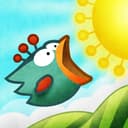
The premise is a small tragedy played for joy: a bird whose wings are too tiny to fly. The only input is press and hold. Hold to dive down a hillside; release at the crest to convert that momentum into flight. Chain perfect slides and the bird soars. Fumble the rhythm and it bounces along like a dropped grocery bag while the sun — the actual clock, the actual antagonist — sinks toward the horizon. When night falls, the run ends.
What separates Illiger’s work from the thousand endless runners it inspired is restraint. There are no coins to buy, no energy meters, no interstitial ads begging for attention. The monetization model is prehistoric in the best way: pay once ($2.99), own it. In 2026, that alone reads as radical. Add a daily mode with fresh missions, Flight School races against rival hatchlings, split-screen iPad multiplayer, and a large roster of unlockable birds — expanded substantially in a surprise 2023 update, twelve years post-launch — and you have the rare mobile game whose developer treats it as a craft object rather than a revenue funnel.
It remains iOS-exclusive. Android users have been asking for fifteen years. The answer is still no.
Key features
- One-touch physics mastery: Press to dive, release to launch. The entire game lives in the timing of a single input, and the skill ceiling is somewhere in the stratosphere.
- Procedurally regenerating world: Island colors and hill patterns rebuild themselves every day, so no two days present the same terrain.
- Racing the sun: Daylight is the timer. Speed literally slows the sunset, turning momentum into borrowed time — one of the smartest failure states in mobile design.
- Flight School & multiplayer: Downhill races against AI hatchlings, plus genuine split-screen versus on iPad — a rarity in touch gaming.
- A deep bench of unlockable birds: Many with distinct abilities, earned through mission mastery rather than microtransactions.
- Nest progression: Completing mission sets upgrades the nest and score multiplier, giving the endless mode a persistent spine.
Analysis
The Loop
Tiny Wings runs on one of the tightest feedback loops ever engineered for a touchscreen. The core verb — dive, release, soar — takes ten seconds to learn. Mastering the rhythm takes months, because the hills are procedural and the game demands players read terrain in real time rather than memorize it. This is the crucial design decision: where most runners of the era rewarded pattern memorization, Tiny Wings rewards sight-reading. Every slope is a small improvised performance.
The sun mechanic deserves its own paragraph, because it’s quietly brilliant. Most endless games kill with an obstacle. Tiny Wings kills with dusk. Fly fast enough and the sunset is outrun; slow down and the sky bruises toward purple. The failure state isn’t punishment — it’s a lullaby. The bird sleeps. The feeling is wistful rather than frustrating, and the immediate impulse is to press play again. That emotional engineering is why this game never generated the rage-quit culture that Flappy Bird did. Same difficulty curve, opposite emotional temperature.
Progression Without Predation
The mission system is where Illiger shows his discipline. Each nest level bundles three objectives — reach island four, touch clouds, nail a set number of “great slides” — and completing the set raises the score multiplier. It’s a battle-pass structure, technically, except it costs nothing, expires never, and exists purely to teach the game’s deeper techniques. Missions function as a disguised tutorial for advanced play. That’s onboarding done as level design rather than as a tooltip barrage.
The 2023 update’s wave of new birds could have been a cynical engagement lever. Instead, birds with special abilities function as soft difficulty modifiers — a mutation system that lets veterans remix a game they’ve played for a decade. It respects accumulated skill instead of resetting it.
Where It Shows Its Age
A fair critique: the moment-to-moment variety is thin by modern standards. There are no biomes with distinct mechanics, no boss encounters, no narrative wrapper. Flight School adds competitive texture, but the racing AI is beatable enough that it becomes a solved problem for skilled players. And the daily mode’s missions, while fresh in layout, recycle a familiar objective vocabulary. Anyone who bounced off Tiny Wings in 2012 because “it’s just hills” won’t be converted in 2026. The game deepened; it never widened. Illiger clearly considers that a feature — and that’s mostly the right call, though “mostly” is doing work in that sentence.
Visuals & performance
Illiger’s art direction was a decade ahead of the flat-design curve. The paper-textured hills, the daily-shifting pastel palettes, the way the sky performs an entire color-grade shift as the sun drops — it all still looks current, which is astonishing for a 2011 asset base. The daily regeneration of colors and patterns means the game functions as a generative art piece that happens to be playable.
The soundtrack — also Illiger, because of course — is a plucked, humming folk loop that syncs emotionally with the sunset mechanic. It’s one of the few mobile scores that earns being left unmuted.
Technically, the design is kind to hardware: a 2D game of this scope is light on modern iPhones, and the single-input scheme leaves no room for the input lag that would ruin a timing game where releasing a finger a few frames late means eating a hillside. iCloud sync and Game Center leaderboards round out the package.
Platform nuances
Tiny Wings is iOS-only, and after fifteen years, that’s clearly a philosophy rather than a delay. The one-finger input is perfectly matched to the phone: playable one-handed, on a train, in a queue. This is a game about touch — the press-and-hold mechanic has an almost tactile weight to it that a mouse click or gamepad trigger would flatten.
The iPad split-screen multiplayer is the sleeper feature: two players, one tablet, opposite ends of the screen, genuine head-to-head racing. It’s the best pass-the-tablet experience this side of a board game. An Apple TV version and the Tiny Wings+ Apple Arcade edition exist for households already inside Apple’s walls, but the phone remains the canonical instrument. The permanent absence from Android, Steam, and Nintendo platforms is the single most common complaint in fifteen years of reviews — and it’s a legitimate one. A game this good deserves a wider audience, even if exclusivity kept it pristine.
Final verdict
Tiny Wings is what happens when one person with taste says no to everything except the idea. No ads, no ports, no feature bloat, no sequel treadmill — just fifteen years of quiet refinement on a single perfect mechanic. It isn’t the deepest game on the App Store, and it doesn’t need to be. It’s the most finished. The 2023 update proved Illiger still cares; the 4.8 rating proves players never stopped. If the App Store vanished tomorrow and ten games could be saved for the historical record, Tiny Wings goes in the vault without a debate. We rate it Outstanding — one of the very best of its kind.
Reviewed by the Rankeno Action Desk. Scores are out of 10; the overall score is the desk’s editorial judgement, informed by the four sub-scores above. How we review