
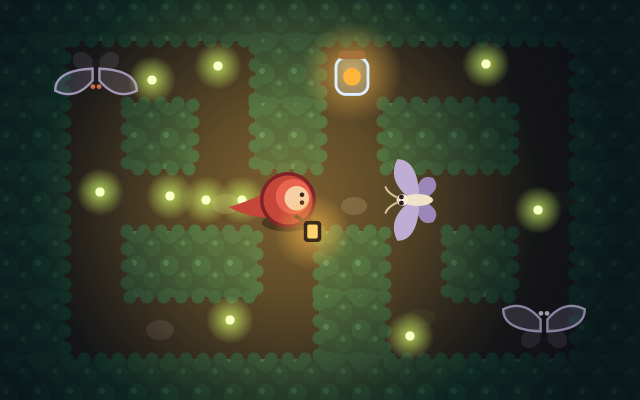
Overview
Most vampire games hand you fangs and call it a power fantasy. Golden Krone Hotel hands you fangs and then spends floor after floor trying to kill you with them. This is a traditional roguelike from solo developer Vulgat — turn-based, grid-based, permadeath, the whole austere lineage stretching back to Rogue and NetHack — but it wears its heritage lightly enough that newcomers won’t bounce off the wall of ASCII intimidation that scares people away from the genre.
You play Sorina Arobase, hunting the vampire general Fane through a hotel that is less a building than a physics problem. The hook, and it’s a real one, is that you are never comfortably one thing. Humans read spellbooks, fire revolvers, and think clearly. Vampires hit twice as hard, move faster, and see in the dark. The catch: you’re constantly sliding between the two whether you like it or not, and each state locks you out of the other’s entire toolkit.
The game launched into a crowded indie roguelike scene and carved out an identity that isn’t “the one with the gimmick” but “the one where the gimmick is the game.” That’s no small feat in a genre notorious for drowning players in inventory tabs and identification minigames.
Positioned on Steam as an approachable-but-deep roguelike, it undercuts the genre’s usual onboarding friction without dumbing down the decisions. It is short by roguelike standards. It is also tighter than nearly anything around it, and that trade is the entire pitch.
Key features
- Dual-State Combat: You’re perpetually shifting between human and vampire. Humans cast magic and shoot; vampires brawl, sprint, and see in the dark but can’t read or hold weapons. Managing the transition is the core loop, not a side system.
- Sunlight as a Tactical Layer: A deterministic day/night cycle dictates exactly where light falls. Shatter a stained-glass window and you can flood a room with sunbeams that incinerate sleeping vampires — or turn that same beam into your own death sentence once you’ve fanged out.
- Color-Coded Potion System: Potions are identified by color, not by tedious sip-and-pray identification. It respects your time and keeps the decisions about when to drink, not whether you dare.
- Streamlined Inventory: No hoarding, no menu spelunking. The design strips away the genre’s traditional clerical drudgery so every turn is about tactics.
- Decay Pressure: As a vampire you rot without blood. The clock never stops. Power always costs.
Analysis
The Gameplay Loop
The core strength here is that Golden Krone Hotel refuses to let you settle. In most roguelikes you find a build, lean into it, and grind the same three buttons to victory. Not here. The moment you commit to human sorcery — stacking spells, kiting enemies with your revolver — your vampirism meter creeps upward, and one bad turn flips you into a creature that can’t read a single one of the scrolls in your pack. Suddenly your carefully assembled toolkit is dead weight and you’re a melee bruiser sprinting through shadows, praying no one opens a curtain.
That whiplash is the point. Every fight is really two overlapping puzzles: the tactical problem in front of you, and the strategic question of which version of yourself you want to be solving it as. Do you turn vampire to burst down the wounded knight, knowing you’ll then have to survive daylight with no spells? Do you stay human and manage the meter, giving up double melee damage to keep your options open? The game never lets that tension go slack.
Sunlight as Terrain
The deterministic day/night cycle deserves its own paragraph because it turns light into a core tactical system. Light isn’t ambiance — it’s terrain. Because the sun’s direction is predictable, you can plan around it. A room full of sleeping vampires becomes not a threat but an opportunity: break the right window, redirect a sunbeam, and the encounter can solve itself before a single blow is thrown. Environmental storytelling becomes environmental weaponry.
And then it flips on you. Turn vampire and that same physics becomes lethal. Water burns. Sunlight incinerates. The systemic honesty is what sells it — the rules apply to you and your enemies identically, so mastery feels earned rather than gifted.
Interface and Onboarding
Traditional roguelikes routinely hemorrhage new players in the first ten minutes. Golden Krone Hotel understands this and fights it hard. The color-coded potions and streamlined inventory are a deliberate stance against the genre’s worst habit — mistaking tedium for depth. Removing the identification busywork doesn’t make the game easier. It makes the game about the right things. Every removed menu is a decision you get to spend on the board instead.
The difficulty curve is real, and the game is honest about it. Certain runs demand precise, almost chess-like planning, and death to your own bloodlust is part of learning the rhythm. But because the systems are legible — the game is built so you can always see why you died — death feels instructive rather than arbitrary. That’s the difference between a hard game and a cheap one.
The one genuine knock is length. This is a compact experience. Roguelike veterans hunting for a sprawling lifestyle game with dozens of classes and deep meta-progression will notice the ceiling. What’s here is dense and replayable, but it’s a tight, focused package, not an endless one — and whether that’s a feature or a limitation depends entirely on what you want from the genre.
Visuals & performance
The pixel art is functional gothic — dim corridors, stained glass, the muted palette of a place where the lights went out a long time ago. It won’t be the screenshot that sells your friend on the game, and it doesn’t need to be. What matters is legibility, and here the visuals do serious work: sunbeams are unmistakable, state changes read instantly, and the UI is designed to communicate your vampirism meter and status without forcing you to hunt for it. In a game where a misread tile means death, clarity beats spectacle every time, and Vulgat clearly knew which one to prioritize.
Performance should be a non-issue by design. This is a turn-based game of modest scope, and a 2D game like this is light on hardware — the kind of thing that shouldn’t strain anything built in the last decade. There’s no latency to speak of because there’s no twitch input to betray. The technical demands are minimal, which is exactly what you want.
Platform nuances
On Steam, the mouse-and-keyboard setup is the natural home for this kind of game. Keyboard movement gives you the precise, turn-by-turn control the tactics demand, while the mouse handles targeting and menus. This is a game meant to be played at a desk, deliberately, one considered move at a time — not something you thumb through on a couch. The Steam integration brings the usual conveniences (cloud saves, achievements, easy updates), and the deterministic systems mean nothing about the design depends on your hardware. It’s a keyboard game to its bones, and it’s better for the focus that demands.
Final verdict
Golden Krone Hotel does a hard thing well: it makes an old genre feel new without betraying what made it worth loving. The vampire/human duality isn’t a costume draped over familiar systems — it’s a foundation that forces you to think differently on every single turn. Turning sunlight into a weapon you can aim, and then handing that same weapon to your enemies, is clean, confident design that many far larger productions never manage.
It’s short. It’s demanding. Its art won’t win awards. None of that undercuts what it accomplishes. This is a game that knows exactly what it is, strips away everything that doesn’t serve that vision, and executes the rest with discipline. We rate it a solid Good — recommend it to the right audience: anyone who has ever wanted to feel the tension between power and control, to hold both the fangs and the fear.
Reviewed by the Rankeno Strategy & Sim Desk. Scores are out of 10; the overall score is the desk’s editorial judgement, informed by the four sub-scores above. How we review