Overview
Golf has spent decades trying to convince video games it belongs. The results are usually a mess of power meters, wind gauges, and physics engines fighting over your thumb. Afterburn, the Polish indie studio behind Golf Peaks, looked at all of that and did something audacious: they threw the physics out entirely.
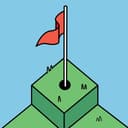
What remains is a game that barely resembles a sports title at all. You climb misty, isometric mountains by moving a golf ball across a grid, one tile at a time, using a hand of movement cards dealt to you at the start of each level. A card might roll the ball two spaces. Another might loft it over a water hazard. Another might send it airborne to clear a bottomless pit. There is no aiming, no timing, no meter to stop at the right instant. There is only the question: given these exact cards, in what order do you play them to reach the hole?
That reframing turns golf into something closer to chess, and it’s the smartest design decision the game makes. Golf Peaks isn’t about execution; it’s about planning. The tension lives entirely in the player’s head, which is precisely why the developers could wrap the whole thing in a soothing lo-fi soundtrack and a fog-softened color palette without any dissonance. This is a puzzle game cosplaying as a spa day.
The market positioning is deliberate. With 120-plus handcrafted levels across 10 worlds, unlimited undo, instant restart, and zero on-screen text, Golf Peaks is engineered for the commute, the couch, the ten minutes before sleep. The reception has been strong — 4.7 out of 5 on iOS — and it’s easy to see why. This is a game that knows exactly what it is and refuses to be anything else.
Key features
- Card-Based Movement System: Every shot is a card played onto a grid. No physics, no aiming—just spatial logic and the hand you’re dealt. This is the entire game’s foundation, and it’s a genuinely fresh idea.
- Textless Onboarding: Golf Peaks teaches you everything through level design alone. New hazards and mechanics are introduced visually, one at a time, without a single tooltip or wall of instructions.
- Escalating Hazard Design: Sand traps, water, bottomless pits, ice patches that keep the ball sliding, mud that stops it dead, and conveyor belts that hijack its trajectory. Each element rewrites the rules of the grid.
- Zero-Pressure Systems: Unlimited undo and one-tap restart mean failure costs you nothing but a moment’s thought. The game never punishes; it only invites you to try again.
Analysis
The Gameplay Loop
The loop is elegant to the point of being invisible. You arrive at a level. You see the ball, the hole, the terrain, and your hand of cards laid out at the bottom of the screen. You study the board. You commit to a shot. The ball moves. You reassess. Repeat until you sink it.
What makes this work is that every level is a closed system. You are given a finite, curated set of cards, and the puzzle is baked into that scarcity. You can’t brute-force your way through with a lucky swing, because there’s no swing. If you have a “jump 3” card and a “roll 2” card, the solution exists somewhere in the permutations of those specific tools. The designers aren’t testing your reflexes. They’re testing whether you can read the board.
This is where Golf Peaks earns its praise. The difficulty curve is built with real restraint. Early worlds are almost meditative—the kind of levels you can solve faster than you can second-guess yourself. But by the later worlds, the game introduces mechanics that force you to think in three dimensions. Ice means a rolling ball won’t stop where you’d expect. Conveyor belts add a layer of forced movement that you have to route around or exploit. Elevation changes mean a ball that rolls off a ledge behaves differently than one that’s lofted onto it. Suddenly, a level with only four cards becomes a knot that takes ten minutes to untangle.
The Interface
The UX philosophy here is subtraction as design. There is no HUD clutter, no currency, no energy timer, no nagging notification to come back tomorrow. The cards sit at the bottom; the board fills the screen; a small counter tracks your strokes. That’s it.
The unlimited undo deserves specific credit, because it fundamentally changes the psychology of play. In most puzzle games, a wrong move carries a cost—a reset, a lost life, a walk of shame back to the start. Golf Peaks removes that friction entirely. Experimentation becomes free. You can try a shot just to see what the ice does, then rewind it and plan properly. This transforms the game from a test you might fail into a sandbox you’re encouraged to poke at. It’s the single biggest reason the “zen” label actually holds up instead of being marketing gloss.
Where It Stumbles
No hint system. This is the game’s most cited flaw, and it’s a real one. When a late-game puzzle stumps you, Golf Peaks offers you nothing but the undo button and your own stubbornness. For most players, that’s fine—the levels are short enough that trial and error rarely feels like a slog. But there will be moments where you’re staring at four cards, certain there’s a solution, and the game’s serene silence starts to feel less like calm and more like indifference. A single optional hint would have cost the tone nothing.
And then there’s length. The credits are reachable in a handful of sittings. For a premium puzzle game, that’s lean. Golf Peaks is a beautifully made appetizer, and some players will finish it wishing it were the main course. That the studio later released Golf Peaks: Champion’s Cup as expanded content is a tacit acknowledgment that the original left people wanting more.
Visuals & performance
The art direction is flat-shaded, low-poly minimalism wrapped in fog, and it’s lovely. Muted greens, soft blues, warm sand—the palette shifts subtly across the 10 worlds without ever breaking the calm. The isometric perspective reads cleanly, which matters enormously in a grid puzzler where misjudging a tile’s elevation means misjudging the whole solution. Golf Peaks never leaves you squinting to figure out what’s a ledge and what’s a pit.
The lo-fi soundtrack is the other half of the mood. It’s unobtrusive, loopable, and warm—the kind of thing you’d leave on after you stopped playing. This is not a game of bombast. It’s a game of hush.
Technically, there’s little here to strain hardware—no real-time physics, no particle storms—so a 2D puzzle game of this scope should run comfortably on just about anything. That’s not damning with faint praise; it’s the correct engineering for a game that lives or dies on its ability to never break your concentration.
Platform nuances
Golf Peaks was born for touch, and the design shows it. On iOS and Android, dragging a card onto the board with your thumb is the most natural expression of the mechanic—tactile, direct, and well suited to one-handed play on a commute. This is the definitive way to experience it, and the 4.7/5 iOS rating reflects a game meeting its ideal audience.
On Steam, the card-and-grid interface translates cleanly to mouse. Clicking a card and clicking a direction is frictionless, and the larger screen makes the art breathe. What you lose is the intimacy—Golf Peaks on a desktop monitor feels slightly oversized for its own gentle ambitions, like a haiku printed on a billboard. It’s still perfectly enjoyable; it’s just not home.
On Nintendo Switch, you get the best of both worlds. Handheld touchscreen mode replicates the mobile experience almost exactly, while docked play with a controller works fine—if slightly less elegantly, since navigating a grid with a stick will never feel as immediate as a fingertip. The Switch is the versatile choice, and for many it’ll be the ideal one.
Final verdict
Golf Peaks is proof that constraint breeds creativity. Afterburn took the least likely sport, stripped away everything that makes sports games stressful, and built a puzzle experience of real clarity and grace. It’s not flawless—it’s brief, and its refusal to help you when you’re stuck occasionally tips from serene into stubborn. But those are the complaints of someone who wanted more of a good thing, not someone who found a bad one.
This is a game with total command of its own identity. It knows it’s small. It knows it’s calm. It never apologizes for either. In a medium obsessed with bigger maps, longer campaigns, and endless engagement loops, a puzzle game that respects your time and leaves you relaxed is a welcome change. We recommend it to puzzle fans who value calm over challenge—but go in knowing it’s a short trip.
Reviewed by the Rankeno Puzzle & Casual Desk. Scores are out of 10; the overall score is the desk’s editorial judgement, informed by the four sub-scores above. How we review