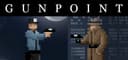

Overview
Most stealth games hand you a knife and a shadow and call it a day. Gunpoint hands you a pair of wires and dares you to think. Released June 3, 2013 by Suspicious Developments—the one-person studio fronted by former games journalist Tom Francis—this is a debut that arrives with a fully-formed idea and the discipline to execute it. Francis wrote about games for a living before he built one, and it shows. Gunpoint isn’t a designer flailing for a hook. It’s a critic who knew exactly what was missing.
The setup is pulpy and self-aware. You play Richard Conway, a freelance spy in a rumpled trench coat, framed for the murder of a weapons magnate. Clearing your name means breaking into corporate offices, dodging armed guards, and unraveling a noir plot that never takes itself too seriously. The story is delivered through a text-based dialogue system dripping with dry wit, where you can flirt, threaten, or antagonize your clients—sometimes to your own detriment, always to your amusement.
But nobody remembers Gunpoint for its plot. They remember it for the Crosslink, the rewiring mechanic that turns every level into an electrical logic puzzle you can bend to your will. In a market crowded with stealth clones aping Metal Gear and Thief, Gunpoint carved out new territory: the building itself is your playground, your weapon, and your puzzle. It earned a Metacritic score of 83 and became a quiet touchstone for the indie-puzzle renaissance. At $9.99, it remains one of the easiest recommendations on the platform, with one honest caveat we’ll get to.
Key features
- The Crosslink Rewiring System: Enter a schematic view of the level’s electrical wiring and reconnect anything to anything. Wire a light switch to a locked door, a motion sensor to a trap floor, or a guard’s own light switch to the elevator that drops him three stories. This is the game’s beating heart and its smartest idea.
- Bullfrog Hypertrousers: Spring-loaded super-pants that let Conway leap across entire rooms, cling to walls and ceilings, and detonate through windows to flatten a guard mid-sentence. Movement is fast, floaty, and gloriously silly.
- Tactical Freedom: Every mission bends to your temperament. Ghost through untouched, or crash through the glass and beat every guard unconscious. The game grades your approach but rarely punishes ambition.
- Witty Branching Dialogue: A text-message-style conversation system with real personality and consequences, where being a smartass can cost you a paycheck.
- Full Level Editor & Steam Workshop: Build, break, and share your own security nightmares—the feature that quietly turns a short campaign into an open-ended obsession.
Analysis
The Gameplay Loop
Gunpoint’s loop is simple on the surface: case the room, rewire the room, break the room. You enter a building, survey the guards and the wiring, then slip into Crosslink mode—a schematic overlay where the game slows to a stop and the level becomes a circuit diagram. Here is where the design earns its keep. Every switch, door, camera, and light is a node. Drag a wire from one to another and you’ve rewritten the building’s nervous system.
The elegance is in the emergence. A guard flips a light switch he’s walked past a hundred times—except now it opens the door behind him, and you’ve already wired that door to knock him into the hallway where your fist is waiting. You’re not solving the developer’s puzzle so much as engineering your own solution out of the pieces on offer. Two players can clear the same level in completely different ways, and both will feel clever. That’s the mark of design working at a high level.
Interface and the Crosslink
The smart move is making the puzzle-solving tactile rather than abstract. Crosslink mode isn’t a menu—it’s a spatial, visual act. You drag glowing lines across the screen, color-coded by circuit, and the readability holds even when the wiring gets baroque. The pause when planning keeps friction out of the loop, which matters enormously: the design lets you slip in and out of Crosslink and adjust on the fly when a guard doesn’t move where you expected. The onboarding is nearly frictionless: within minutes you understand the core verb, and the game spends the rest of its runtime complicating it in satisfying ways.
Where the design shows real confidence is in restraint. Gunpoint introduces new elements—guards who notice tampered wiring, encrypted circuits that require different tools, colored security tiers—at a measured pace. It never dumps its whole toolbox on you. Each mission is a small, self-contained thesis on a mechanic, and the difficulty curve rises without ever becoming punishing. This is a puzzle game built to respect your time and your intelligence in equal measure.
Freedom Versus Friction
The tactical freedom cuts both ways. Because the game rewards experimentation so generously, it occasionally undercuts its own tension. A truly stuck player can often brute-force a solution by leaping through a window and punching everyone before the alarm resolves. Purists chasing a flawless stealth run will find deep satisfaction; players looking for hard-edged fail-states may find the guardrails too soft. The combat is intentionally shallow—a single hit downs most guards, and a single bullet downs you—so encounters resolve in a heartbeat. That immediacy keeps the pace brisk, but don’t come here for combat depth. The depth lives entirely in the wiring.
The dialogue system deserves a nod for character work that most puzzle games wouldn’t bother with. It won’t change how you play, but it gives Conway’s world a personality—wry, a little bleak, funny in a way that makes the connective tissue between levels a pleasure rather than a loading screen.
Visuals & performance
Gunpoint wears its noir pixel-art like a well-cut suit. Rain-streaked windows, moody blue-and-amber lighting, the silhouette of a spy mid-leap against a lit office grid—it’s atmospheric without ever straining. The pixel work is clean and purposeful, prioritizing readability over decoration, which is exactly right for a game where you need to parse a room at a glance. Nothing here is showing off. Everything is legible.
The moody jazz soundtrack is the aesthetic’s secret weapon, all smoky bass lines and late-night cool that sells the freelance-detective fantasy harder than any cutscene could. It loops without grating and knows when to recede.
Technically, this is a featherweight by design. A 2D game of this modest scope is light on hardware, and nothing in its architecture demands much of a machine. That’s not a surprise for a game this size—but it’s still worth stating plainly: the technical footprint is as small as the ambition is large.
Platform nuances
On Steam, Gunpoint is a mouse-and-keyboard game through and through, and it’s all the better for it. The Crosslink system is essentially a click-and-drag interface, and the mouse is the right instrument—precise, fast, and intuitive. We’d steer players toward M&K here without hesitation.
The real Steam advantage is the Workshop. The built-in level editor plugs directly into a community library of user-made missions, and this is what answers the game’s single biggest weakness. The core campaign is short—roll credits in an afternoon and it’s done. But the editor is robust and built for tinkering, and the Workshop turns a finite game into an effectively bottomless one. That ecosystem only exists because of the platform, and it’s central to the value proposition.
Final verdict
Gunpoint is a small game with a big idea, and it commits to that idea with a clarity most triple-A studios can’t muster. The Crosslink mechanic is honest innovation that reframes what a stealth game can be—turning infiltration from a test of patience into an act of gleeful engineering. Yes, it’s brief. Yes, the combat is thin and the tension occasionally slack. But Tom Francis knew exactly what he was building and had the discipline not to pad it. What’s here is sharp, confident, and completely his own. Between the campaign, the editor, and the Workshop, you’re getting more than the price tag suggests. We rate it a clear recommendation: buy it, break into a building tonight, and rewire your expectations of the genre.
Reviewed by the Rankeno Strategy & Sim Desk. Scores are out of 10; the overall score is the desk’s editorial judgement, informed by the four sub-scores above. How we review