
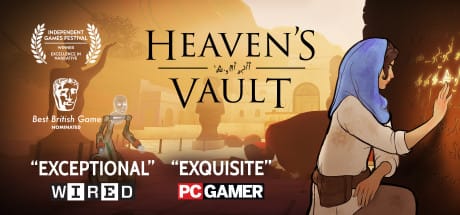


Bottom Line: Heaven’s Vault is a rare intellectual achievement that treats language not as window dressing, but as the primary engine of discovery. It is a slow, meditative, and deeply rewarding exercise in linguistic archaeology.
The Grammar of Discovery
The most striking aspect of Heaven’s Vault is its refusal to hold your hand. The Ancient language isn't a simple 1:1 substitution cipher. It has its own internal logic, with roots, prefixes, and suffixes that denote tense, plurality, and relationship. When you encounter a phrase, the game presents you with options based on words you've "learned" or guessed previously.
If you incorrectly translate a word as "king" instead of "god," that error persists. It colors your understanding of the next inscription. You might find yourself four moons later realizing that your entire interpretation of a specific dynasty’s fall was based on a fundamental linguistic misunderstanding. This creates a level of agency rarely seen in narrative games; the history of this world is literally what you make of it. The friction of the translation process is the point. It’s about the "aha!" moment when you realize the symbol for "water" and "flow" combined creates the word for "river."
Narrative Branching and the "Ink" Engine
Inkle has mastered the art of the responsive script. Unlike games where "Choice A" leads to "Ending A," Heaven’s Vault feels like a living document. The order in which you visit moons, the way you treat your colleagues at the University of Iox, and the theories you share with Six all ripple through the dialogue.
The game handles player failure with remarkable grace. If you fail to find a specific artifact, the story doesn't grind to a halt. Instead, the narrative routes around it, perhaps offering a different perspective on the same mystery later on. This mitigates the "stuck" feeling common in adventure games, though it can occasionally make the game feel a bit aimless for those used to clear objective markers.
Pacing and the Nebula
If there is a significant point of onboarding friction, it is the sailing. Navigating the Nebula in the Nightingale is a slow, deliberate process. While it serves to emphasize the scale of the world and provides space for character development between Aliya and Six, it can feel tedious. The "space rivers" are visually stunning but mechanically thin. You are mostly steering through currents, and while the dialogue keeps things interesting, the actual act of travel lacks the intellectual bite of the rest of the experience. It’s a meditative breather that occasionally overstays its welcome.