Bottom Line: Hyperbolica is a staggering technical achievement that turns non-Euclidean geometry into a tactile playground, though its thin gameplay loop often struggles to keep pace with its brilliant custom engine.
The Geometry of Awe
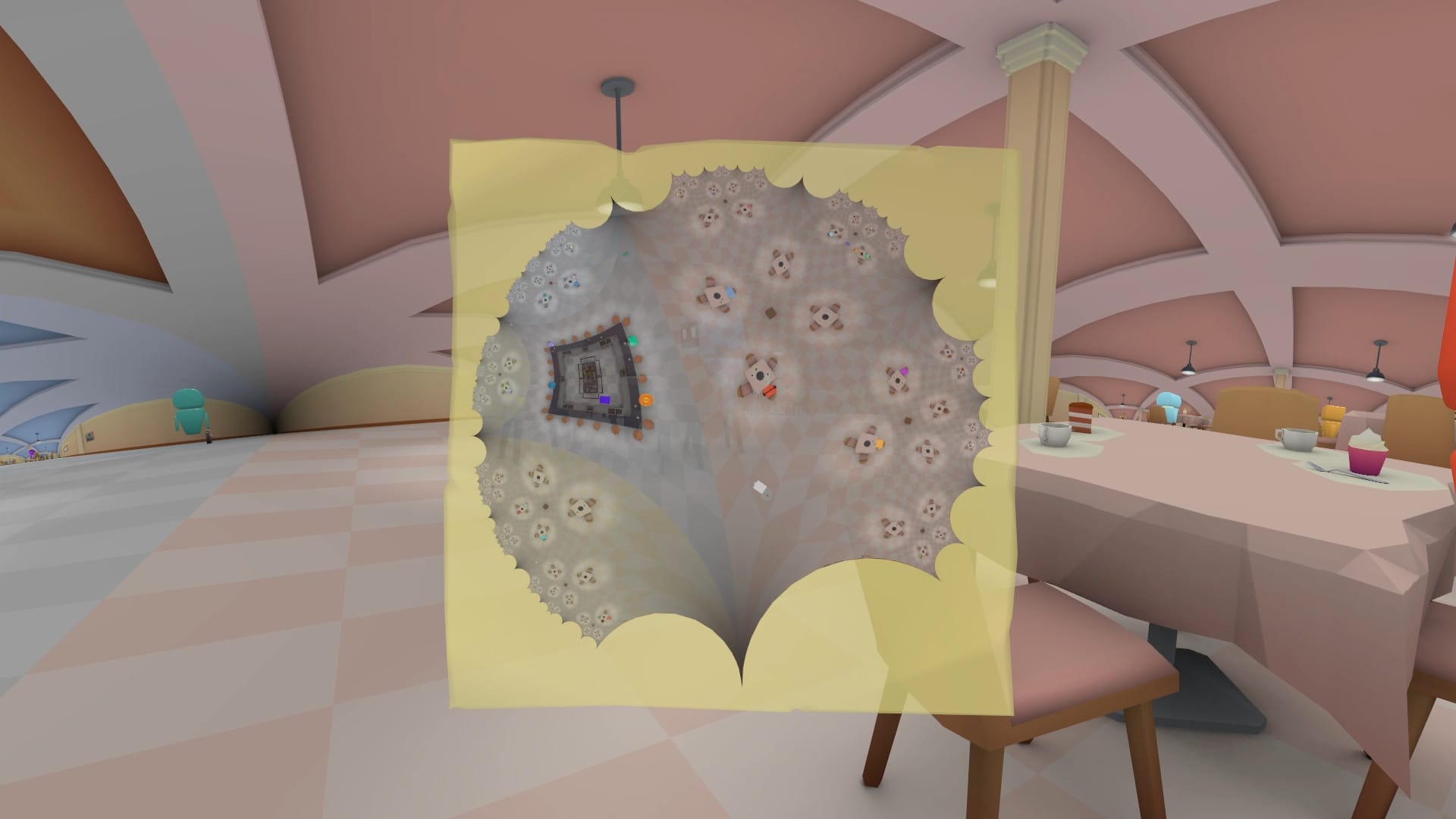
Navigation in Hyperbolica is less about getting from point A to point B and more about unlearning everything you know about distance. In a standard Euclidean game, if you turn four 90-degree corners, you end up back where you started. In Hyperbolica’s hyperbolic realms, you’ll find yourself miles away from your origin point. This spatial reasoning challenge is the game’s core hook. There is a primal, dizzying thrill in watching a landscape bloom outward as you move toward it, or seeing a massive tower shrink into a microscopic dot after just a few steps.
The developer has cleverly used the math to solve a common "walking simulator" problem: boredom. In most games of this ilk, travel is friction. In Hyperbolica, travel is the friction and the reward. You aren't just walking; you are trying to maintain a mental map of a world that refuses to be mapped. The engine handles this with surprising grace, maintaining a high level of visual fidelity and performance even as it calculates complex geometric distortions on the fly. It is, quite literally, a masterclass in technical implementation.
The Gameplay Deficit
However, once the initial "wow" factor of the geometry begins to fade—and it does take a few hours—the actual "game" elements start to feel frustratingly sparse. The activities provided—snowball fights, drone piloting, and light puzzle-solving—are mechanically shallow. They feel like tech-demo interactions designed to show that, yes, you can throw a projectile in hyperbolic space. But they don't evolve. The onboarding friction is low, but the ceiling for mastery is equally low.
The narrative is equally lightweight. The NPCs are charming enough, and the puns are frequent, but there is a lack of narrative stakes that makes the exploration feel aimless at times. You are exploring because the world is weird, not because you are invested in the outcome. For a tech critic, this is the classic "innovation vs. utility" trap. The technology is a 10/10, but the utility of that technology within the context of a game loop is closer to a 6.
The VR Variable
If you are playing this on a standard monitor, you are seeing the math. If you are playing this in VR, you are feeling it. The spatial distortion in VR is intense. It is one of the few experiences that justifies the hardware by offering something that simply cannot be replicated on a 2D screen. The way the world wraps around your peripheral vision in spherical mode is both claustrophobic and awe-inspiring. However, users should be warned: this is a high-latency-for-the-brain experience. Even those with "VR legs" might find the exponential expansion of space a bit much for their inner ear. It is a visceral, trippy experience that pushes the boundaries of what VR can do for educational immersion.