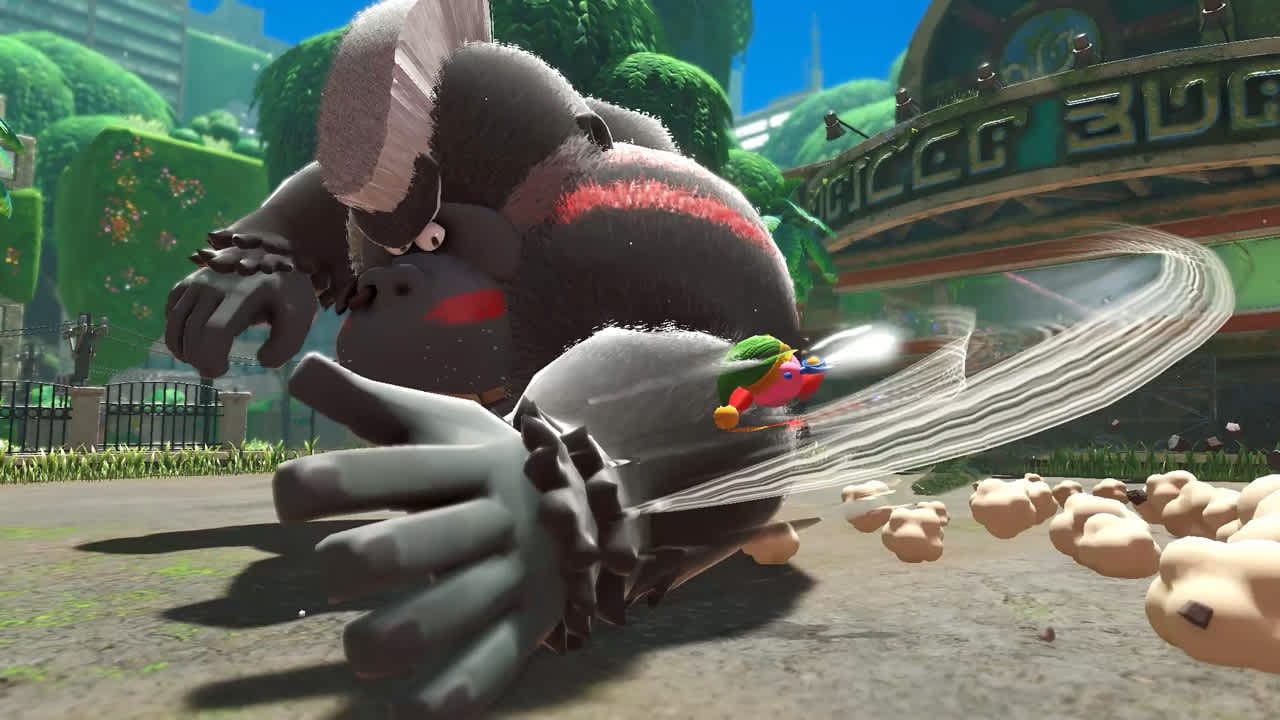
Bottom Line: HAL Laboratory's first fully 3D mainline Kirby is a small miracle of design confidence — inventive, gorgeous, and relentlessly generous — but its main campaign is so gentle it treats challenge as an optional download you unlock after the credits.
The Gameplay Loop
The structure is old-fashioned in the best way: world map, discrete stages, a boss at the end of each region. What HAL layered on top is a completion economy that's smarter than it looks.
Each stage hands you three overlapping incentives. Rescue the caged Waddle Dees, because they're the hard currency that gates world progression and rebuilds the hub. Find the blueprints, because they upgrade your abilities. And complete the secret missions — which you cannot read until you've already done them. That last mechanic is the design pivot the entire game rests on. If the missions were listed upfront, you'd play a checklist. Because they're hidden, you play curiously: you shove the camera into corners, attack scenery, try the dumb idea. Most reveal themselves as "defeat the mini-boss without taking damage" or "find the hidden Waddle Dee behind the billboard," and the reveal lands as a small, well-timed reward. It converts the tedium of 100% completion into something closer to play.
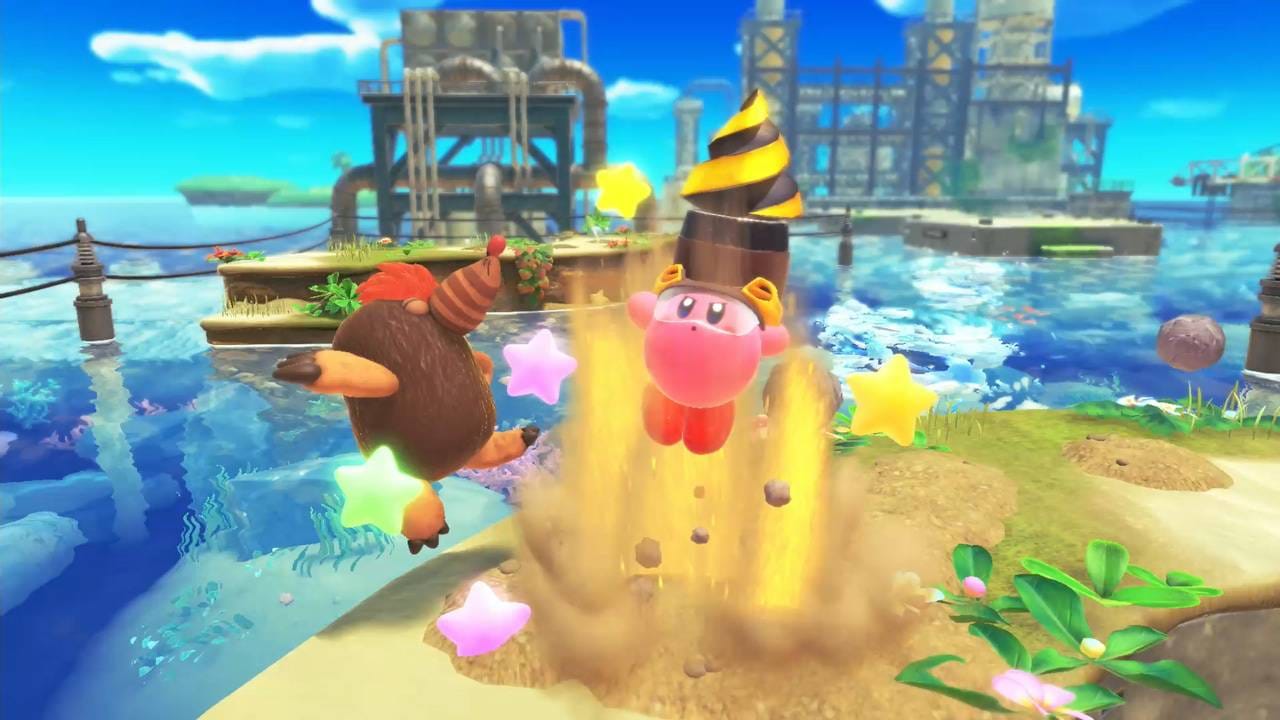
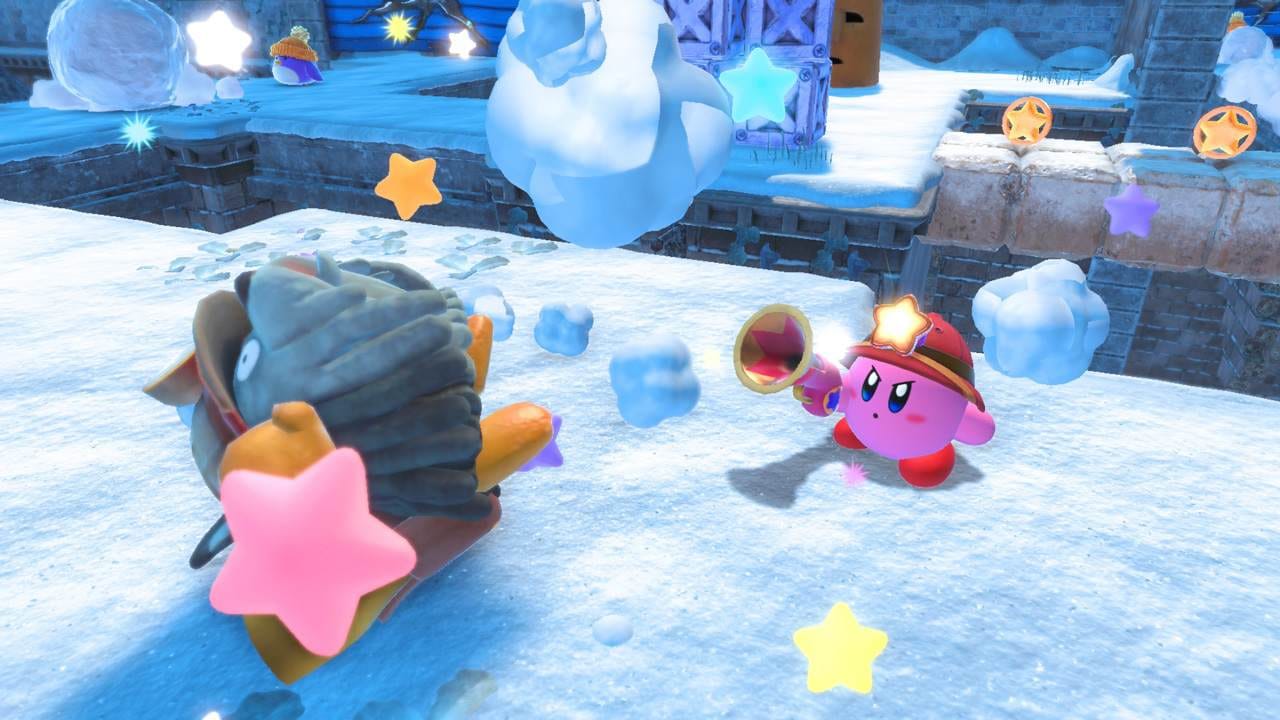
The moment-to-moment combat is where the extra dimension pays off. Copy abilities that felt like reskins in 2D become spatially distinct in 3D — Ranger turns Kirby into a third-person shooter with lock-on, Drill makes him a burrowing threat that attacks from below, Hammer is a slow, committed windup that demands you read enemy telegraphs. The upgrade system gives these abilities a progression arc that Kirby games have historically lacked, and the Rare Stone economy is tuned tightly enough that you're always one or two upgrades short of what you want. That's good scarcity design.
Mouthful Mode, and the Problem With Great Ideas
Mouthful Mode is the marquee feature and the most-quoted thing about this game, for good reason. Watching Kirby engulf a sedan and waddle around as a horrifying pink car-creature is the kind of image that sells a console. Mechanically, each transformation is a single-use puzzle verb: the vending machine fires cans as projectiles, the staircase lets you build bridges, the water balloon irrigates dead ground.
Here's the honest critique. Mouthful Mode is a spectacle system, not a mechanical system. Each transformation appears in a curated stretch of level, does its one trick, and disappears. You never combine them, never carry them into open problem spaces, never discover a use HAL didn't author. It's Odyssey's capture mechanic with the improvisation surgically removed. That's a defensible choice for a game designed to be played by children — it's legible and impossible to fail — but it means the game's headline feature is also its most disposable. The transformations delight you and then leave.
Difficulty, and the Elephant in the Room
The main campaign runs roughly 10–12 hours and is, bluntly, very easy. Kirby has a health bar that regenerates from food dropped constantly, floats indefinitely, and takes hits like a pillow. Deaths in the main story are more likely to come from accidentally walking into a pit than from any enemy encounter. There is a Wild Mode difficulty option, and it barely moves the needle.
The real game — the one with teeth — is post-credits. Isolated Isles: Forgo Dreams remixes stages with meaningfully harder layouts and enemy placement, and the Colosseum stacks boss gauntlets that will actually kill you. That content is excellent. It's also locked behind ten hours of tutorial-adjacent platforming, which is a genuine barrier for an experienced player evaluating whether this is worth full price. HAL made a deliberate choice to sequence the challenge rather than let you select it, and I understand the logic — the family audience never needs to see the hard version. But an unlockable difficulty toggle from hour one would have cost nothing and served everyone.
Co-Op and the Interface
Local co-op is a triumph of low friction. Player two picks up a Joy-Con and exists — no menu, no interruption. Bandana Waddle Dee is a competent spear fighter, not a hollow escort, and the game scales health rather than punishing you for bringing a less-skilled partner. It's the best implementation of "play with your kid" I've seen on the platform.
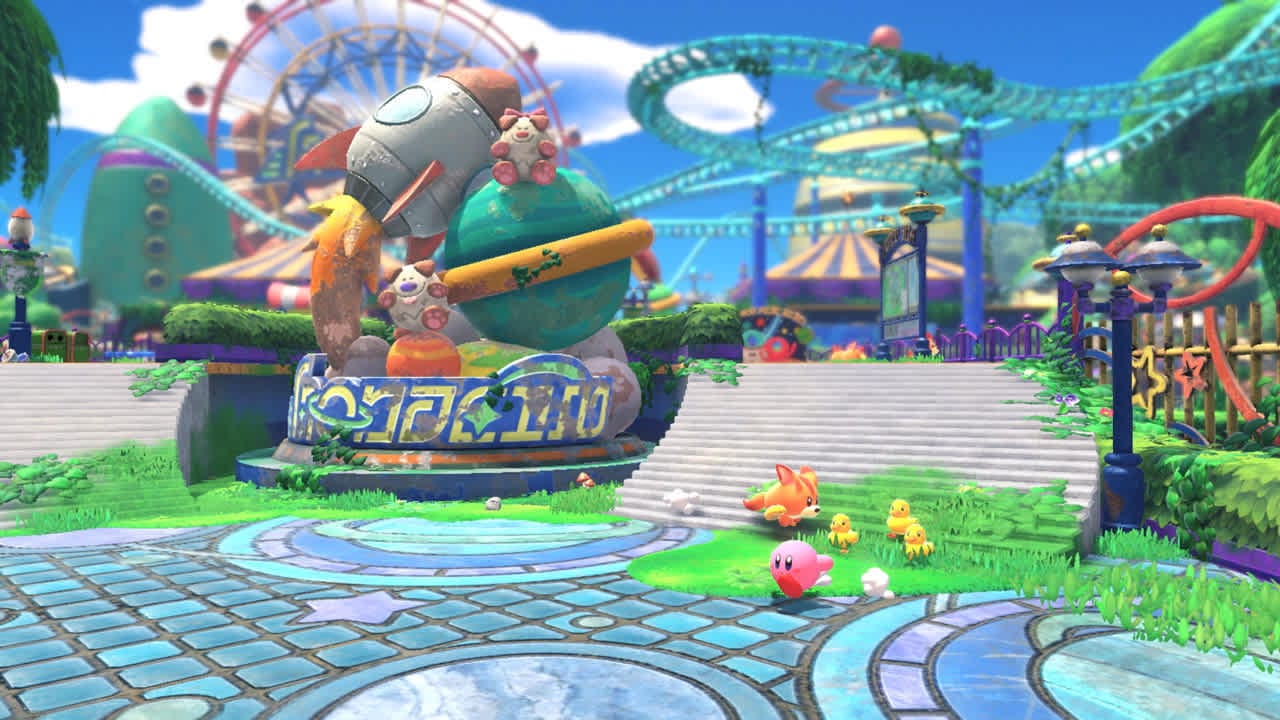
Waddle Dee Town is the connective tissue. Watching a barren field fill with shops, a fishing hut, minigames and a movie theater as you rescue more Dees gives progression a physical shape. Menu design throughout is clean, readable at a distance, and mercifully free of the tutorial popups that plague modern Nintendo titles.