
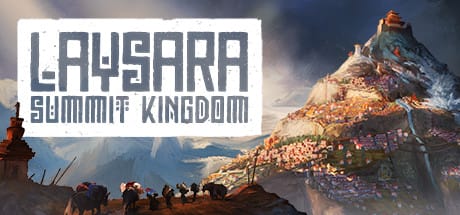



Bottom Line: Laysara: Summit Kingdom abandons the flat-earth comfort of traditional city builders for a grueling, beautiful, and mechanically dense vertical climb. It is a logistical puzzle disguised as a city builder, demanding as much spatial awareness as it does economic foresight.
The brilliance of Laysara lies in its refusal to let you ignore the terrain. In most strategy games, the map is a canvas; here, the map is the antagonist. The core gameplay loop isn't about resource extraction so much as it is about resource transit. You can produce all the salt and wool you want in the lower terraces, but if you haven’t engineered a way to get those goods to the monks living in the thin air of the peaks, your society will stagnate.
The Logistics of Gravity
Most builders treat "distance" as the primary friction. Laysara adds "altitude" to that equation, and the results are transformative. You start with basic roads and yaks, but as your settlement grows, you must graduate to heavy-duty transport shafts. These aren't just flavor text; they are expensive, high-throughput nodes that dictate the entire layout of your city.
The yak-based transport system is a masterclass in logistical planning. You aren't just clicking "A to B." You are managing the throughput of specific waypoints. If you over-burden a single road segment with too many yak caravans, the resulting traffic jam will starve your upper-tier citizens. It’s a system that rewards players who think in three dimensions, forcing you to look at a cliff face and see not an obstacle, but a potential elevator shaft.
Caste Conflict and Production Chains
The caste system provides the "why" behind the "how." The lowlanders do the heavy lifting, the artisans refine the goods, and the monks provide the spiritual (and late-game) progress needed to finish the temple. This creates a fascinating vertical economy. The resources needed for the lower castes are often found at the bottom, while the high-tier needs are scattered across the peaks. You are constantly building two or three cities at once, all interconnected by a fragile web of lifts and bridges.
The Avalanche: A Masterful Threat
Avalanches are Laysara’s version of a boss fight. They are predictable—you can see the snow accumulating—but they are devastating if ignored. The choice between clear-cutting a forest for lumber or leaving it as a natural snow-break is one of the game's better mechanical tensions. When an avalanche does trigger, watching it tumble down the mountain in real-time is both terrifying and visually arresting. If your barriers hold, you feel like a genius; if they fail, you watch as hours of logistical planning are wiped off the map in seconds.
Interface Friction
It isn't all peak performance, however. As your city expands across several thousand meters of vertical space, the UI begins to groan under the weight. Managing production chains across different "levels" can become a chore. While the game provides overlays to show resource flow, the sheer density of icons in the late game can lead to "information soup." There is a certain unintuitive nature to the transport menus that occasionally feels like you’re fighting the game rather than the mountain. It isn't a dealbreaker, but it is a noticeable rough edge on an otherwise polished stone.