Overview
In an industry often obsessed with the “end of the world,” Die Gute Fabrik’s Mutazione dares to ask a more interesting question: what happens a century after the dust has settled? This isn’t a survivalist power fantasy or a gritty look at societal collapse. Instead, the developer presents what they aptly call a “mutant soap opera,” a narrative-driven adventure that plays less like a game and more like a summer spent in a strange, isolated town where the extraordinary has long since become mundane.
You play as Kai, a 15-year-old girl traveling to the secluded community of Mutazione to care for her dying grandfather, Nonno. The setup is classic “stranger in a strange land,” but the execution is anything but typical. Mutazione is populated by a cast of mutants—ranging from the cat-like to the gelatinous—but their problems are universal. They deal with unrequited love, historical trauma, the weight of expectation, and the simple friction of living in close quarters.
Die Gute Fabrik has positioned this title as a challenge to the modern attention economy. There are no high-stakes combat encounters, no branching paths that lead to world-ending catastrophes, and no complex puzzles designed to stump the player. Instead, the game demands patience and presence. It is a slow-burn experience that prioritizes conversation over action, asking the player to inhabit the space and listen—really listen—to the stories being told. In a market saturated with high-octane spectacle, Mutazione occupies a unique niche: it is the “slow food” movement of independent gaming, offering a rich, nourishing experience for those willing to wait for the harvest.
Key features
- Musical Gardening: A unique procedural audio mechanic where players plant seeds that generate ambient music based on their species and emotional “mood.”
- Ensemble Storytelling: A rich, character-driven narrative that follows the intersecting lives of a diverse community rather than focusing solely on a single protagonist’s journey.
- Hand-Illustrated Art Style: A striking, flat-color aesthetic that feels like a living graphic novel, blending magical realism with grounded, atmospheric environments.
Analysis
To understand Mutazione, one must first accept its pace. The game operates on a diurnal cycle, moving through days and nights as Kai navigates the island. While there is a central mystery involving Nonno and the island’s history, the real “gameplay” lies in the social architecture of the town.
The Rhythms of Restoration
The core loop involves checking in on neighbors, delivering items, and engaging in long, text-based dialogues. This could easily have become a chore, but the writing is sharp enough to avoid the pitfalls of “fetch-quest” fatigue. Each character has a distinct voice and a history that feels lived-in. Kai becomes a participant in a delicate social ecosystem. The game tracks these interactions in a diegetic journal, which Kai uses to map out the complex web of relationships. It’s a smart way to handle quest tracking without breaking the immersion of the world.
Sonic Stewardship
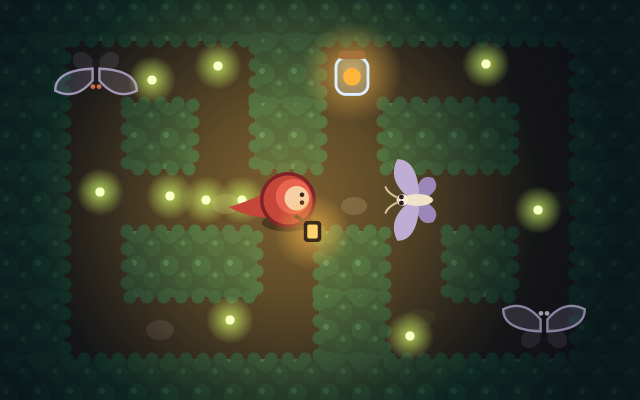
The most innovative aspect of the game is the Musical Gardening. As Kai progresses, she learns to plant gardens that serve as sites of emotional and environmental restoration. Each plant belongs to a specific “mood”—Melancholy, Joy, Wonder—and contributes a specific instrument or sound to the area’s background track. Planting a “Melancholy” garden might result in a sparse, cello-heavy arrangement, while a “Joy” garden might trigger a polyphonic synth loop.
The mechanic serves the story directly. The gardens act as a bridge between the narrative and the mechanics. You are often tasked with planting a garden to help a character process a specific emotion or to heal a piece of the island’s scarred landscape. It turns the player into a sonic steward, curating the atmosphere of the world. The procedural nature of the music means that no two players will hear exactly the same soundtrack, making the player’s impact on the world feel personal and quiet, rather than loud and destructive.
The Friction of the Slow Burn
However, this commitment to a slow pace is a double-edged sword. There is a significant amount of backtracking, and for some, the lack of traditional mechanical stakes will feel like a vacuum. The movement speed is deliberate—some might say sluggish—and the game refuses to be rushed. This is a design choice that serves the theme of “being present,” but it creates a high barrier to entry for players conditioned by the dopamine-loop design of modern titles. If you are looking for “fun” in the traditional sense, you won’t find it here. What you will find is resonance, which is a far more difficult thing for a developer to achieve.
Visuals & performance
Visually, the game is a standout. The hand-illustrated environments use a bold, limited color palette that makes every frame look like a piece of high-end concept art. The character designs are imaginative without being grotesque; the “mutancy” of the inhabitants is treated as a physical trait rather than a plot point, which reinforces the game’s themes of acceptance.
On the technical front, a 2D adventure of this scope is light on hardware, and the clean UI stays out of the way to let the art breathe. The design does lean on transitions between certain areas of the island, which can interrupt the flow of exploration—a small cost in an otherwise polished package.
Platform nuances
On Steam, the game benefits from the precision of mouse-and-keyboard navigation, which suits the gardening interface. However, Mutazione seems most at home on the Nintendo Switch. The “soap opera” structure of the narrative—short vignettes that build over time—lends itself naturally to handheld play, where a few “days” of the game make for a satisfying chapter-like session. The bold art style and vibrant colors are well suited to the Switch’s screen.
Final verdict
Mutazione is a distinctive entry in the gaming landscape. It is a confident, quiet, and deeply human experience that understands the power of a well-timed conversation. While its slow pace and lack of traditional action will deter those seeking a thrill, it offers something rarer: a space to breathe, to listen, and to reflect on the complicated nature of community. Die Gute Fabrik hasn’t just built a game; they’ve cultivated an ecosystem of radical empathy — one we recommend, with the caveat that it asks more patience than most.
Reviewed by the Rankeno RPG & Adventure Desk. Scores are out of 10; the overall score is the desk’s editorial judgement, informed by the four sub-scores above. How we review