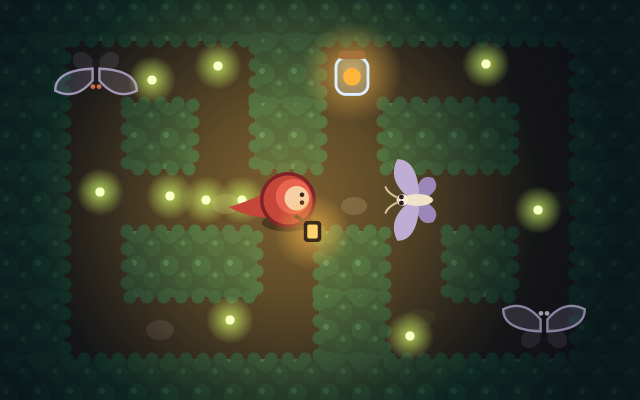
Overview
At first glance, Pâquerette Down the Rabbit Hole (and its meta-textual rabbit hole) looks like a relic from the Game Boy Advance era that somehow missed its release date. It is draped in the “cozy” aesthetic that has become the default skin for independent projects seeking to lure in the unsuspecting. But do not let the charming pixel art or the whimsical soundtrack fool you. Beneath the surface of this bunny-catching exercise lies a mechanical rigidity that would make the most hardened software engineer sweat. Developed by Bunstack and published by Abiding Bridge, this title is a rigorous interrogation of the player’s ability to internalize and manipulate a closed logical system.
The premise is simple: players take the role of Pâquerette, a girl whose singular, borderline-unsettling obsession is capturing bunnies. Players navigate through five distinct burrows, each introducing mechanics that complicate the core task. However, the market positioning here is what truly interests us. We are currently living through a “Golden Age” of the “Knowledge-Gate” puzzle genre—a lineage that includes giants like Baba Is You, Stephen’s Sausage Roll, and The Witness. Pâquerette fits into this hierarchy not by offering more content, but by offering more depth per square pixel. It strips away the fluff of modern gaming, focusing entirely on a deterministic pathfinding logic that turns every movement into a high-stakes calculation. It doesn’t rely on RNG or “hidden” variables; every failure is a direct result of the player’s misunderstanding of the world’s immutable laws. This is a game for those who find beauty in the absolute and the predictable—and who aren’t afraid to have their intelligence insulted by a digital rabbit.
Key features
- Deterministic Pathfinding: Bunnies follow a strict movement priority (Forward > Left > Right) based on the player’s position, removing all guesswork from the equation.
- Layered Toolset: Traps, pickaxes, shovels, and carrots act as logic modifiers rather than simple “power-ups,” requiring surgical precision in their deployment.
- The ‘Hell’ Meta-Layer: A hidden, non-linear progression path that breaks the conventional level structure and forces players to exploit the game’s underlying engine in ways that feel like hacking.
Analysis
To understand why Pâquerette Down the Rabbit Hole works, one must first accept that the bunnies are not characters; they are mobile logic blocks. The core gameplay loop is an exercise in spatial manipulation. Because the bunny’s behavior is entirely predictable—moving away from the player with a fixed priority of Forward, then Left, then Right—the player’s avatar becomes the primary input for the bunny’s “algorithm.” Players aren’t “chasing” a bunny so much as “programming” its path towards a corner.
The Deterministic Trap
The brilliance of this system lies in its transparency. In many puzzle games, difficulty arises from complexity—too many moving parts or obscured rules. Bunstack takes the opposite approach. The rules are laid bare almost immediately. The friction comes from the human brain’s inability to perfectly project the consequences of five sequential moves. When the pickaxe (which breaks walls) or the shovel (which creates holes) enters the picture, players are rewriting the bunny’s potential pathfinding tree. The carrot, perhaps the most nuanced tool, flips the script by luring the bunny towards the player, yet it still adheres to the deterministic priority. It builds emergent complexity out of minimalist inputs.
Knowledge Gates and the Meta-Shift
Around the midpoint of the game, the experience shifts from “solving levels” to “understanding the universe.” This is where the “knowledge gate” philosophy takes center stage. Players encounter obstacles that seem physically impossible given their current understanding of the mechanics. The solution isn’t a new item or a level-up; it’s a realization. The design invites long, staring-at-the-screen standoffs until a specific interaction between a trap and a hole suddenly behaves in a way that hadn’t been considered. This is the “Aha!” moment that defines the genre, and Pâquerette delivers them with punishing frequency.
Then there is “Hell.” Without spoiling the discovery, the transition into this hidden area represents a tonal and mechanical pivot that few games have the courage to attempt. It strips away the hand-holding of discrete levels and presents a sprawling, interconnected nightmare of logic. Here, the game expects players to apply the rules in non-linear ways, often requiring them to carry “state” across what previously looked like independent puzzles. The presence of Ophéline adds a layer of mystery that serves as a narrative carrot, but the real draw remains the masochistic satisfaction of cracking a seemingly unbreakable code. The onboarding friction is high, but the payoff is a rare sense of genuine intellectual triumph.
The UX of Logic
The interface is sparse, which is a necessity. In a game where one wrong step ruins a ten-minute setup, the Undo function is the most vital tool, and Bunstack has made the “undo/redo” cycle frictionless, acknowledging that experimentation is the only way to bridge the gap between intuition and logic. However, the game could benefit from a more robust “planning mode”—perhaps a way to visualize the bunny’s next move without committing to a step. While some might argue this would “solve” the game, it would merely remove the mental fatigue of calculating the F>L>R priority for every tile.
Visuals & performance
The aesthetic direction is a deliberate subversion. The 16-bit pixel art is clean, legible, and evocative of a simpler era, which provides a necessary psychological cushion for the grueling difficulty. As a 2D game of this scope, it is light on hardware demands, and the deterministic logic poses no meaningful technical challenge for any modern machine. The UI design is functional, though some of the meta-secret menus feel intentionally obtuse—a stylistic choice that fits the “rabbit hole” theme but may annoy those looking for a more streamlined experience. The soundtrack is a highlight; it’s atmospheric and looping, designed to fade into the background during deep flow states, yet memorable enough to hum long after the game is closed.
Platform nuances
On Steam, keyboard and controller both feel natural, though the grid-based movement clearly favors the precision of a D-pad or arrow keys. There is something tactile about tapping out a sequence of moves like a programmer entering code. The game’s “one more puzzle” structure is a natural fit for handheld play, though the later, more complex meta-puzzles might benefit from a larger screen and a notepad. The design is lightweight and polished to a mirror finish.
Final verdict
Pâquerette Down the Rabbit Hole (or Bunburrows, if you’re a literalist) is an essential addition to the modern puzzle canon. It refuses to compromise its vision, offering a pure, unadulterated distillation of logical challenge. It is frequently frustrating, occasionally obtuse, and utterly brilliant. We rate it Outstanding: Bunstack has proven that you don’t need a sprawling open world or a blockbuster budget to create a sense of vast, terrifying scale; you just need a girl, a bunny, and a set of rules that never, ever break.
Reviewed by the Rankeno RPG & Adventure Desk. Scores are out of 10; the overall score is the desk’s editorial judgement, informed by the four sub-scores above. How we review