


Bottom Line: Tensori’s POOLS is a masterclass in atmospheric minimalism that proves the scariest thing in the dark isn't a monster, but the sheer, clinical indifference of an empty room. It is a haunting, high-fidelity exploration of "liminal space" that values mood over mechanics to a degree that will either entrance or infuriate you.
To understand POOLS, one must first accept the "walking simulator" label not as a critique, but as a manifesto. Most horror games use the environment as a stage for an antagonist; in POOLS, the environment is the antagonist. The gameplay loop is deceptively simple: walk, observe, turn a corner, and hope the next room makes more sense than the last. But within this simplicity lies a profound understanding of how architecture can manipulate human emotion.
The Architecture of Anxiety
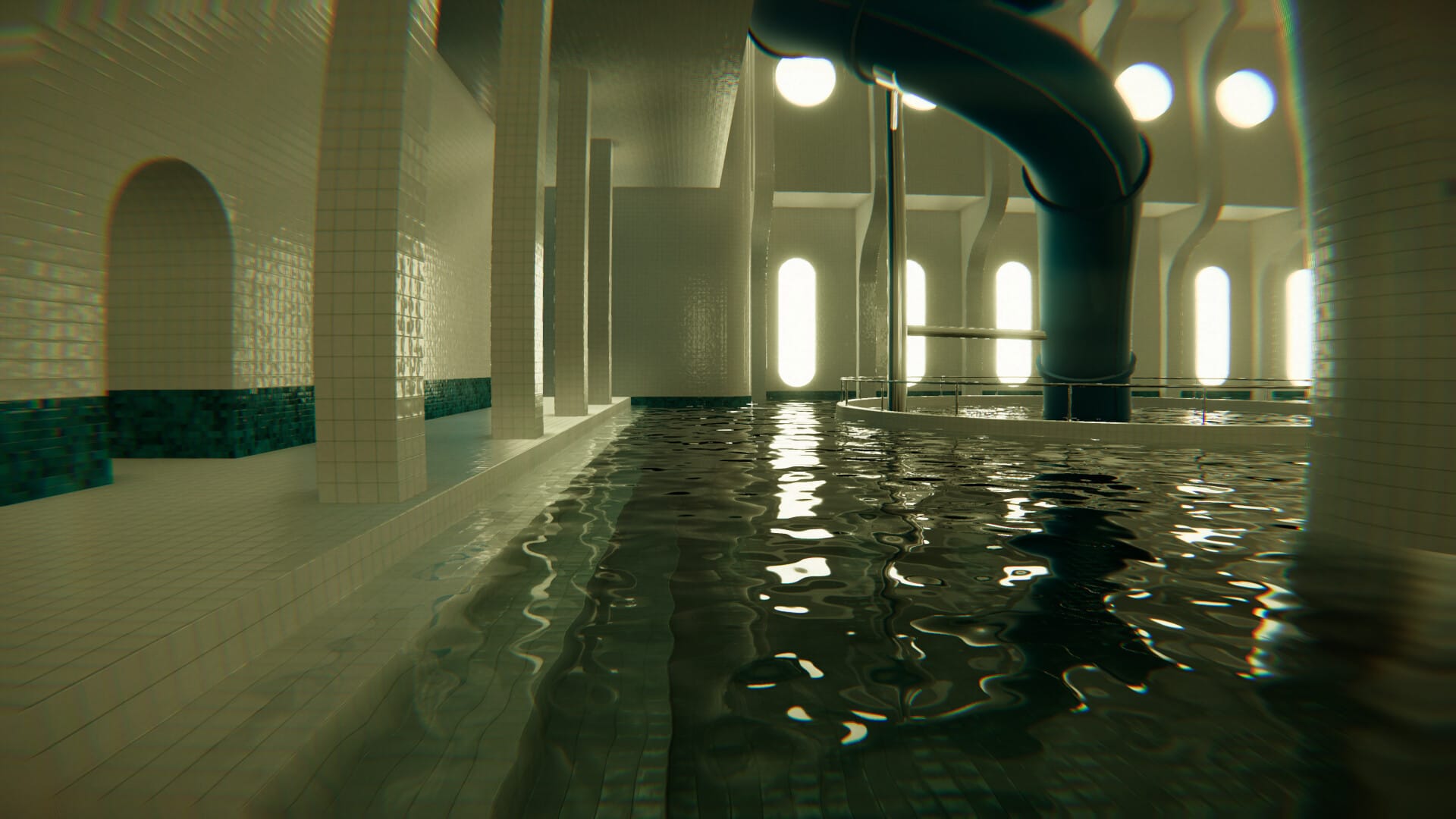
Tensori’s level design is a triumph of the "uncanny valley," applied not to faces, but to spaces. The hallways are just a bit too long; the ceilings are just a bit too high. The game excels at creating non-Euclidean-adjacent feelings—the sense that you have circled back to where you started, only to find the water level has risen six inches. By removing the traditional UI, the developer forces you to look at the world, not at a compass. This creates a sense of onboarding friction that is entirely intentional. You feel lost because you are lost, and without a "map" button to save you, you are forced to engage with the tiles, the drains, and the ladders with an intensity rarely seen in more traditional titles.
The Weight of Silence
The decision to omit background music is perhaps the game’s most effective technical choice. In most horror titles, the soundtrack acts as a safety rail, signaling when to be scared and when to relax. POOLS removes that rail. Every sound you hear is generated by your interaction with the world. The acoustic latency of the echoes in a large vaulted pool room creates a persistent sense of being followed. You stop walking, but the echo takes a half-second to catch up, leading to a constant, neck-prickling paranoia. It’s an ASMR experience curdled into something threatening. The "squelch" of footsteps on wet porcelain is captured with such clarity that it becomes a rhythmic hypnotic device, lulling you into a trance before a sudden change in water depth jolts you back to reality.
Minimalism vs. Engagement
Critics of the genre will inevitably point to the lack of "agency." You aren't "doing" much in POOLS besides moving forward. However, this critique misses the point of the existential dread the game seeks to evoke. The lack of traditional mechanics—puzzles, keys, combat—removes the "gamer" brain's ability to gamify the fear. You can't optimize your path; you can't "beat" the architecture. You can only endure it. This makes the seven-chapter structure feel less like a series of levels and more like a series of psychological states.
That said, the two-hour runtime is a double-edged sword. For some, it is the perfect "one-sitting" experience that doesn't overstay its welcome. For others, the lack of a traditional narrative payoff or a "boss" might make the $10-$15 price point feel steep. Yet, the overwhelming positivity from the community suggests that there is a massive hunger for this kind of pure aesthetic immersion. It’s a bold rejection of the "more is more" philosophy of modern AAA development, proving that a single, well-rendered tile can be more evocative than a hundred scripted explosions.