
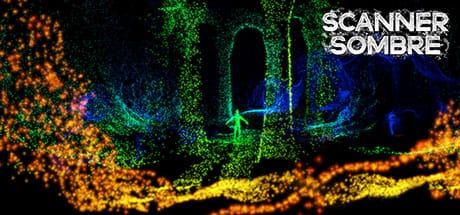



Bottom Line: A haunting, visually arresting experiment in sensory deprivation that turns exploration into an act of creation, even if the journey ends before it truly peaks.
The LIDAR Loop
The brilliance of Scanner Sombre lies in its friction. In most games, vision is a given—a passive background process. Here, vision is an active resource. Every step forward requires a choice: do you scan the floor to ensure you don't tumble into a chasm, or do you scan the ceiling to appreciate the scale of the cathedral-like cavern you’ve stumbled into? This creates a rhythmic, hypnotic gameplay loop. You aren't just walking through a level; you are an archaeologist of the immediate, uncovering the geometry of the world one click at a time.
The color-coding isn't just aesthetic; it’s critical for survival. The transition from the warm reds of a nearby stalactite to the cold, distant blues of a far wall provides a primitive form of depth perception that feels remarkably natural. There is a profound sense of satisfaction in turning around after an hour of play and seeing the trail of "light" you've left behind—a neon scar cut through the darkness that maps your exact movements.
Narrative Friction and Atmosphere
While the mechanic is the star, the story acts as the tether. Scanner Sombre leans heavily into the "haunted cave" trope, but it does so with surprising restraint. You aren't being chased by monsters in the traditional sense; the horror is purely atmospheric. The discovery of abandoned campsites, rickety rope bridges, and the occasional "echo" of a past event provides enough momentum to keep you moving upward.
However, the narrative is where the game’s linear nature becomes most apparent. Because the world only exists where you point your scanner, there is very little room for emergent discovery. You follow the path the developers laid out because, quite literally, nothing else exists. The cultist subplot feels a bit thin—a standard-issue mystery to justify the creepy vibes—but it serves its purpose without getting in the way of the visuals.
The VR Factor
If you play Scanner Sombre on a traditional monitor, it is a beautiful, if somewhat detached, experience. In VR, however, the game becomes a different beast entirely. The sense of scale is staggering. Standing on the edge of a light-mapped abyss while wearing an HTC Vive triggers a genuine physiological response. The claustrophobia of the tight tunnels and the sudden, overwhelming openness of the larger chambers are felt in the gut. The LIDAR dots, which look like a 2D effect on a screen, take on a tangible, 3D presence in VR. You feel as though you are standing inside a data visualization, a ghost in a machine.
The Brevity Problem
The most significant critique leveled against Scanner Sombre—and one that is difficult to dismiss—is its length. At roughly two to three hours, it occupies a space between a high-concept tech demo and a full-featured game. Once the novelty of the LIDAR scanner wears off, there isn't much mechanical depth to replace it. The upgrades (like the burst fire or the map) are appreciated but don't fundamentally change how you interact with the world. It’s a tight, focused experience, but those looking for a deep exploration of "why" might find the "how" a bit too fleeting.