Bottom Line: Screeps: World is a brutal, brilliant experiment in decentralized engineering that transforms software architecture into a weapon of war. It is less of a game and more of a full-time job where the "fun" is found in the elegance of your own abstractions.
To understand Screeps, one must stop thinking like a gamer and start thinking like a System Architect. Most RTS games are about the "loop"—harvest, build, destroy. In Screeps, the loop is shifted. You aren't managing units; you are managing the logic that manages the units.
The Script as an Organism
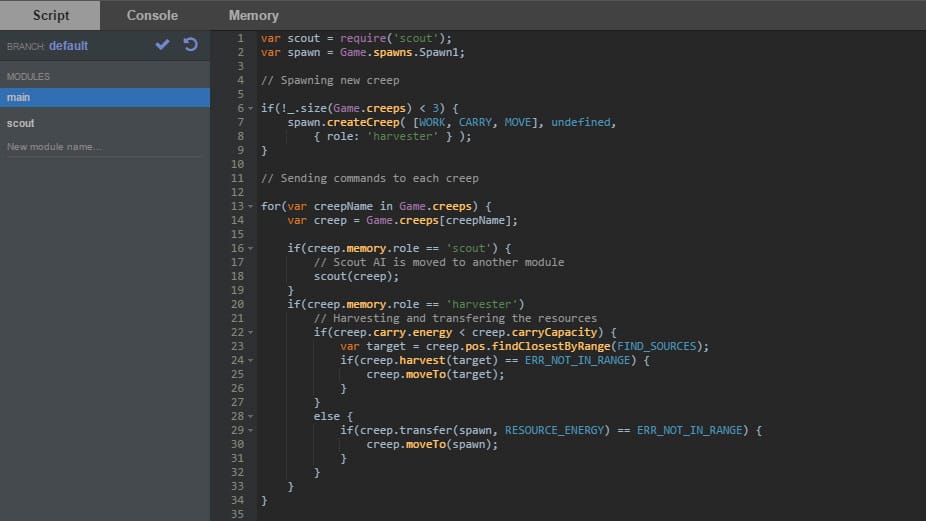
The initial "onboarding friction" is immense. While other games might give you a sword, Screeps gives you an empty IDE and a link to a documentation API. Your first few hours will be spent writing basic state machines: if energy < capacity, move to source; else, move to controller. However, as your colony grows, these simple routines collapse under the weight of their own inefficiency. You quickly realize that you need a task-scheduler, a centralized memory management system, and a way to handle creep spawning based on dynamic demand. The game forces you to evolve your code from a script into a full-fledged application.
The CPU Economy
The true brilliance of Screeps lies in its CPU limit. Unlike traditional games where "optimization" is something developers do, here it is a core gameplay mechanic. Every tick, you are allotted a certain number of milliseconds of execution time. If your pathfinding algorithm is sloppy or your logic loops are inefficient, you will hit your cap, and your creeps will simply stop moving. This creates a fascinating tension: do you write a more intelligent combat AI that consumes more CPU, or do you keep it simple so you can manage more rooms simultaneously? It’s a literal translation of computational complexity into territorial influence.
Socio-Technical Dynamics
The MMO aspect introduces a layer of meta-diplomacy that is rarely seen outside of titles like EVE Online. Because players are programmers, the "warfare" often takes place on Slack or Discord, where players negotiate non-aggression pacts or trade shared code libraries. Attacking a rival isn't just about having more units; it’s about finding a logic flaw in their defense script. Can you bait their defenders into a corner using a specific movement pattern that their code doesn't handle? Can you overwhelm their CPU by forcing them to calculate too many hostile paths? It is a cerebral, cold-blooded form of competition.
The Barrier to Entry
It must be said: Screeps is hostile to those who cannot code. While the community is helpful, the game makes no apologies for its steep learning curve. The "tick rate"—the speed at which the game processes turns—is intentionally slow on the official servers to accommodate the massive scale, which can be frustrating for those used to the instant gratification of modern RTS titles. Yet, for those who speak the language, this slowness is a feature. It allows for deep, contemplative engineering.