
Bottom Line: Severed Steel is a blistering, neon-soaked fever dream that strips the first-person shooter to its core kinetic essentials and leaves the reload button on the cutting room floor.
The brilliance of Severed Steel lies in its rejection of the "stop-and-pop" mechanics that have defined the genre for decades. Most shooters treat movement as a way to get from one shooting gallery to the next. Here, movement is the defense. The moment you stop sliding or wall-running, you are vulnerable. This creates a psychological shift in the player; you stop looking for cover and start looking for the next piece of geometry to exploit.
The Kinetic Loop
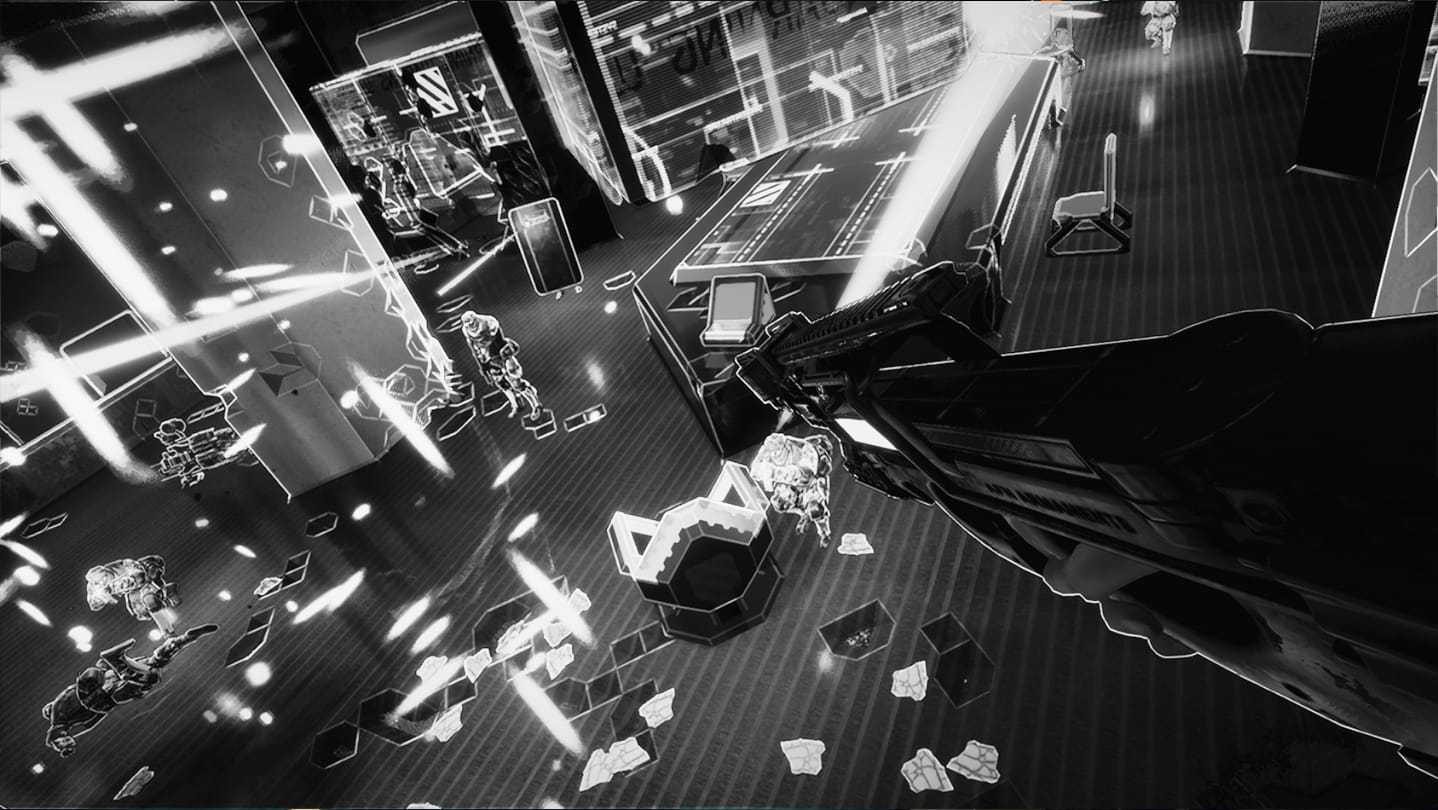
The gameplay is a staccato rhythm of chaos. You enter a room, trigger Bullet Time, and evaluate the threat. You see three guards. Your pistol has two rounds. You headshot the first, throw the empty gun at the second to stagger him, and slide toward the third. During the slide, you are invincible. You kick the third guard, take his shotgun, and use your arm cannon to blow a hole in the floor, dropping into the room below before the second guard can recover.
This isn't just a sequence of actions; it’s a lethal choreography. The "Bullet Ballet" isn't marketing speak—it’s an accurate description of the game’s spatial puzzles. The challenge isn't just aiming; it’s maintaining the stunt meter to ensure you don't get shredded by the overwhelming odds. The AI is aggressive enough to punish hesitation but predictable enough to be manipulated by a player who understands the verticality of the voxel environments.
Spatial Vandalism
The destructibility isn't just for show. In many shooters, a locked door is an impassable barrier. In Severed Steel, a locked door is an invitation to use your arm cannon on the wall next to it. This level of environmental agency transforms the maps into playgrounds. You aren't following a path; you are carving one. However, this freedom comes with a trade-off. The levels are often quite small, designed more as combat arenas than sprawling worlds. This brevity is the game’s most significant friction point. The campaign can be cleared in a single sitting, which might leave some feeling short-changed.
Replayability and Depth
To combat the short campaign, the inclusion of Firefight Mode and Rogue Mode is essential. Rogue Mode, in particular, adds the "one-more-run" hook that the base game lacks. By introducing permadeath and randomized upgrades, it forces you to master the mechanics rather than just memorizing enemy placements. It turns a brief experience into a deep, iterative challenge that rewards technical mastery.