
Bottom Line: Sokobond is a masterclass in minimalist puzzle design, cleverly translating chemical bonding into a surprisingly accessible and deeply satisfying intellectual challenge. Its understated brilliance on Nintendo's platform proves that profound engagement doesn't require sensory overload.
To truly appreciate Sokobond, one must look beyond its unassuming façade. This isn't a game about flashy graphics or intricate narratives; it's a masterclass in mechanical purity, demanding intellectual rigor and spatial reasoning above all else. The central loop—moving a primary atom to initiate bonds—might appear simplistic, but it quickly blossoms into a rich tapestry of emergent complexity. Each bond formed irrevocably alters the geometry of the burgeoning molecule, restricting subsequent movements and demanding foresight several steps ahead. This is where Sokobond graduates from a mere puzzle game to a profound exercise in systems thinking.
The Molecular Metaphor
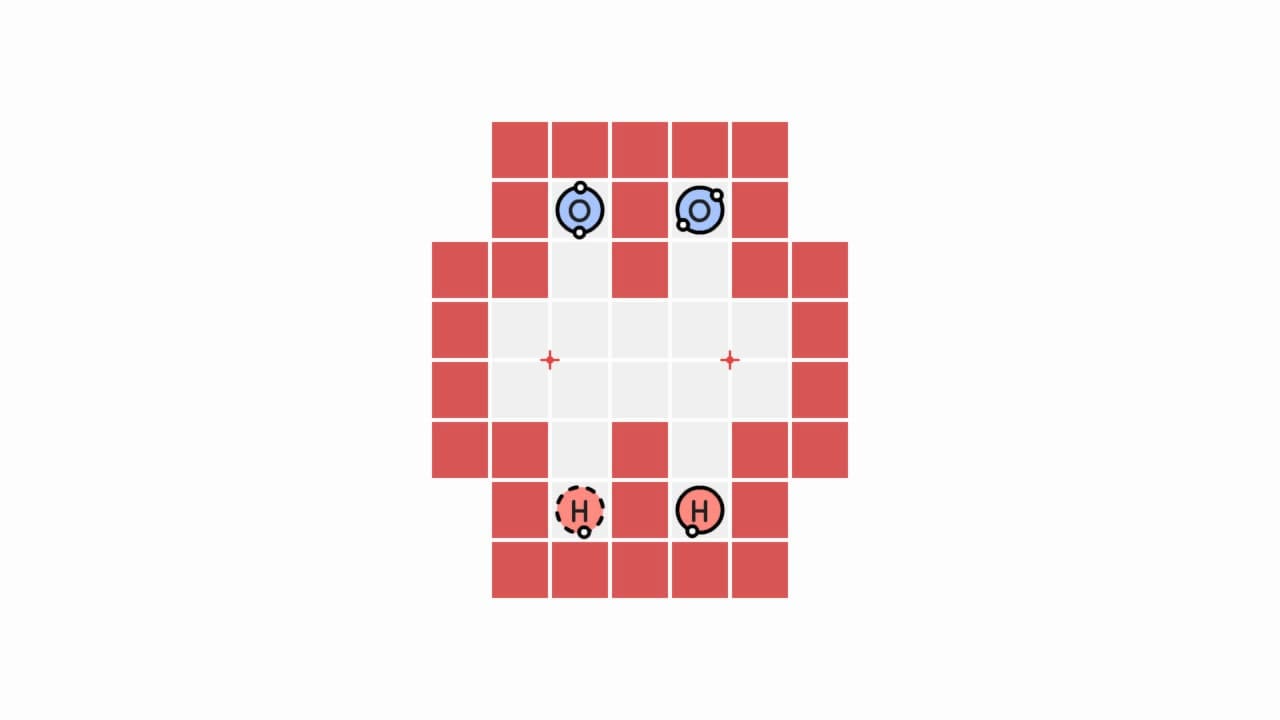
The genius of Sokobond lies in its complete demystification of chemistry. Players aren't performing complex calculations or recalling molecular formulas; they're intuitively grasping the rules of connection and restriction. An atom with a valency of two, for instance, visually communicates its capacity, guiding players to understand that it needs two connections. As atoms bond, they become a single, larger entity, changing their collective movement properties. This visual and mechanical feedback loop is impeccable, allowing players to internalize complex rules through direct interaction rather than rote memorization. The game constantly introduces new elements—double bonds, unstable configurations, or environmental obstacles—each subtly layered onto the core mechanic, creating a sense of natural progression that feels both challenging and fair. The initial levels serve as an exquisite tutorial, patiently establishing the lexicon of its unique logic without a single word of explicit instruction.
The Art of the Puzzle Curve
Draknek & Friends demonstrate an exceptional understanding of puzzle design. The difficulty curve in Sokobond is less a jagged mountain and more a gently ascending incline, punctuated by strategic plateaus where new concepts are introduced and then immediately integrated into the existing framework. This iterative process prevents frustration, ensuring that players always feel equipped to tackle the next challenge, even as the solutions become exponentially more intricate. Solving a particularly thorny level in Sokobond isn't just a matter of trial and error; it’s an "aha!" moment, a sudden crystallization of understanding where the entire molecular structure snaps into place. This intellectual gratification is the game's primary reward, a testament to its design philosophy that values pure ingenuity over forced engagement. The game respects the player's intelligence, offering no hand-holding beyond the initial, elegant mechanical introductions.
User Experience and Cognitive Flow
The user experience in Sokobond is defined by its frictionless interface and contemplative pacing. There are no timers, no distractions, just the puzzle and the player's mind. This creates a powerful cognitive flow, allowing for deep concentration and sustained problem-solving. Controls are inherently simple: move the primary atom, and any bonded atoms follow, often rotating in a constrained fashion. Understanding these rotational dynamics is key to mastering the later levels. The clean, minimalist UI means all vital information—atom types, bonding capacity, available space—is immediately visible, reducing any extraneous cognitive load. The subtle sound design further enhances this, with gentle clicks and pops accompanying movements and bonds, providing satisfying audio feedback without ever becoming intrusive. Sokobond doesn't shout for attention; it earns it through sheer intellectual magnetism.