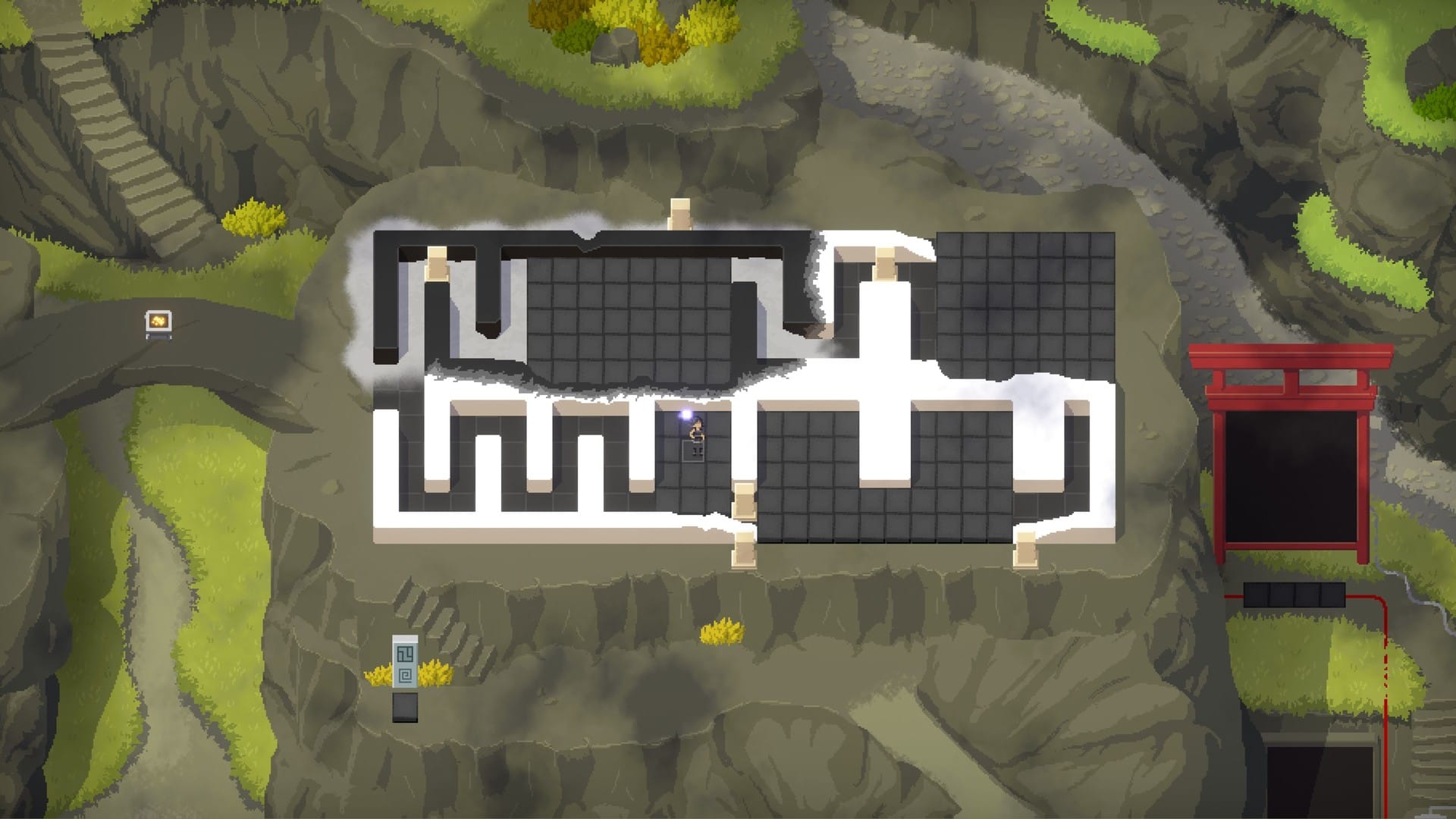




Bottom Line: A masterful evolution of the "witness-like" genre that replaces heavy-handed tutorials with pure, unadulterated epiphany; it is the most rewarding logic-puzzler in years.
The core of Taiji is a masterclass in onboarding friction. Instead of explaining a mechanic, the game presents you with a trivial puzzle. You solve it, feel clever, and move to the next. Then, the rules shift. Suddenly, the environment—the colors of the flora, the placement of stone pillars, the specific orientation of shadows—becomes the key. This is the epistemic loop that defines the experience: you are constantly learning a language that is written into the very pixels of the world.
The Mechanics of Epiphany
The interface is deceptively simple. Every puzzle is a grid. You toggle tiles on or off. That’s it. However, the logic behind those tiles is where the genius lies. In the serene gardens, you might be tracking floral patterns; in the industrial zones, you might be tracing the flow of electricity through broken pipes or observing the rhythm of flickering lights. The game forces you to step back from the screen—literally and figuratively—to see the world as a series of hints. This is where Taiji excels over its contemporaries; it integrates the world and the puzzles so tightly that the island itself becomes a giant, sprawling logic board.
Structural Rhythms and Friction
The non-linear structure is a necessary safety valve. In a 400-puzzle game, you will hit walls. VanDevander understands that the "aha!" moment cannot be forced; it must be cultivated. By allowing players to wander off to a different biome, the game provides a "cooling off" period. You might be struggling with a complex meta-puzzle in the Ancient Ruins, only to find a simpler iteration in the Serene Gardens that suddenly makes the original problem click into place. It’s a rhythmic flow of frustration followed by sudden, sharp clarity.
However, the game isn't without its friction points. Traversal speed is arguably the game’s greatest weakness. The walking pace is deliberate, bordering on sluggish, which makes backtracking through solved areas feel like a chore. While a hidden fast-travel system exists, players may spend several hours feeling the weight of the island’s scale before they uncover it. Furthermore, some of the late-game "meta-puzzles"—which require you to solve puzzles that aren't even on grids—can feel so abstract that they veer into "guide-dang-it" territory for anyone who isn't a savant of spatial observation.
The Depth of the Meta
Beyond the surface grids lies a layer of depth that rewards the most observant. Taiji is packed with secrets that are hidden in plain sight. It challenges your assumptions about what constitutes a "puzzle." Sometimes the answer isn't in the grid you're clicking; it's in the way the grid reflects the horizon. This level of environmental storytelling through logic is rare, and it elevates Taiji from a mere collection of brain-teasers to a cohesive, atmospheric world that feels lived-in, even in its silence.