Bottom Line: A brutal, tactile love letter to analog signal processing that swaps abstract code for the intimidating reality of a modular rack. It is the most satisfyingly frustrating engineering sim on the market.
The Logic of Electricity
Most "coding" games rely on the comfort of discrete values. You move a block from A to B; you increment a variable. The Signal State abandons this safety net. By focusing on analog signals, it introduces a layer of onboarding friction that is both its greatest strength and its most significant barrier to entry. You aren't just solving a puzzle; you are learning the fundamentals of signal attenuation and voltage manipulation.
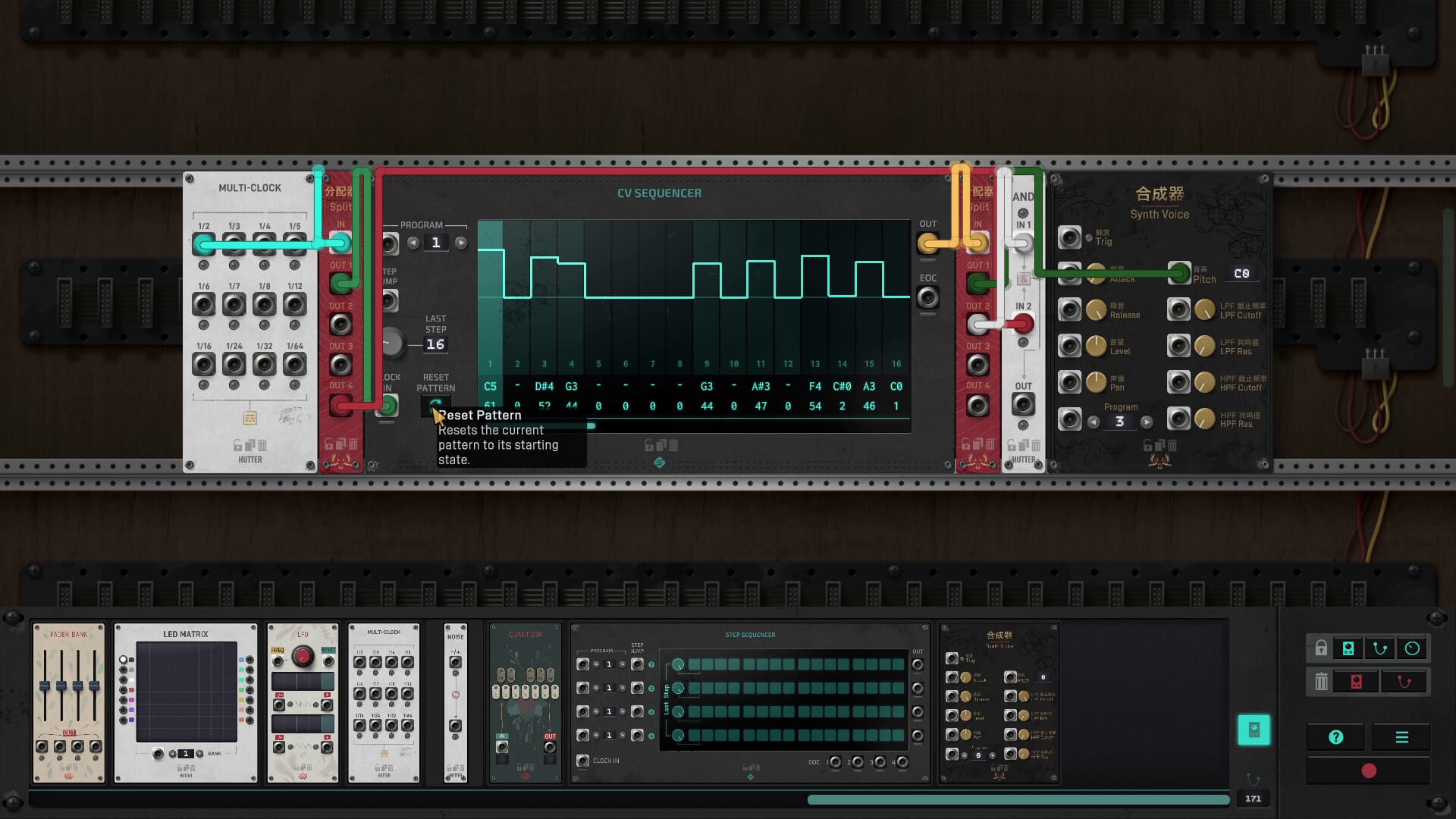
The goal in each stage is to transform a set of input signals into a target output waveform. To do this, you must understand how a mixer combines signals or how a VCA can be used to modulate one signal's amplitude with another. This isn't just "logic" in the traditional sense; it’s an exercise in flow. The difficulty curve doesn't just climb; it sheer-faces. By the middle of the campaign, the game expects a level of fluency in signal routing that would make a professional roadie sweat.
Tactile Skeuomorphism
The user experience is defined by its tactility. There is a distinct, visceral satisfaction in dragging a patch cable from an output jack to an input, hearing the subtle click of the connection, and watching the virtual oscilloscopes react in real-time. This isn't a "clean" UI in the modern, flat-design sense. It is cluttered, industrial, and heavy. It feels like hardware.
However, this commitment to realism brings its own set of challenges. As puzzles grow in complexity, the "cable spaghetti" becomes a legitimate obstacle. While the game provides tools to manage the mess, the visual noise can occasionally obscure the underlying logic. It’s a design choice that favors immersion over "gamey" convenience, forcing the player to stay organized or drown in their own complexity.
The Engineering Loop
The gameplay loop is a relentless cycle of hypothesis, execution, and failure. You will spend twenty minutes staring at a target waveform, trying to reverse-engineer the math required to reach it, only to realize your logic gate is inverted. The "aha" moments aren't just rewarding; they are earned through genuine mental labor.
The inclusion of the Steam Workshop is the game’s secret weapon. While the campaign is a masterclass in puzzle design, the community has pushed the modules to their breaking point, creating "impossible" machines that function more like Rube Goldberg devices than agricultural tools. This longevity is critical for a title this niche, ensuring that once you've mastered the developer's curriculum, there is still a graduate program waiting for you.