Overview
The original Train Valley was a game about panic. You laid track, dispatched trains, and prayed two of them didn’t meet at the same intersection while a timer screamed at you. It was good. It was also thin. Train Valley 2, from Flazm (Alexey Davydov, Sergey Dvoynikov, Timofey Shargorodskiy), keeps the toy trains and throws out the panic-first design philosophy. What replaces it is something far more interesting: a game about supply chains.
That shift matters. Where the first game asked “can you avoid a collision?”, the sequel asks “can you build a system?” You’re no longer just moving a train from A to B. You’re hauling workers to a sand mine, routing the sand to a glass factory, and delivering the finished glass to a city that keeps demanding more. Each level is a little economy, and you are its infrastructure. The genre it lands in is the production-chain puzzle—closer to Factorio’s DNA than to a railway simulator—but wrapped in a presentation so gentle it could pass for a mobile time-waster.
It isn’t one. Underneath the low-poly charm sits a genuinely demanding optimization game. The market positioning is clever: this is a title that sells itself to the relaxed player browsing a phone store, then quietly hooks the min-maxer chasing a five-star clear. Priced as a modest indie across Steam, Android, and Nintendo Switch, it offers a lot for the money. The warm reception it has found is no accident. It’s earned.
Key features
- Multi-Step Production Chains: The heart of the game. Raw materials become intermediate goods become final products, and you build the rail network that makes each hand-off happen. Get one link wrong and the whole line stalls.
- Real-Time Track Switching: You don’t just build the network—you conduct it. Switches are thrown live, mid-run, forcing you to think like a dispatcher rather than an architect.
- Era Progression, Steam to Space: Levels march through history, from wheezing steam engines to the Space Age, with locomotive upgrades that change how you route and how fast the whole system breathes.
- Scalable Five-Star Objectives: Every level can be finished slowly and gently, or clawed through under punishing time, budget, and efficiency constraints. One game, two audiences.
- Steam Workshop Integration: On PC, a deep catalog of community maps. On console, a curated bundle of the best of them—an unusually generous port decision.
Analysis
The Gameplay Loop
The loop here is simple to grasp and quietly addictive. You survey a level: here’s a mine, there’s a factory, over there a city with a shopping list. Between them, empty land. Your job is to fill that land with track, place stations, and choreograph the trains so raw goods flow into finished goods and finished goods flow into demand. Then you hit go, and the system either sings or seizes.
What makes it work is friction between planning and execution. A lesser game would let you draw a perfect network and walk away. Train Valley 2 doesn’t. Trains share track. Junctions bottleneck. A route that looked elegant on paper becomes a traffic jam the moment three locomotives want the same switch at the same second. So you’re constantly toggling between two modes of thought—the architect who designs the layout and the operator who throws switches in real time to keep it from gridlocking. That duality is the game’s central pleasure, and few puzzle games pair planning with live dispatching this way.
The production chains are where the design earns its “2.” Hauling workers to a sand mine so the mine can produce sand, then feeding that sand to a glass factory, then delivering glass to the city—each step is trivial alone. Stacked, they demand you think about throughput, sequencing, and dependency. Miss the workers and the whole downstream chain dries up. It’s logistics, and it scales well as later levels layer three, four, five interdependent products on top of each other.
The Difficulty Curve
The five-star system is the smartest structural choice here. Clearing a level is easy—the game practically hands you a pass for finishing at your own pace. But five stars demand you do it fast, cheap, and clean, and that’s where the game reveals its teeth. Suddenly you’re re-laying track to shave seconds, deleting redundant stations to protect a budget, and rerouting whole lines to eliminate a two-second stall. This is the same trick that makes games like Baba Is You and Opus Magnum endlessly re-playable: a low floor and a very high ceiling, with the player choosing where on that slope to stand. Casual players get a spa day. Completionists get a spreadsheet’s worth of optimization. Neither feels like an afterthought.
The Interface and Onboarding
Track-laying is direct and tactile—click, drag, build. The onboarding is patient without being condescending, doling out new mechanics one level at a time so the production chains never feel like a wall. The one persistent friction point is real-time management under a tight clock: when four trains need attention and the timer is bleeding out, the interface asks a lot of your reflexes, and the demands can outrun the tools you’re given to meet them. On PC that’s a fair fight. Elsewhere, less so—more on that below. But the core flow, plan-then-conduct, is clean enough that the rhythm should come quickly and hold.
Visuals & performance
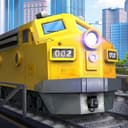
The low-poly 3D aesthetic is doing quiet, deliberate work. It’s not a budget compromise—it’s a legibility choice. Every station, factory, and locomotive reads at a glance, which matters enormously in a game where you’re parsing a whole network under time pressure. Cluttered realism would kill this game. The soft, storybook geometry keeps the board readable even when six trains are in motion.
The soundtrack matches the visuals: relaxed, atmospheric, and content to sit in the background rather than perform. It’s the aural equivalent of a good desk lamp—you stop noticing it, which is exactly the point. As for performance, a 2D-styled game of this modest scope is light on hardware by design, so it should sit comfortably on phones, PCs, and Switch alike. The art direction ages well precisely because it never chased fidelity in the first place.
Platform nuances
Here’s where the review has to get honest. Train Valley 2 is a PC game first, and it shows.
On Steam, with mouse and keyboard, the game is at its best. Track-laying is precise, switch-throwing is instant, and the tight five-star time constraints feel calibrated to exactly this input. The Steam Workshop is the cherry on top—a deep catalog of community maps means the content well is effectively bottomless.
On Nintendo Switch, the port is thoughtful. Bundling curated Workshop maps in place of live Workshop access is the right call, and it’s more generous than most console ports bother to be. But the track-laying controls turn slightly fiddly on a stick, and that fiddliness compounds under the clock. The demanding time objectives that feel fair with a mouse can feel faintly unjust with a controller. It’s playable and pleasant—just know the five-star grind asks more of you here.
On Android, touch is a natural fit for laying track—arguably more intuitive than a mouse for the building phase. The trouble is the same tight timers, now managed with fingertips that occlude the very board you’re reading. For a relaxed session, phone is a lovely place to play this. For hardcore optimization, the touchscreen fights you.
Final verdict
Train Valley 2 is a small game with a big idea executed with discipline. It takes a forgettable crash-avoidance toy and rebuilds it into a satisfying logistics puzzle that respects both the player who wants to unwind and the player who wants to break the level in half chasing efficiency. The production chains are clever, the five-star system is elegant difficulty design, and the art and sound know exactly what job they’re there to do.
It isn’t flawless. The real-time demands are pitched squarely at mouse and keyboard, which leaves the console and mobile versions a step behind when the timer gets mean. But that’s a caveat, not a condemnation. On any platform, at any pace, this is a sharp, well-made puzzle game—and on PC, it’s the version to get.
Reviewed by the Rankeno Puzzle & Casual Desk. Scores are out of 10; the overall score is the desk’s editorial judgement, informed by the four sub-scores above. How we review