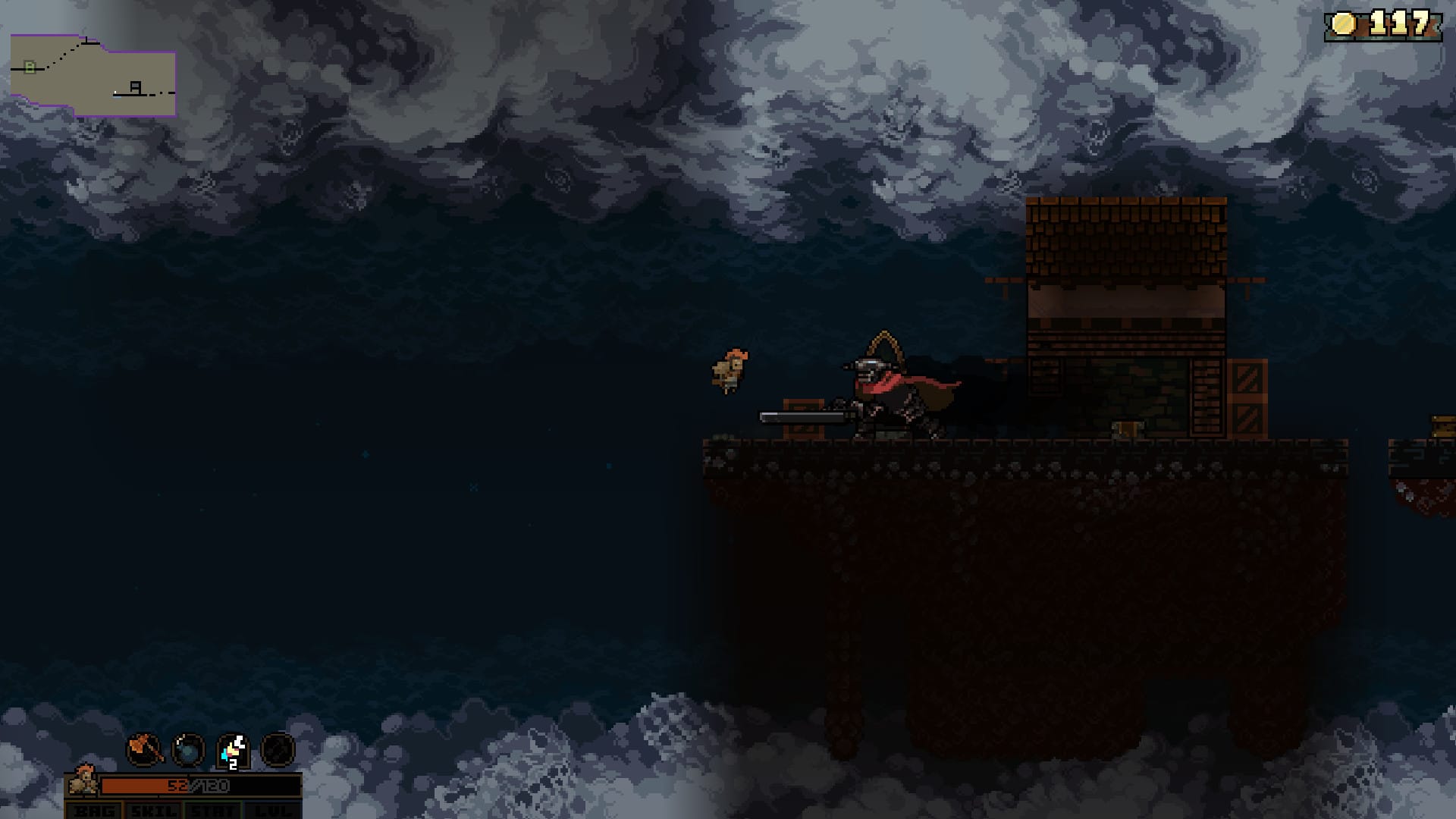
Bottom Line: Vagante is a punishing, deeply systems-driven roguelike that trades Spelunky’s slapstick chaos for a gritty, loot-heavy descent into darkness. It is an uncompromising masterclass in risk-reward design for those with the patience to survive its opening hours.
The RPG Pivot
The genius of Vagante lies in its rejection of the "flat" power curve. Most 2D roguelikes rely on a slow drip of permanent upgrades or simple stat buffs. Vagante instead embraces a robust RPG progression system that feels meaningful. Resting at a bonfire between levels isn't just a breather; it’s a moment of critical decision-making. Do you dump points into the Knight’s defense to mitigate the inevitable trap damage, or do you specialize in the Rogue’s agility to avoid it entirely? This granular control over your build transforms each run from a simple survival exercise into a specialized mission. The loot system further reinforces this, offering a vast array of weapons and artifacts that can be enchanted with buffs—or plagued by debilitating curses. Finding a powerful sword is one thing; deciding whether to risk equipping it before you've found an identification scroll is where the real tension lives.
The Identification Friction
Vagante’s most controversial and brilliant mechanic is its loot identification system. In an era where modern games prioritize "frictionless" experiences, Vagante purposefully grinds you against the stone. Finding a "Mysterious Ring" is a moment of genuine anxiety. Is it a ring of regeneration or a cursed band that prevents you from swapping weapons? You can use scrolls, or you can rely on intuition and bravery. This mechanic forces players to weigh the immediate need for power against the long-term risk of a ruined build. It’s a psychological layer that makes the simple act of looting feel like a high-stakes poker game.
Cooperative Chaos and Performance
While the solo experience is a somber, methodical crawl, the four-player co-op (both local and online) shifts the tone toward directed mayhem. The inclusion of a ghost mechanic—where fallen allies can continue to assist the living—is a smart concession that keeps the group engaged without trivializing the difficulty. However, the game's difficulty is notoriously punishing. There is a specific brand of frustration reserved for "one-hit" traps that are occasionally obscured by the game's dark art style. Some may call it "unfair," but in the context of Vagante’s design philosophy, these traps serve as an environmental tax on impatience. The game rewards tactical play and punishes the reckless with extreme prejudice.
Environmental Agency
The complex physics system allows for emergent gameplay moments that feel earned rather than scripted. Flooding a lower chamber to drown a difficult mob or lure a boss into a series of destructible traps provides a sense of agency that pure combat lacks. This interactivity makes the procedurally generated biomes feel less like "randomly arranged tiles" and more like a cohesive, if hostile, world. You aren't just moving through the cave; you are manipulating it to survive.