Bottom Line: A masterclass in non-violent mechanical expression that proves optimism is a more powerful design tool than a sword.
The Song Wheel: Communication as Gameplay
The core of Wandersong is its refusal to let the player do anything but sing. In most adventure games, the "interact" button is a context-sensitive Swiss Army knife. In Wandersong, that interaction is replaced by the Song Wheel. Using the right analog stick (or mouse), you trigger notes in an eight-directional circle. This isn't just a rhythm game mechanic; it is the game's primary language.
The brilliance of this system lies in its contextual flexibility. In one scene, you are singing to match the frequency of a ghost to understand its plight; in another, you are using your voice to direct the wind or guide a group of birds to lift you to a higher platform. There is a slight onboarding friction as you learn to map directions to pitches, but once it clicks, the act of "singing" becomes second nature. It creates a sense of mechanical intimacy with the environment that "press E to open" can never achieve.
Narrative Friction and the Relatable Hero
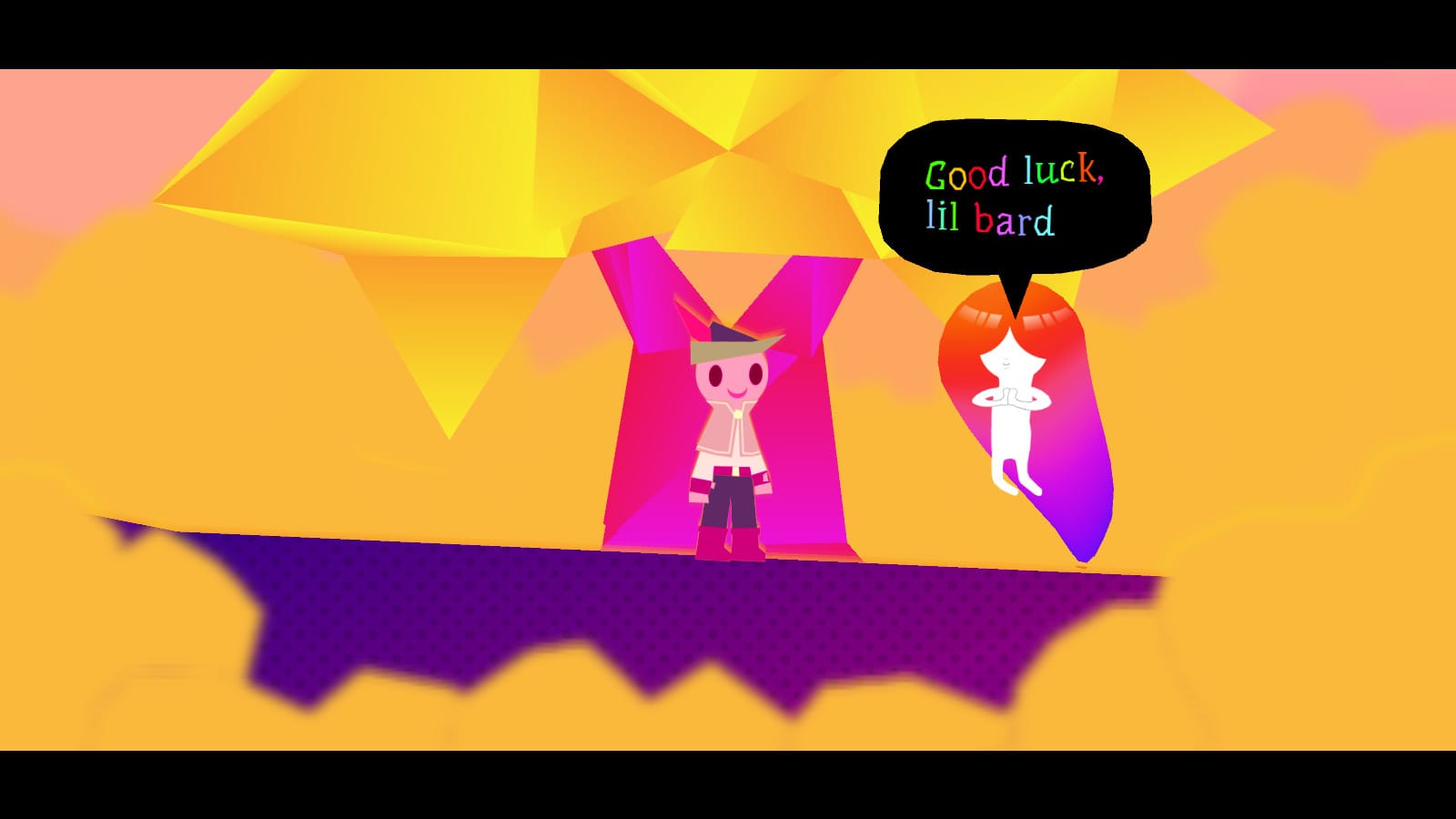
The Bard is a fascinating protagonist because of their inherent lack of "cool." They are clumsy, overly optimistic, and frequently ignored by the world’s "real" heroes. This creates a refreshing ludo-narrative harmony. Because you cannot fight, you must find other ways to resolve conflict. You don't defeat a grumpy dragon; you sing it a lullaby. You don't kill a group of pirates; you help them form a band.
The narrative is bolstered by Miriam, a cynical witch who joins the Bard on their quest. She serves as the perfect foil—the voice of the skeptical player who wonders if singing can actually save anything. Their relationship provides the game's emotional anchor, shifting from mutual annoyance to a deep, platonic bond that feels earned rather than scripted. The writing avoids the trap of being purely "saccharine" by acknowledging the weight of the apocalypse. The optimism isn't a denial of the world's end; it is a choice made in spite of it.
Accessibility as a Design Pillar
It is rare to see a game centered on music that doesn't alienate players with hearing or vision impairments. Wandersong solves this through visual skeuomorphism and clever UI design. Every note on the Song Wheel is associated with a distinct color and a directional symbol, meaning you don't actually need to hear the pitch to solve the puzzles. This isn't a "mode" you toggle in the settings; it is baked into the very architecture of the interface.
The puzzles themselves are rarely brain-teasers. They are more about rhythmic flow and environmental observation. While some hardcore genre fans might find the lack of "teeth" in the difficulty curve to be a drawback, it’s clear that the friction is meant to come from the story and the character arcs, not the platforming. The gameplay loop is designed to keep you moving forward, ensuring the pacing never stalls on a frustrating jump or an obtuse riddle.