

Bottom Line: Lingvist is a high-precision instrument for the serious learner, stripping away the colorful distractions of "edutainment" to focus on the cold, hard efficiency of AI-driven vocabulary acquisition.
The "gameplay loop" of Lingvist, if you can call it that, is a relentless stream of contextual challenges. You are presented with a sentence, a blank space, and a hint. You type the word. You move on. It is repetitive, bordering on meditative, and designed to induce a state of flow.
The Efficiency Engine
The brilliance of Lingvist lies in its real-time adaptation. Most apps force you through a linear path; Lingvist is a dynamic map. If you correctly identify a complex word on the first try, the app registers that knowledge and moves the goalposts immediately. This eliminates the "boredom ceiling" that plagues other platforms. By focusing on high-frequency vocabulary, the app ensures that every five minutes spent in the interface translates directly to increased comprehension in the real world. You aren't learning the word for "apple" for the tenth time; you are learning the words that actually appear in Le Monde or El País.
The Custom Deck Revolution
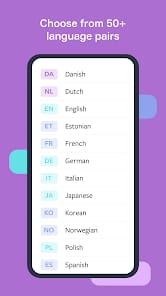
While the pre-built courses for Spanish, French, German, and others are robust, the Custom Deck feature is where Lingvist justifies its subscription price. In a professional context, this is invaluable. A lawyer can upload a set of legal briefs; a developer can upload technical documentation. The AI parses the text, identifies the most relevant terms you don't yet know, and builds a specialized curriculum. This transforms Lingvist from a general learning tool into a bespoke professional development platform. It is a feature that feels genuinely "next-gen" in a sea of stagnant competitors.
The Grammar Gap
However, Lingvist is not a silver bullet. The platform’s skepticism toward traditional instruction means that grammar explanations are relegated to the background. You learn grammar through osmosis and pattern recognition, which is fine for Romance languages but can lead to significant frustration with more complex systems like Japanese or Russian. It is a "vocabulary first" philosophy that assumes you will seek out deeper structural explanations elsewhere. If you are looking for a standalone course to take you from zero to hero, Lingvist will leave you with a massive vocabulary but a shaky grasp of why sentences are built the way they are. It is best viewed as a supplementary power-up rather than a primary textbook.