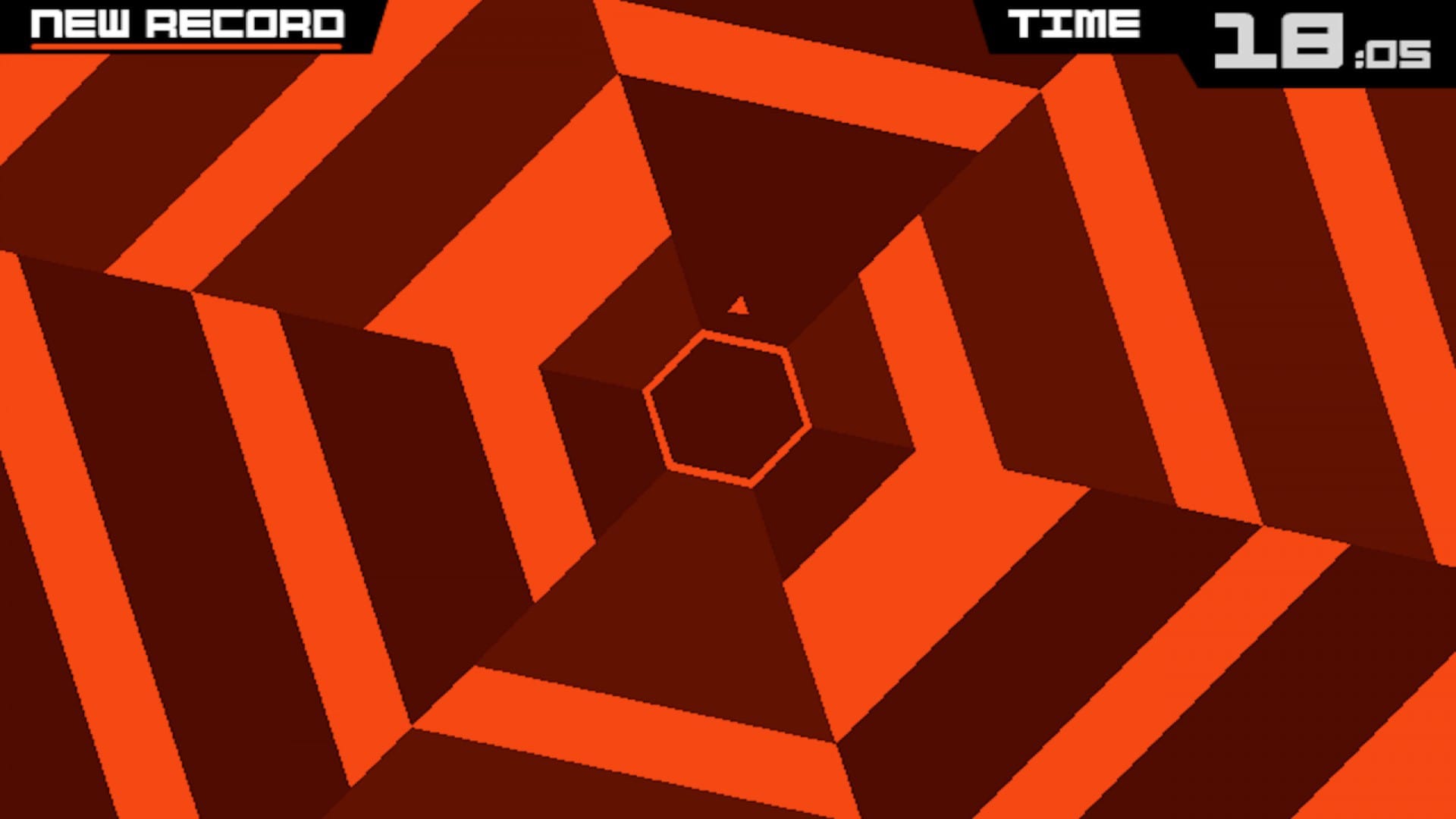

Bottom Line: Super Hexagon is an exercise in minimalist perfection that weaponizes frustration into a pure, rhythmic flow state. It is a brutal, essential masterclass in game design that demands everything from your nervous system and gives back nothing but the thrill of another two seconds of survival.
To play Super Hexagon is to enter a state of active meditation. At high speeds, the conscious mind becomes a bottleneck; if you have to think about which way to turn, you’ve already lost. Success requires a transition into a subconscious "flow state" where the player's eyes track the gaps and the thumbs react before the brain can process the threat.
The Psychology of the "One-More-Try" Loop
The core of the experience is the survival timer. Lasting ten seconds feels like an achievement; reaching sixty seconds feels like a god-like feat. The game leverages our innate desire for incremental improvement. Because each run is so short—often ending in five to fifteen seconds during the first hour of play—the perceived "cost" of failure is negligible. This is the secret to its addictiveness. You aren't losing twenty minutes of progress; you're losing twenty seconds. This lowers the barrier to re-entry until the player is caught in a recursive loop of "just one more."
Synesthesia as a Mechanic
The relationship between Chipzel’s soundtrack and the gameplay isn't just aesthetic; it’s functional. The music—a driving, aggressive chiptune score—acts as a metronome for the player's reflexes. The visual pulses of the background colors and the shifting of the hexagon's edges occur on the beat. This creates a cohesive sensory experience where sound and sight merge to provide cues about upcoming pattern changes. When the track "Focus" kicks in, the rhythmic driving force actually helps stabilize the player’s internal timing, allowing them to navigate the "spiral" and "half-hexagon" patterns that would otherwise feel chaotic.
The Brutality of "Hardestestest"
The difficulty curve is a vertical wall. By the time a player reaches the Hyper modes (the "Hardestestest" tier), the game ceases to be about reaction and becomes about pattern recognition and muscle memory. The screen begins to spin, the colors invert, and the walls close in at a pace that seems designed for machines rather than humans. Yet, it never feels unfair. Every failure is attributable to a late press or a misread pattern. There is no RNG (random number generation) that can't be overcome with skill. This mechanical honesty is why the game maintains a 97% positive rating on Steam; it respects the player enough to be uncompromising.
Interface and Friction
The UI design is a masterclass in stripping away "fluff." There is no main menu in the traditional sense; you simply cycle through the stages. The game stays out of its own way. Even the voice-over—a cool, detached female voice announcing "Begin" or "Game Over"—adds to the sterile, high-stakes atmosphere. It is a game that values the player's time, focusing entirely on the core mechanic of survival.