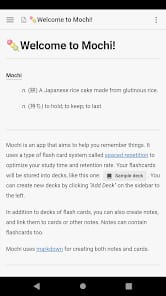




Bottom Line: Mochi isn't just another flashcard app; it's a sophisticated networked knowledge tool that bridges the gap between passive note-taking and active recall with surgical precision.
The Markdown Marriage
The decision to build Mochi entirely around Markdown is its most defining characteristic and its greatest barrier to entry. For the uninitiated, Markdown might seem like an unnecessary hurdle—why not just use a standard "What You See Is What You Get" (WYSIWYG) editor? The answer lies in structural integrity. By using Markdown, Mochi ensures that your data is clean, portable, and easily transformed.
When you write a note in Mochi, you aren't just typing text; you are building a database. The ability to flip a note into a flashcard with a simple syntax change is a revelation for anyone who has spent hours manually copying and pasting facts from a textbook into a study app. This isn't just a time-saver; it’s a fundamental shift in the onboarding friction of studying. You are curate-as-you-learn, rather than study-after-you-write.
The Networked Knowledge Base
Where traditional flashcard apps fail is in the "silo" effect. You might memorize that the mitrochondria is the powerhouse of the cell, but you lose the context of its role in cellular respiration if that card exists in a vacuum. Mochi’s support for bi-directional linking—the ability to link Card A to Card B and see that relationship from both ends—is where the app moves from a study tool to a genuine knowledge management system.
This "second brain" approach allows for latent discovery. As your deck grows, you begin to see connections between subjects you studied weeks apart. It encourages a deeper level of synthesis that rote memorization simply cannot touch. The interface visualizes these links with a clarity that makes your growing knowledge base feel like a physical, interconnected thing rather than a pile of digital scraps.
The SRS Engine and Utility Flow
The Spaced Repetition System (SRS) is the hidden hand that guides the user experience. Mochi’s implementation is transparent and customizable, but its default settings are tuned for high-efficiency retention. The "Review" loop is where the utility of the app truly shines. The interface strips away everything but the content, forcing you to engage with the material.
However, there is a distinct learning curve here. Mochi does not coddle you. If you don't understand how Markdown works, or if you aren't disciplined enough to tag and link your cards, the app can feel overwhelming. It demands a level of organizational intentionality that casual students might find taxing. The Pro subscription, while necessary for cross-platform syncing, is a reasonable ask for the level of cloud infrastructure required to keep a massive, media-rich networked database in sync across devices.