Bottom Line: SANABI is a rare triumph that marries the punishing precision of a hardcore platformer with a narrative so emotionally resonant it makes the genre's titans look shallow. It is a mandatory experience for anyone who values mechanical mastery and storytelling in equal measure.
The brilliance of SANABI lies in its refusal to compromise on its central conceit. In most action-platformers, the grappling hook is a secondary tool—a situational "get out of jail free" card. Here, it is your everything. The Gameplay Loop is built entirely around the tension and release of that chain. To play SANABI well is to maintain a constant state of flow, swinging through skyscraper canyons and using your momentum to smash through enemies like a kinetic wrecking ball.
Mechanical Purity
The "feel" of the hook is impeccable. There is a weight to the protagonist that requires you to account for gravity and inertia. You aren't just clicking on a point and teleporting there; you are anchoring yourself and managing a swing. This creates a steep but rewarding learning curve. Once you internalize the physics, the game transforms. You stop seeing platforms and start seeing arcs. The transition from swinging to a high-speed dash feels like snapping a rubber band, providing a tactile satisfaction that few 2D games achieve.
The Narrative Ambush
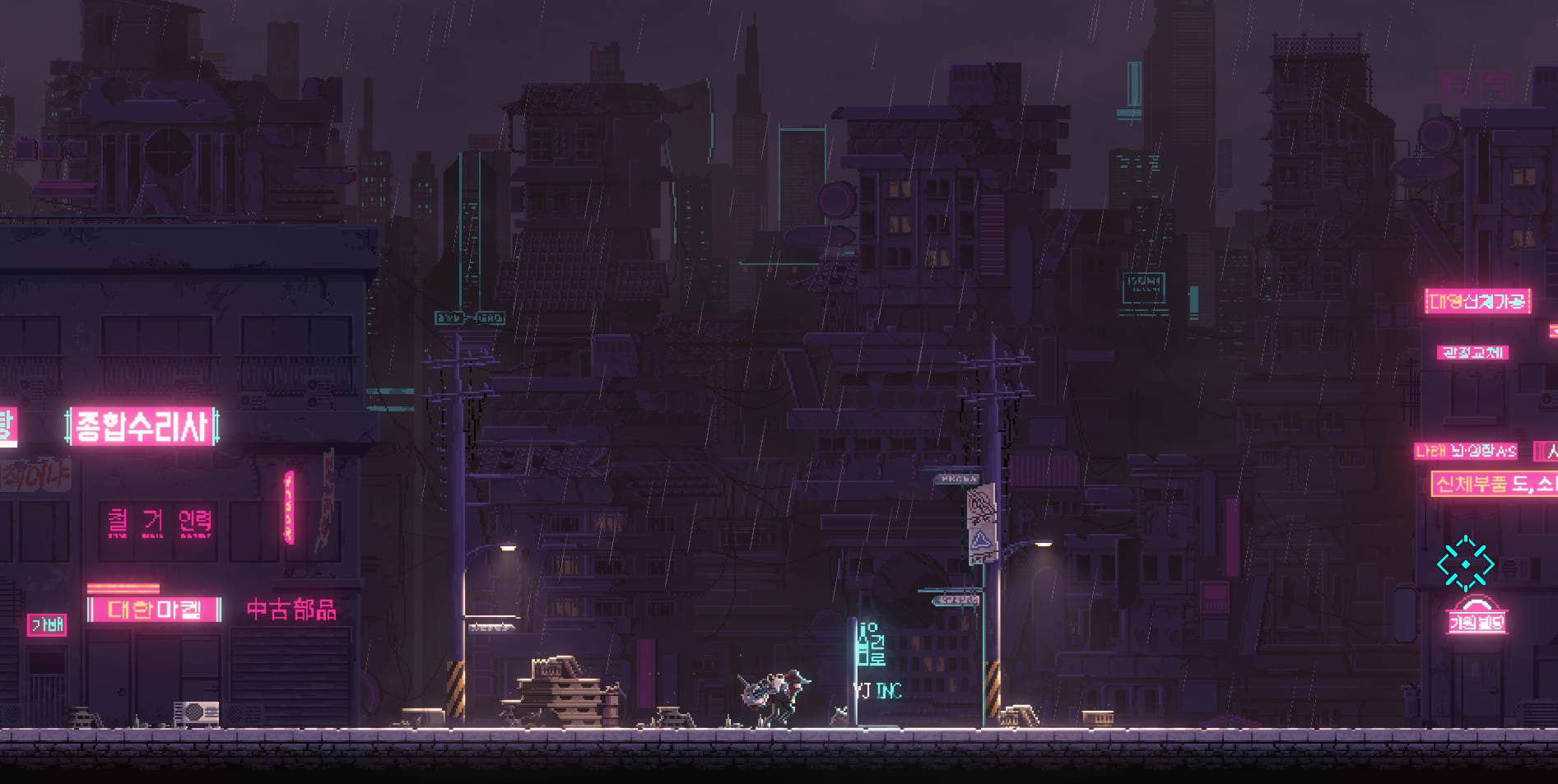
I went into SANABI expecting a "pure" mechanical exercise and was instead hit by a freight train of emotional storytelling. The game uses its "Neo-Seoul" backdrop to tell a story that is intimately human. The mystery of why Mago City is empty serves as the hook, but the relationship between the characters keeps the line taut. The narrative doesn't just sit in the background; it drives the level design. However, this focus on story leads to the game's most polarizing element: Dialogue Pacing. SANABI is wordy. It frequently pauses the action for character beats. While I found the writing sharp enough to justify the interruptions, players looking for the uninterrupted flow of a "speedrun" game may find the frequent halts jarring.
Complexity and Friction
As you progress into the late-game sections, the difficulty spikes are undeniable. WONDER POTION demands near-perfect execution of the hook-and-dash combo. Some of the later platforming puzzles feel less like "action" and more like high-speed logic problems, where one missed click results in an immediate reset. It’s challenging, but rarely feels unfair because the controls are so responsive. If you fail, it’s almost always because you misjudged an angle, not because the game failed to register an input.