

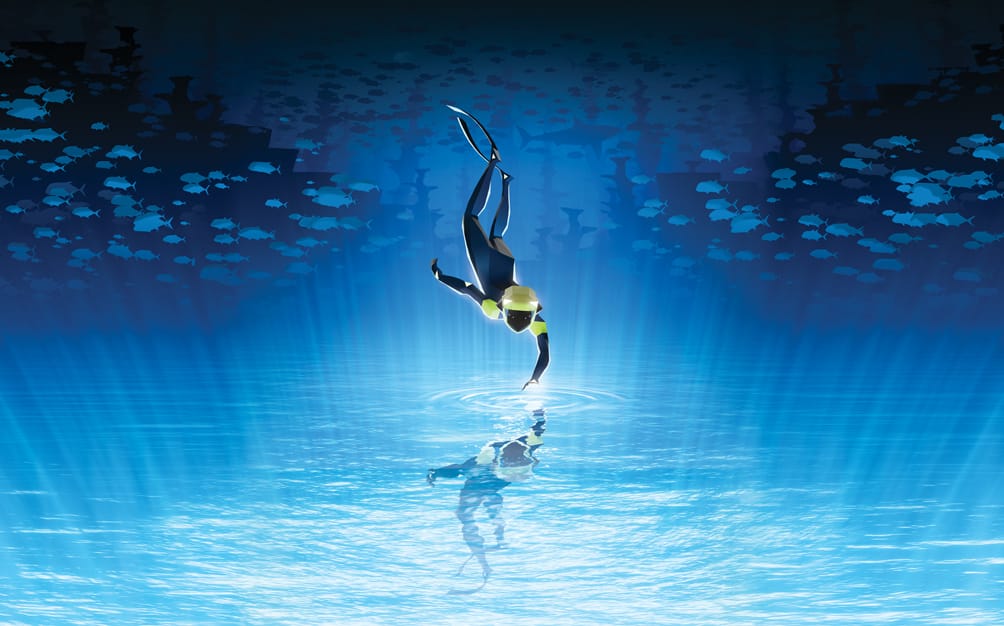
Bottom Line: Abzû is a masterclass in atmospheric storytelling that prioritizes emotional resonance over mechanical complexity. It isn't a game you play; it’s a world you inhabit, provided you’re willing to trade traditional challenge for pure sensory immersion.
The Mechanics of Peace
To understand Abzû, you have to understand what it deliberately lacks. There is no combat. There is no death. There isn't even a "lose" state. For the hardcore demographic, this might sound like a walking simulator with fins, but that's a reductive take. The core gameplay loop is built around discovery and movement.
The swimming mechanics are the best in the business. In most games, water is an obstacle—a medium that slows you down and complicates controls. Here, it is liberating. You can somersault, dash, and hitch rides on larger megafauna like manta rays or blue whales. This "hitching" mechanic isn't just a gimmick; it changes your perspective, anchoring you to the massive scale of the ocean's inhabitants. It turns the player from an observer into a participant in the migration.
Narrative Through Atmosphere
The story is told entirely through environment and murals. You play as a nameless diver, uncovering the ruins of a civilization that seemingly had a complex, perhaps parasitic, relationship with the ocean's life force. There are no dialogue boxes or lore dumps. Instead, you find yourself restoring life to "dead" zones—barren trenches that bloom into color once you trigger specific nodes.
This creates a powerful, if simple, emotional arc. The transition from the sun-drenched, vibrant coral reefs of the opening to the oppressive, metallic depths of the mid-game is handled with incredible cinematic precision. The "threats" in the game are environmental and symbolic—giant triangular drones that crackle with red electricity, representing a mechanical intrusion into the natural world.
The Observation Trap
The "Meditation" feature is Abzû’s most honest inclusion. By allowing you to sit on a statue and cycle through the various fish species, the game admits it is a virtual aquarium. You can follow a specific predator, watch it hunt, or simply drift with a school of sardines. This highlights the sophisticated AI at work, but it also exposes the game’s primary limitation: once you stop moving, the thinness of the "gameplay" becomes apparent. If you aren't captivated by the visuals or the music, there isn't much else to hold your attention. However, for those seeking a meditative "flow state," this lack of clutter is its greatest strength.