
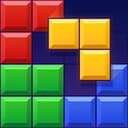

Overview
How much game fits on a board of sixty-four squares? On the evidence of Block Blast!, quite a lot. HungryStudio’s puzzle game carries a 4.9 out of 5 store rating from 2,841,723 ratings. That points to a specific design achievement: the game asks almost nothing of a newcomer and still gives committed players a reason to return.
The premise fits in one breath. An 8x8 grid sits on screen. Each turn deals three block shapes, and the player drags each one onto the board without overlapping anything already placed. Fill a complete row or column and it clears. Clear several at once and combo bonuses inflate the score. There is no timer, no opponent and no network requirement, so a run can stop on a train platform and resume three stops later.
HungryStudio positions the game at the casual end of the market. It is free to download, funded by ads and optional in-app purchases, and pitched as a way to fill commutes and short breaks. Around the classic endless high-score mode it adds an adventure mode with progressive levels and themed jigsaw designs, daily puzzle challenges with rewards, unlockable visual themes, leaderboard-style personal bests and social sharing. Those systems give structure to players who want goals. The endless mode remains the product’s center of gravity.
The store rating is strong, but two design limits keep the recommendation qualified: ad load and random deals. The low-pressure loop and offline play suit short breaks, and the puzzle can work as a brain warm-up or a time-killer. The ad model and the luck factor are the reasons the package does not clear a higher bar. The question for any prospective player is whether the puzzle survives the business model wrapped around it. We think it only partly does.
Key features
- 8x8 grid with a three-piece tray: Every turn deals three shapes that must all find room on the board, so each placement is made with the other two in mind.
- Line clears and combos: Completing any row or column clears it. Clearing multiple lines in one move triggers combo bonuses and the largest score gains.
- Classic endless mode: A pure high-score chase, tracked through leaderboard-style personal bests.
- Adventure mode: Progressive levels built around themed jigsaw designs, giving the same mechanics a goal-driven structure.
- Daily puzzle challenges: A new challenge each day, with rewards attached.
- Unlockable themes and block-crush effects: Cosmetic visual themes and clearing animations that reward continued play.
- Full offline play: The entire game runs without WiFi.
- Social sharing: Scores and results can be pushed out to friends.
- Free-to-play model: No upfront cost. Ads and optional in-app purchases fund the game.
Analysis
The Three-Piece Tray
The decisive design choice is the tray. A single-piece puzzler asks one question per move: where does this go? Block Blast! asks three at once, and the order matters. Placing a long bar first can seal off the only gap a square block needed. A piece that completes a row can open room for the next one in the tray. Each turn becomes a small sequencing problem nested inside the larger task of managing the board.
That structure is the source of the strategic depth the game advertises, and the claim holds up on paper. The rules take seconds to learn, but the decision space per turn is wide, and the description frames the central skill correctly: spatial planning and foresight, keeping room open for pieces that have not arrived yet. Good players will think in terms of board shape, avoiding isolated single holes and preserving long open lanes, rather than in terms of the next move alone.
No Clock, All Consequence
Removing the timer is a deliberate trade. Pressure in Block Blast! comes from board state, never from a countdown. A cluttered grid full of scattered holes is a slow-motion problem the player built; an open board is a resource earned through discipline. Because every threat is self-inflicted, a loss reads as a planning error, not a reflex failure. That is the right emotional register for a game aimed at commuters and people looking to decompress.
The combo system supplies the tension the missing clock would otherwise provide. Clearing one line at a time is safe. Holding back to set up a multi-line clear pays more but leaves the board more crowded in the meantime. That risk-reward lever separates a casual run from a serious score attempt, and it gives the endless mode a skill ceiling well above what its plain presentation implies.
Randomness and the Fairness Problem
The design’s weak joint is the deal. Players never know what the next three pieces will be, so foresight can only be probabilistic: keep shapes of every size viable and hope the tray cooperates. That uncertainty keeps the endless mode from becoming solvable, but it also means a well-managed board can still end on an unlucky set.
We treat this as a tuning issue, not a fundamental flaw. Randomness drives replayability in this format, and some exposure to bad draws is the price of a run never repeating. Still, a personal-best leaderboard implies a measurement of skill, and when the deal swings outcomes visibly, the number on the screen means less. Record chasers will feel this most. Players using a run as a short wind-down will barely register it.
Structure Beyond the Endless Mode
The adventure mode and daily challenges address the standard weakness of any endless puzzler: no milestones. Progressive levels and themed jigsaw designs create a sense of forward motion, and dailies give players a reason to open the app on a schedule. These are familiar retention tools, and they read as such. They broaden the package without changing the core mechanic, which is sensible but limits how much new thinking they bring. The current spread may leave long-term players wanting more.
Monetization
The business model is where the design loses points. A free, ad-supported puzzle has to show ads somewhere, and a turn-based game with natural pauses between runs offers obvious places to put them. The ad load sits heavier than the format needs. The listed 12+ content rating is not the issue; the ad load is. For a game this broadly appealing, heavy ads are a self-inflicted wound.
Visuals & performance
The visual design puts legibility first, which is correct for the format. An 8x8 grid is coarse enough to read at a glance on a phone screen and fine enough to leave room for real planning. The block-crush effects are the main reward signal; a line clear should register as a payoff, and a multi-line combo should feel proportionally bigger.
Unlockable themes add cosmetic variety, but the theme system is narrow. A cosmetic layer that could carry more variety is a missed opportunity, particularly in a free game that could monetize it.
On performance, a 2D grid puzzle with no network dependency is light on hardware by design and should run comfortably on modest phones. Full offline play also removes connectivity as a point of failure, which matters for the commuter audience the game courts.
Platform nuances
- Input: Both the iOS and Android versions are touch-first. Drag-and-drop placement onto the grid is the only input the design calls for, and it maps naturally onto a phone screen.
- Feature parity: Modes, offline play and the free model with ads and in-app purchases are presented identically across both platforms, so parity is the reasonable expectation.
- Age rating: The listed content rating is 12+.
- Store reception: The store rating is 4.9 out of 5 from 2,841,723 ratings.
Final verdict
Block Blast! has a strong puzzle at its center, but the ad load and random deal keep it from being an easy recommendation. Three pieces, sixty-four cells and a scoring system that rewards patience produce a loop that fits a two-minute break as well as a long record attempt, and offline play removes the last barrier to picking it up anywhere. The store rating of 4.9 out of 5 from 2,841,723 ratings makes sense for the loop; the recommendation does not follow automatically.
The problems sit outside the puzzle. Ad frequency is the main obstacle, the random deal can end a well-managed board, and the theme system is narrow. None of that breaks the design, but it caps it. We rate it Mixed: a smart, pressure-free puzzle for players who can tolerate ads, but not a default pick for most people.
Reviewed by the Rankeno Puzzle & Casual Desk. Scores are out of 10; the overall score is the desk’s editorial judgement, informed by the four sub-scores above. How we review